Rundstedt, Gerd von. Generalfeldmarschall.

[English version at the end]

 PERSONAJES DE BARBARROJA

¡Ya a la venta Barbarroja 03:00 hrs!

MARISCAL DE CAMPO KARL RUDOLF GERD VON RUNDSTEDT (1875-1953)

rundstedt
Mariscal de campo Gerd von Rundstedt. Comandante en jefe del Grupo de Ejércitos «Sur», responsable de las operaciones en la zona ucraniana.

Al comienzo de la Segunda Guerra Mundial, von Rundstedt está ya retirado. Pero al comenzar el nuevo conflicto es reincorporado al servicio activo y participa en las campañas de Polonia y Francia. Asciende a mariscal de campo en 1940.

A las 21:00 horas del 21 de junio de 1941, a tan sólo 6 horas del desencadenamiento de la mayor campaña militar de la historia, un desertor del 6º Ejército cruza las líneas y se interna en la URSS para avisar del ataque inminente. De poco va a servir su desesperado intento (que ya se venían recibiendo indicios por otras vías desde tiempo atrás), excepto para ordenar una alerta demasiado tardía y órdenes de dispersión de medios y enmascaramiento. Es uno de los soldados de uno de los ejércitos de von Rundstedt. Sea como fuere al curtido prusiano la Operación Barbarroja le va a reservar un papel protagonista. El veterano mariscal de campo Gerd von Rundstedt está listo para el asalto del sector meridional del gigante «frente ruso» a través de Ucrania y nada lo puede ya impedir. Es el comandante en jefe del Grupo de Ejércitos Sur (Heeresgruppe Süd). Se enfrentará en primera instancia por su flanco izquierdo al general Kirponos, comandante del Distrito Especial Militar de Kiev. Es precisamente aquí en Ucrania donde el Mando soviético teme más el ataque alemán. A 2 horas del comienzo de la Operación el Grupo de Ejércitos Sur retransmite la palabre clave WOTAN por la cadena de mando hasta el OKW (Oberkommando der Wehrmacht <>Alto Mando de las Fuerzas Armadas), dando así a conocer que todo está preparado.

Como fuerzas móviles cuenta con solamente el 1er Grupo Acorazado de von Kleist, con el que no conseguirá hasta agosto un golpe realmente decisivo cuando copará en un «golpe de guadaña» a casi 100.000 hombres en el «caldero» de Uman. Bajo su mando se integrarán formaciones de otros países (italianos, húngaros, rumanos y eslovacos). Cuenta además con el poderoso 6º Ejército de von Reichenau protegiendo el flanco izquierdo y avanzando al sur de los pantanos del Pripyat, mientras que el 17º (von Stülpnagel) actúa en el flanco derecho en la zona de Lvov. El 11º Ejército de von Schobert está desplegado más a la derecha y al sur hasta las costas del Mar Negro, junto con las formaciones de Antonescu a lo largo de las fronteras rumanas, con objeto de fijar a los soviéticos y no permitir un contraataque hacia los valiosos campos petrolíferos de los que Hitler está tan necesitado. El ataque de von Schobert no está programado para el 22 de junio, sino para el 1 de julio.
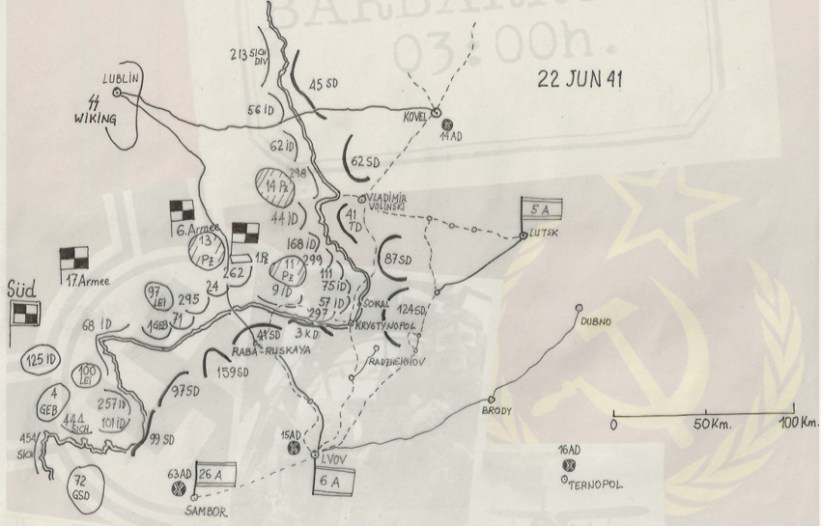
mapa-heeresgruppe-sud
Despliegue de fuerzas en el sector sur, responsabilidad de Rundstedt por el lado germano y Kirponos en el soviético.

Del 26 al 29 de junio los Panzer del anciano mariscal sufren el acoso de Kirponos en el triángulo de Brody-Lutsk-Dubno, en el que se va a dar el mayor enfrentamiento de blindados de la Historia hasta este momento. El general soviético tiene en inventario una fuerza 3-4 veces superior en carros de combate a la de von Kleist. Las tropas de Ründstedt se enfrentan aquí por vez primera contra nuevos modelos de carros de combate, T-34 y KV. Toda la campaña en el Este pende de un hilo. Si Kleist es detenido o cercado con su fuerza de poco más de 700 Panzer, Barbarroja se irá al traste. Si el mariscal es frenado en seco o peor, obligado a retirarse, el 5º Ejército del RKKA (Ejército Rojo de Trabajadores y Campesinos) de Potapov podría verse libre y acometer por el sur al Grupo de Ejércitos Centro desde las marismas del Pripyat. Von Ründstedt escribe: «Los rusos están combatiendo muy empecinadamente; las cosas no van a ser tan fáciles como esperábamos y como hasta ahora han sido».

¿Querrías conocer los detalles de esta y las demas operaciones?

¡Adquiere la obra cronológica Barbarroja 03:00h en edición de coleccionista!


Comprar Ahora Button

Sigue interesantes referencias también en Twitter @barbarroja0300h

Deja tu comentario abajo…


[English version]

BARBAROSSA’S PROTAGONISTS

FIELD-MARSHALL KARL RUDOLF GERD VON RUNDSTEDT (1875-1953)
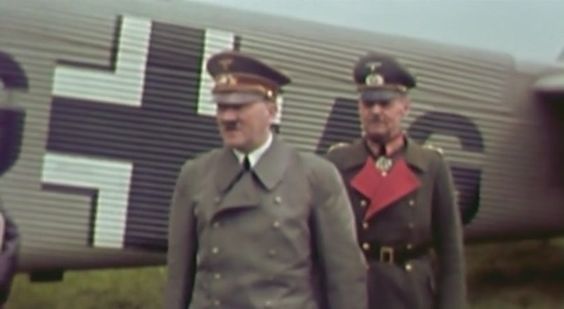
hitler rundstedt ju52
Rundstedt accompanying Adolf Hitler after a Junkers Ju-52 trip

When World War II starts, von Rundstedt is already a retired General. But as soon as the new conflict starts he is recalled to active duty and participates in the victorious campaigns of Poland and France. He is then promoted to Field Marshall in 1940.

At 21:00 hours of the 21st of June 1941, just 6 hours before the unleash of the vastest military campaign in History, a deserter from the 6th Army crosses the lines into the Soviet Union to warn about the impending attack. Little to no avail will be his desperate attempt (by other means many warnings have been received lately), except for rising a too late alarm and dispersal and camouflage measures. He is a soldier of one of the armies of von Rundstedt. All in all Operation Barbarossa is sparing a main role for the Field Marshall. The seasoned Prussian Gerd von Ründstedt is ready for the onslaught on the Southern sector of the gigantic Eastern Front throughout the Ukraine. He is the Commander-in-Chief of Army Group South (Heeresgruppe Süd). On a first stage he will fight on his left flank Commander Kirponos’ Kiev Special Military District. It is precisely here in the Ukraine were the Soviet High Command fears the main thurst of the German attack. 2 hours before the commencement of the assault Army Group South transmits along the chain of command the codeword WOTAN to the OKW (Oberkommando der Wehrmacht <> Armed Forces High Command), signaling that all is ready.

rundstedt general
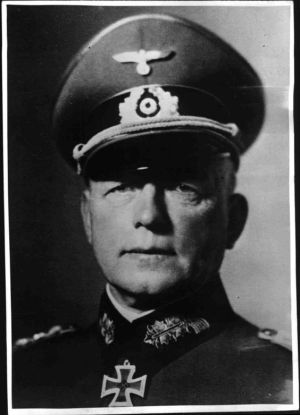
Portrait of the still General Gerd von Rundstedt in 1940 before being promoted to Field Marshall

His mobile/armoured forces consist only of von Kleist’s Panzer units (1. Panzergruppe). Thus he will not be able to achieve an important blow to the adversary until August, when he will encircle almost 100,000 Soviets in the Uman «cauldron». Under his operational command he counts with the expeditionary forces of some of Germany’s allies (Italians, Hungarians, Rumanians and Slovaks). In addition he has von Reichenau’s powerful 6th Army protecting his left flank and advancing along the Southern edges of the Pripyat marshes. At the same time the 17th Army (von Stülpnagel) is in charge of the right flank in the Lvov area. Finally von Schobert’s 11th Army is deployed due South to the Black Sea shores along with Antonescu’s troops. They are in charge of commiting Soviet formations along the Romanian borders and to fend off any attempts against the Romanian oilfields, a Hitler’s much needed treasure. Von Schobert’s maneouvre is not scheduled to start on the 22nd of June 1941, but on the 1st of July.

From the 26th until the 29th of June Rundstedt will endure Kirponos‘ counter-offensive with 6 of his mechanized corps in the triangle Brody-Lutsk-Dubno. It will be the largest tank battle up to date in History. Kirponos fields 3-4 more tanks than Kleist. Von Rundstedt’s troops meet here for the first time the new tank types, T-34‘s and heavy KV‘s. The whole Eastern campaign is at stake. If Kleist is stopped or cut off with his +700 Panzer from the German lines, Barbarossa will turn into a fiasco. Consequently at this stage if Rundstedt fails or is driven back, then  RKKA General Potapov’s 5th Army would be able to disangage and drive north across the Pripyat marshes to attack Army Group Centre‘s right flank. Von Rundstedt writes: «The Russians are fighting very stubbornly; things will not be as easy as we hoped and as they used to be».

Did you find this article interesting? Leave your comments below…

Follow other articles in Twitter @barbarroja0300h

T-28

[English version at the end]

 MÁQUINAS DE BARBARROJA

¡Ya a la venta Barbarroja 03:00 hrs!


CARRO DE COMBATE MEDIO SOVIÉTICO T-28


t-28 museo moscu
T-28 hoy en día expuesto en el museo de la Fuerzas Armadas de la Federación Rusa (Moscú). El puesto del conductor se adivina tras la aspillera central entre las dos torretas auxiliares.

Siguiendo la doctrina ofensiva del RKKA (Ejército Rojo) su diseño se origina en 1931 como respuesta a la necesidad de un carro de combate de tres torretas capaz romper las líneas enemigas y combatir en profundidad. Antes de la Operación Barbarroja es uno de los símbolos del arma acorazada del RKKA (Ejército Rojo), apareciendo en innumerables documentales y noticieros de la época. En 1932 el primer prototipo sale de fábrica y en 1933, tras numerosos ensayos, es aceptado finalmente en la plantilla del RKKA. Su dotación es de 6 hombres, en donde el jefe de carro actúa a la vez como cargador y artillero del armamento principal. El blindaje no es especialmente grueso, montando en su glacis frontal una coraza de 30 mm. lo que no será gran defensa contra proyectiles de 5,0 o 7,5 cm de los Panzer a partir del verano de Barbarroja.

La torreta principal alberga un cañón de 76,2 mm KT-28 (en 1938 se le sustituye por el modelo L-10) más una ametralladora DT de 7,62 mm., mientras que las dos torretas adicionales albergan una ametralladora más cada una. El cañón KT-28 también arma a modelos ligeros BT-7A y pesados T-35. Esta es un arma que se empieza a producir en la fábrica de Kirov ya desde 1933. Algunos T-28 son probados, no obstante, con el modelo de cañón PS-3, un arma con mejor balística que el KT y por lo tanto con mejor poder de penetración.  También, y curiosamente, en 1939 el modelo de cañón F-34 (que montará el archifamoso T-34) será ensayado en los T-28.

kt-28 gun
Diagrama del cañón KT-28 normalizado en su alojamiento en la torreta principal. Nótese la ametralladora trasera DT de 7,62 mm. El monetaje de armamento defensivo trasero es muy común en los vehículos soviéticos, no así en los del Eje.

Así pues está relativamente bien armado, aunque el mayor defecto del T-28 reside en su motor y delicado sistema de transmisión. No obstante a mediados de los años 30 se le considera el carro de combate medio más potente del mundo. Como tal toma parte en las operaciones de captura de Besarabia (oeste de Ucrania-Rumanía), la invasión del este de Polonia (17 de septiembre de 1939, por acuerdo secreto Hitler-Stalin) y la Guerra de Invierno 1939-40 contra Finlandia. Allí se les usa para batir los fortines finlandeses con fuego directo, pero su blindaje de 30 mm. no da muestras de ser lo suficientemente grueso contra la artillería contracarro del adversario y los soviéticos pierden numerosos T-28. Tras la experiencia finlandesa se decide incrementar el grosor de la coraza a 80 mm. en la parte frontal.

En Barbarroja la mayor ventaja del T-28 sigue residiendo en su potente cañón de 76,2 mm., capaz de enfrentarse a gran distancia contra los PzKpfw. III y IV (51 mm. de penetración a 1.000 metros). No obstante los modelos germanos son mucho más maniobrables y confiables. Disponen de radios y una excelente doctrina de coordinación de fuegos entre varias armas incluidas la aviación. Los soviéticos disponen en junio de 1941 de 481 unidades, aunque listas para el combate solamente unas 200.

En la mañana de Barbarroja, las vanguardias acorazadas del general Hermann Hoth (3. Panzergruppe) se acercan a las aguas del río Niemen dispuestos a capturar el puente de Alitus. Bajo acoso de la Luftwaffe la 5ª División Acorazada del general Kurkin pasa a la contraofensiva. 24 T-28 dan fuego de cobertura a un número de veloces BT-7 y frenan a los Panzer durante unas horas. No obstante la llegada de elementos de otra división blindada germana, con fuerte apoyo aéreo, obliga a los soviéticos a retirarse en la mañana del 23 en dirección a Vilnius. Hoth fuerza el Niemen. 16 T-28 quedan destruidos y el resto son abandonados por averías serias. Así, para el verano de 1941, la mayor parte de los T-28 habrán sido destruidos o abandonados por fallos técnicos…


¿Querrías conocer los detalles día a día de la Operación Barbarroja? Comenta abajo y haz click en seguir para recibir en tu correo los últimos artículos publicados

¡Adquiere la obra cronológica Barbarroja 03:00h en edición de coleccionista!


Comprar Ahora Button

Sigue interesantes referencias también en Twitter @barbarroja0300h


[English version]

BARBAROSSA’S MACHINES


SOVIET MEDIUM TANK T-28


t-28 forest
T-28 in a forest. The close up clearly shows the 2xDT 7.62 mm. machine guns fitted in the auxiliary turrets. Many T-28’s were lost due to mechanical breakdowns in engine and transmission system.

Following the RKKA‘s (Red Army) offensive doctrine the development of this medium battle tank starts in 1931. It is the answer for a request for a «deep penetration» tank, capable of breaking through enemy lines. It is a three-turret tank design. It becomes before Operation Barbarossa one of the icons of the Soviet armoured arm, being presented in numerous newsreels and documentaries. In 1932 the first T-28 prototype rolls out from factory and after extensive testing it will be eventually accepted in the ranks of the RKKA in 1933. It is crewed by 6 men, where the commander must perform additional tasks as loader and gunner of the main gun. It is not specially heavily armoured, being the frontal hull 30 mm. thick, which won’t be sufficient against Panzer 5.0 and 7.5 cm. projectiles during the Barbarossa summer.

Its main turret will be initially fitted with a powerful 76.2 mm. KT-18 cannon (replaced in 1938 by the enhanced L-10) plus a 7.62 mm. DT machine gun, while the two auxiliary turrets will lodge only one DT machine gun each. The KT-28 is fitted in the light BT-7A’s and heavy T-35’s as well. This weapon is produced since 1933 in the Kirov factory. Some T-28’s are tested with a better gun, though, the PS-3; a cannon with enhanced ballistics and better penetration. Curiously enough the F-34 gun type (also fitting the iconic T-34) will be tried on T-28’s.

It is well armed by the 1930’s standards but it will suffer from never ending engine and transmission gear problems. However, at its time it is considered the best medium tank in the world. It takes part in combat during the operations of the capture of Bessarabia (Western Ukraine-Romania), the invasion of Eastern Poland on the 17th of September 1939 (secretly agreed between Stalin and Hitler) and during the Winter War 1939-40 against the Finns. In this last scenario it is used to blast Finn fortifications with direct fire, but at the same time, being exposed themselves to effective antitank fire, many T-28’s are lost (its 30 mm. frontal armour proves not thick enough). As lessons learned, the Soviets decide to add extra armour (80 mm. in the frontal sector).

t-28 crew
Interesting front view depicting 5 of its 6 crew members.

At Barbarossa start its main advantage is still its 76.2 mm. cannon capable to engage at long distances either the PzKpfw. III’s and IV’s (51 mm. of penetration at 1,000 metres). Nevertheless the German types are more reliable, maneuverable and are fitteed with radios with excellent coordination doctrines inter-arms including the Aviation.

In the very same morning of Barbarossa General Hermann Hoth‘s armoured vanguard reaches the waters of the Niemen river poised to seize the vital bridge at Alitus. Under relentless Luftwaffe strikes, General Kurkin’s 5th Armoured Division counterattacks. 24 T-28’s give cover fire to a formation of fast BT-7’s and manage to stop the Panzer for a few hours. However, the arrival the next morning of reinforcing elements of another Panzer division, with lethal air support, forces Kurkin to withdraw his forces towards Vilnius. Eventually Hoth crosses Niemen. 16 T-28’s remain knocked out in the battlefield while the rest are abandoned due to breakdowns. Similarly, with the invaluable help of the Luftwaffe, by mid-summer 1941 most of the T-28’s will have been destroyed or simply abandoned due to technical failures…


Did you find this article interesting? Comment below and click Seguir to receive the latest posts in your e-mail

Follow other articles in Twitter @barbarroja0300h

FIAT G.50 «Freccia»

[English version at the end]

 MÁQUINAS DE BARBARROJA

¡Ya a la venta Barbarroja 03:00 hrs!

CAZA MONOPLANO FIAT G.50 «Freccia»

FIAT G.50 LeLv26
fiat g.50 ilmavoimat lelv 26

El «Freccia» (Flecha) es un aparato de caza desarrollado en Italia que efectúa su primer vuelo de ensayos en 1937. Es presentado internacionalmente en el salón aeronáutico de Milán como el aparato de caza más moderno del inventario italiano. La versión ya de serie monta un motor FIAT A.74 RC38 de 840 C.V. con una velocidad máxima de 472 km/h. El aparato en sí supone un avance en el diseño de ingeniería, al ser ya monoplano y de contrucción metálica, pero otros modelos británicos o alemanes contemporáneos lo superan en capacidades.

En enero de 1939 una docena de Fiat G.50 son enviados rápidamente al combate por primera vez a la Guerra Civil Española, donde son apreciadas sus buenas prestaciones y maniobrabilidad. También está bien armado con un par de ametralladoras pesadas BREDA-SAFAT de 12,7 mm. Se les encuadra en el Gruppo Sperimentale da Caccia, bajo dependencia de la Aviazione Legionaria de Mussolini, pero el conflicto finaliza en pocos meses antes de que se pueda acumular gran experiencia operativa.

A finales de 1939 el gobierno finlandés hace un pedido apresurado de 35 unidades para incrementar su capacidad defensiva frente al ataque de la URSS (Guerra de Invierno 1939-40). Llegarán demasiado al final. Serán incorporados a la base de Utti, hogar del 26º Escuadrón, el LeLv 26 (Lentolaivue<>escuadrón).

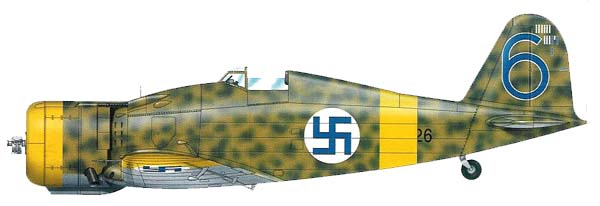
fiat g.50 perfil
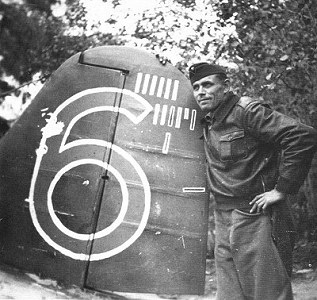
Perfil del FIAT G.50 «Freccia». El aparato está encuadrado en el LeLV 26 y es la montura del suboficial «Oippa» Tuominen, el mayor as de este tipo de aeroplano. En la cola están marcadas las 13 victorias conseguidas en el «Freccia» de matrícula FA-26. Con ocasión de la Operación «Barbarroja», la Luftwaffe pide a la Ilmavoimat (Fuerza Aérea finlandesa) pintar una banda en el fuselaje y las puntas del intradós alar también en amarillo, con fines de identificación.

Ya en junio de 1941 y tras 3 días del comienzo de la Operación Barbarroja, Stalin autoriza ataques preventivos contra Finlandia. Los fineses denominarán esta nueva fase de combates como la Guerra de Continuación. Las fuerzas de la Ilmavoimat (Fuerza Aérea finalndesa) están mejor preparadas que hace un año y medio y cuentan esta vez con dos regimientos de interceptadores, el LeR 2 y el LeR 3, totalizando 155 aparatos de caza. El primero es el más potente y engloba a tres escuadrones; uno de Brewster 239, otro de MS 406 y otro de FIAT G.50 «Freccia». Este último escuadrón es el mencionado LeLv 26. La VVS (Voenno Vozdushnye Sily<>Fuerza Aérea Soviética) va a oponerle «sólo» 500 aviones, dado que el grueso de sus fuerzas están intentando contener en vano a los germanos en otros sectores del vasto «frente ruso». Y de este modo los «Freccia» son empleados en la segunda lucha contra Stalin en cielos de Finlandia (donde dan algunos resultados bastante respetables). Intervienen en numerosas acciones en la zona del lago Ladoga y el itsmo de Carelia. Varios ases fineses comenzarán precisamente su carrera en el ligero y maniobrero caza italiano, como el suboficial Oiva Tuominen (44 victorias), quien el 17 de agosto de 1941, a los mandos de un G.50 derriba 4 bombarderos soviéticos en el asombroso intervalo de 4 minutos, sólo retirándose del combate al agotar la munición.

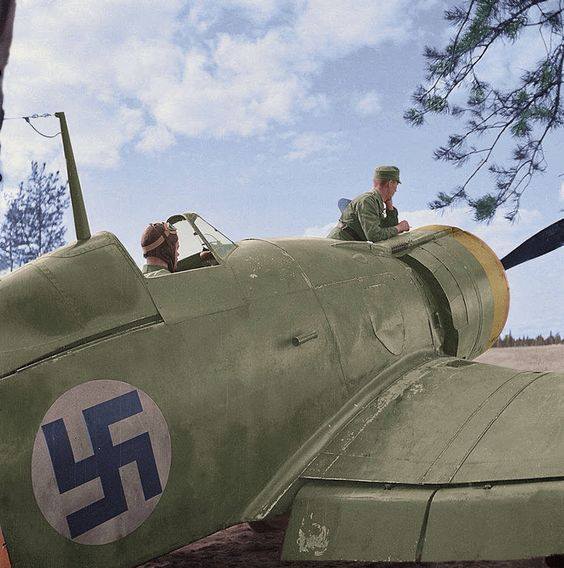
tuominen
Tuominen posa junto a la cola de su «Freccia» mostrando marcas de victorias aéras. Las blancas corresponden a bombarderos y las negras a cazas.

25 de Junio de 1941: Stalin autoriza ataques preventivos contra su vecino del norte. Los regimientos aéreos LeR están preparados. Unos 150 bimotores de bombardeo soviético aparecen en el espacio aéreo finlandés. La caza les sale al encuentro, entre ellos los “Freccia” del LeLv 26. Una vez interceptados los bombarderos los pilotos del LeLv 26 dan cuenta de 13 de ellos…

¿Querrías conocer los detalles día a día de la Operación Barbarroja? Deja tu comentario abajo…

¡Adquiere la obra cronológica Barbarroja 03:00h en edición de coleccionista!


Comprar Ahora Button

Sigue interesantes referencias también en Twitter @barbarroja0300h


[English version]

BARBAROSSA’S MACHINES


MONOPLANE FIGHTER AIRCRAFT FIAT G.50 «Freccia»


g.50 cockpit
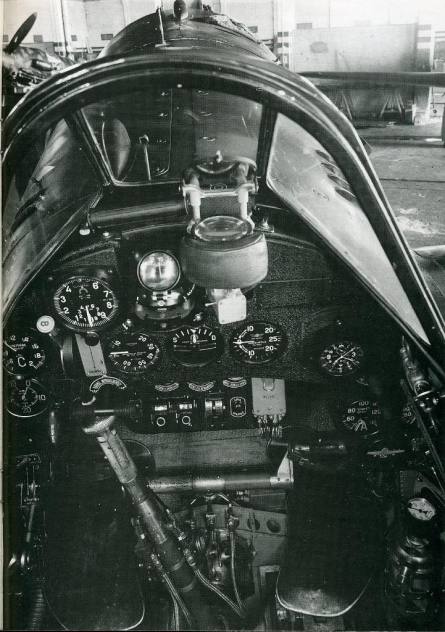
FIAT G.50’s cockpit. Some versions followed the closed canopy rule, but most of the «Freccias’s» fly open-cockpit.

The “Freccia” (Arrow) is an Italian fighter design which makes its first test flight in 1937. That year is internationally presented in the Milan aeronautical salon as the most advanced combat aeroplane in the Italian inventory. The series version is powered by a FIAT A.74 RC38 engine that develops 840 H.P. and a top speed of 472 km/h. The machine is indeed a leap forward in the aeronautical engineering, being already a monopane and of metal construction. But other countries will develop other models at the time with better capabilities, like Great Britain and Germany.

In January 1939 a dozen FIAT G.50‘s are hurriedly sent to Spain for tests in the civil war, where they show good overall performance and maneouverability. They are fitted with 2xBREDA-SAFAT 12.7 mm. heavy machine guns. They are used by the Gruppo Sperimentale da Caccia (Experimental Fighter Group) depending from Benito Mussolini’s Aviazione Legionaria, but the war ends just a few months later before any useful experience can be gained.

Late the same year the Finnish government orders 35 units to face the USSR invasion in the so-called Winter War 1939-40. But they will arrive late in the conflict. They will be based then at Utti airbase, home of the LeLv 26 (Lentolaivue<>squadron).

Already in June 1941 and after 3 days from the start of Operation Barbarossa, Stalin approves pre-emptive attacks against Finland. The Finns will name this new combat phase against the Soviet Union as the Continuation War. The Ilmavoimat (Finnish Air Force) assets are better prepared than a year and a half ago and they count on two interceptor regiments, the LeR 2 and LeR 3, in all 155 fighter aircraft. The former is the most powerful fielding 3 squadrons: one of Brewster 239‘s, a second of MS 406’s and one another of FIAT G.50 «Freccia». The latter is the aforementioned LeLv 26. The VVS (Voenno Vozdushnye Sily<>Soviet Air Force) will oppose them «only» 500 planes, due to the fact that most of her forces are vainly trying to withstand the German onslaught in other sector of the vast «Russian Front». And this way the «Freccia‘s« are used in the second Finnish war against Stalin (with promising results). They will participate in numerous air combats over lake Ladoga and the Karelian isthmus. Some «aces» will commence their successful careers at the controls if this light and agile Italian machine, like the Warrant Officer Oiva Tuominen (44 victories). On the 17th of August 1941 piloting a G.50 he will shoot down 4 Soviet bombers in the awesome interval of 4 minutes, only to break the engagement after depleting his ammo.

g.50 vs chaika
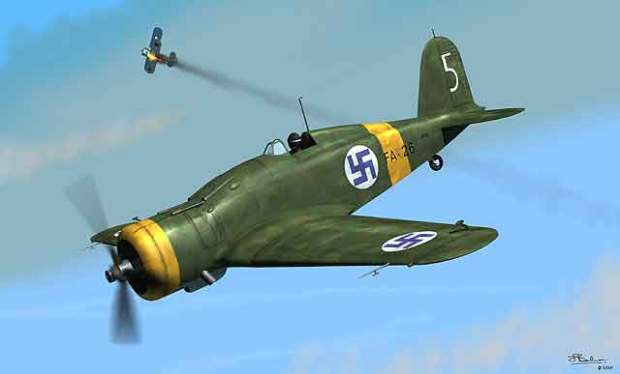
The art shows an air engagement of a «Freccia» vs. a «Chaika» somewhere over southern Finland. [Unknown author].

25th of June 1941: As mentioned, Stalin approves pre-emptive strikes against his northern neighbour. The fighting regiments LeR are combat ready. Some 150 Soviet twin engine bombers show up in the Finnish airspace and the fighters take off to intercept; the LeLv 26 “Freccia’s” are amongst them. They will claim 13 bombers to their list of air victories…

Did you find this article interesting? Leave your comments below…

Follow other articles in Twitter @barbarroja0300h

Ilyushin Il-4

[English version at the end]

 MÁQUINAS DE BARBARROJA

¡Ya a la venta Barbarroja 03:00 hrs!

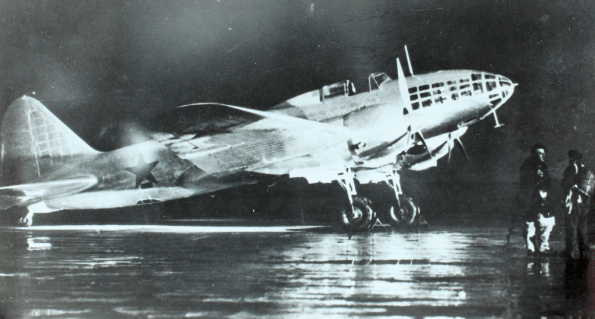
BOMBARDERO MEDIO BIMOTOR ILYUSHIN IL-4 (DB-3F)

il4 museo
Ilyushin Il-4 en la actualidad. Museo del parque de la victoria en Moscú. Se puede apreciar con detalle la sección de morro alargada y acristalada, característica de la versión F de los diseños DB de Sergei Ilyushin.

Aparato de largo alcance derivado del diseño del equipo de ingeniería de Sergei Ilyushin del bimotor DB. De hecho su desarrollo comienza como la variante DB-3F. No obstante en el momento de ser entregado en grandes cantidades a las unidades de ataque de largo alcance cambia su denominación, convirtiéndose en el Il-4. En 1938 comienza su diseño con una modificación sustancial de la célula del aparato original. Conserva la estructura primaria de la serie DB, aunque con una nueva sección de morro (ver video al final de la página con modelos DB e Il-4). Así inicia su primer vuelo en 1939 aún con la designación DB-3F.

A comienzos de la Operación Barbarroja la serie de bombarderos DB constituye la flota de aparatos de ataque  principal de largo alcance, integrándose en las unidades de vuelo DBAP (Dalnyebombardirovochnyi Aviatsionnyi Polk<>Regimiento Aéreo de bombarderos de largo alcance) y MTAP (Minno Torpednyi Aviatsionnyi Polk<>Regimiento Aéreo de Torpederos Minadores). Hay en inventario 1.122 unidades DB-3 y DB-3F (906 de ellos operativos). Está propulsado por dos motores M-88B que desarrollan 1.100 C.V. cada uno, siendo capaz de transportar una carga bélica de hasta 2.500 kilogramos (tanto en bodega como en afustes externos).

En la misma tarde del 22 de junio de 1941, día de comienzo de las hostilidades contra el III Reich, formaciones de bombarderos DB e Il-4 atacan las ciudades de Königsberg (actual Kaliningrado) y Memel e incluso atacan concentraciones de tropas en los arrabales de Varsovia, cubriendo una distancia de 600 kilómetros desde sus bases. Las misiones no cuentan con escolta de cazas y las pérdidas son numerosas. La Luftwaffe domina los cielos. También atacarán objetivos de la industria petrolífera de Rumanía, en Ploesti, desde bases de la Flota del Mar Negro en Crimea. Por su largo radio de acción son aparatos idóneos para la tarea, pero de la misma forma, sin escolta adecuada, para muchas tripulaciones su primera misión será la última al encontrarse con los Hurricanes de la Aviación Rumana o los Messerschmitt de la Lutfwaffe.

radio accion il4 isla oesel a berlin
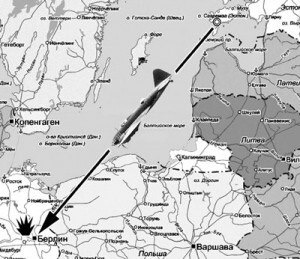
Esquema de la ruta seguida por los aparatos del 1 MTAP desde su base en la isla Ösel hasta Berlín. Los Ilyushin vuelan hacia su objetivo prácticamente al máximo de su radio de acción.

Este bimotor de Ilyushin ya es conocido por la Luftwaffe antes de comenzar las operaciones en el frente del este. Antes de la fecha de invasión de la URSS, la Ilmavoimat (Fuerza Aérea Finlandesa) presenta a los alemanes un DB-3M de este tipo capturado en la Guerra de Invierno para su evaluación.

7 de agosto de 1941: En la base de la aviación naval del Báltico de la isla de Ösel una quincena de aparatos DB-3T (variante «navalizada») calientan motores para una misión especial. La cantidad de combustible es la máxima posible en detrimento de la carga de bombas, pues el objetivo está casi fuera del radio de acción de los bimotores soviéticos. El objetivo es Berlín. Con el avance imparable de la Wehrmacht hacia el corazón de la URSS ya sólo hay disponibles 3 modelos capaces de tal misión: el Yer-2, el Pe-8 y el modelo de Ilyushin. Se le asigna la misión al 1 MTAP de la Flota de Báltico. Como se indica, usarán la base de la isla de Ösel, que dista unos 900 kilómetros hasta Berlín…

¿Querrías conocer los detalles día a día de la Operación Barbarroja? Deja tu comentario abajo…

¡Adquiere la obra cronológica Barbarroja 03:00h en edición de coleccionista!


Comprar Ahora Button

Sigue interesantes referencias también en Twitter @barbarroja0300h


[English version]

BARBAROSSA’S MACHINES

TWIN ENGINE MEDIUM BOMBER ILYUSHIN IL-2 (DB-3F)

il4 machine gunner
Il-4 dorsal machine gunner gets his UBT 12.7 mm ammo ready for a sortie. The aircraft carries 3 gunners (nose, ventral and dorsal). The machine gun turret will suffer different modifications throughout the DB-3 initial versions to the Il-4.

A long range medium bomber derived from the DB type, a design from Sergei Ilyushin’s engineering team. As a matter of fact initially it will still carry the official designation DB-3F. However as it commences the delivery to the long range flying units, it will change into Il-4. The development starts in 1938 using the DB series, with a thorough modification of the structure and specially of the nose section (watch the video at the bottom of the page with both variants). As just mentioned its maiden flight is carried out in 1939 still as a DB-3F.

At Barbarossa start the aircraft DB family is the Red Air Force long range bomber backbone. It is fielded by DBAP flying units (Dalnyebombardirovochnyi Aviatsionnyi Polk<>Long Range Aviation Regiment) and MTAP (Minno Torpednyi Aviatsionnyi Polk<>Mine-Torpedo Aviation Regiment). There are 1,122 DB-3’s (including DB-3F’s) in the VVS (Voenno Vozdushnye Sily<>Soviet Air Force) inventory. Out of them, 906 are airworthy machines. They are powered by two 1,100 H.P. M-88B engines that allow them two carry up to a maximum of 2,500 kg. of warload (inside the bomb bay and in external pylons).

il4 at night
Il-4 at night.The production of this type will continue until 1944 and it will see service well into the Cold War. NATO code «Bob».

In the same afternoon of the 22nd of June 1941, day 1 of the war against the III. Reich,  formations of DB’s and Il-4’s attack the cities of Königsberg (Kaliningrad today) and Memel. They even go deeper into the adversary’s heart and attack concentrations of troops in the vicinity of Warsaw, covering distances of 600 kilometres from their home bases. These raids are not escorted by much needed fighters and the losses are appaling. The Luftwaffe masters the skies. They will attack in the following days the Romanian oil industry in Ploesti from the Black Sea Fleet bases in Crimea. Due to their long range performance they are the suitable airplane model for the task, but once again, with no fighter escort, for many Soviet aviators their first mission will be the last one. Romania is patrolled by her own Air Force Hurricane’s and Luftwaffe Messerschmitt‘s.

This twin engine bomber is already well known by the Luftwaffe before starting the Eastern Front operations. A few months before, the Ilmavoimat (Finnish Air Force) delivers a captured (from the Winter War 1939-40) DB-3M to the Germans for evaluation.

Il-4 over berlin
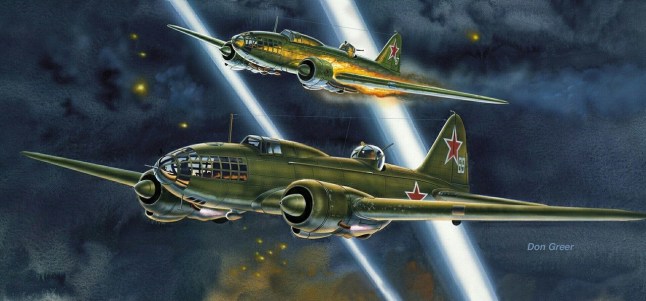
Ilyushin’s over Berlin. In spite of this dramatized drawing, no bombers are shot down the first night as the surprise is complete. As a matter of fact the German press will blame the British R.A.F. with the resposibility of the raid. [Art by Don Greer].

7th of August 1941: In their naval aviation station on Ösel island 15 DB-3T (a navalized variant) warm up engines for a very special mission. The fuel upload is maximum making the warload not too significant, due to the fact that the target is almost beyond the combat radius of the Soviet twin engine bombers. Berlin is the target. With the rapid advance of the Wehrmacht into the USSR there are just 3 types of aircraft that could do the job: the Yer-2, the Pe-8 and the machine of Ilyushin. The task is given to the  Baltic Fleet’s 1 MTAP. As aforementioned its base is 900 kilometres from Hitler’s capital city…

Did you find this article interesting? Leave your comments below…

Follow other posts in Twitter @barbarroja0300h

Sturmgeschütz III

[English version at the end]

 MÁQUINAS DE BARBARROJA

¡Ya a la venta Barbarroja 03:00 hrs!


CAÑÓN AUTOPROPULSADO DE ASALTO STURMGESCHÜTZ III (Sd.Kfz 142)


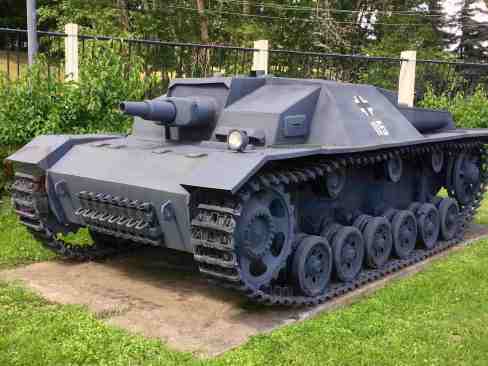
stug park povedy moscu
StuG III con cañón «corto» de 7,5 cm L/24. La velocidad del proyectil de 450 m/s. en su versión perforante aún puede penetrar hasta 90 mm. a 500 metros. Se puede apreciar lo compacto y solidez del vehículo. [Parque de la Victoria, Moscú]

El StuG III ha pasado a la historia como uno de los vehículos acorazados más famosos y respetados. Barato y fácil de producir está presente en todos los escenarios de combate de la Segunda Guerra Mundial y usado por varias naciones (a excepción naturalmente del teatro de operaciones del Pacífico). Es el vehículo de combate más producido por Alemania hasta la finalización de la conflagración mundial, que nace como un derivado sin torreta del PzKpfw. III para apoyo de la infantería. Pronto será adaptado como cazacarros. Cuenta con la ventaja de una silueta baja y buena coraza.

Se atribuye al general Heinz Guderian (que en la Operación Barbarroja mandará el 2. Panzergruppe en el Grupo de Ejércitos Centro) la paternidad de este nuevo concepto. Guderian escribe sobre la necesidad de equipar a las divisiones de infantería con unidades de 6 vehículos capaces de “allanar” el camino para la progresión de los infantes. La tesis de este triunfa y así nace un requerimiento en 1936 para el diseño de un vehículo que pueda montar una pieza de 7,5 cm. que haga fuego directo/indirecto al menos hasta los 6.000 metros, además de poder enfrentarse a blindados enemigos con munición perforante.

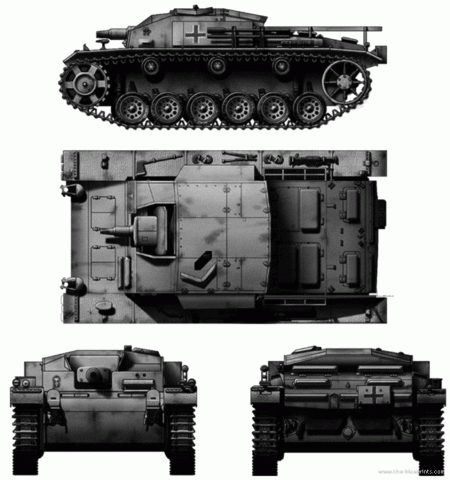
stug iii 4 vistas
StuG III Ausf. E. Bien acorazado por su parte frontal (50 mm. en versiones A – E) es un vehículo polivalente muy apreciado en el campo de batalla.

Se aprovecha el chasis del PzKpfw. III para la producción. En mayo de 1940 los primeros StuG III Ausf. A (Ausführung o versión A) empiezan a salir de fábrica a tiempo para entrar en acción en la campaña de Francia. El cañón es el Krupp 7,5 cm. Kanone L/24 (24 calibres). En realidad es una adaptación del KwK L/24 que monta ya el PzKpfw. IV. Aunque primero está ideado principalmente para la destrucción de defensas enemigas y fortificaciones.

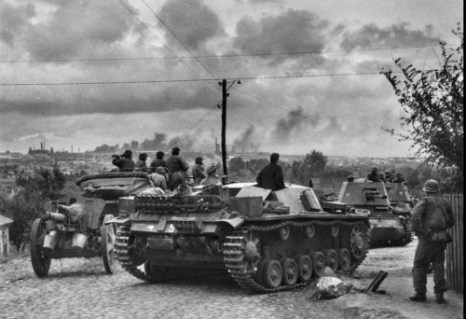
Para comienzo de la invasión de la Unión Soviética el 22 de junio de 1941 la industria del Reich desarrolla ya el StuG III Ausf. D. Ya existen 11 batallones y 9 baterías independientes. Constituyen una buena simbiosis para con la infantería. Los hombres de a pie se sienten protegidos y los StuG necesitan de ellos para su defensa cercana (no dispondrán de ametralladora hasta el Ausf. E y tienen una coraza débil trasera). Los StuG avanzan en el campo de batalla a la velocidad de los hombres de a pie. Son un éxito incluso contra los T-26 y BT contra los que su proyectil de 7,5 cm., aún siendo de baja velocidad, sigue teniendo buena «pegada».

Se organizarán en batallones (Sturmgeschütz Abteilungen) y baterías (Sturmgeschütz Batterien) de vehículos independientes, cada batallón englobando a 3 baterías de 6 cañones autopropulsados cada una. En primavera de 1941 se las aumentará con 7 StuG. Y así se asignan a otras formaciones superiores según las necesidades. A partir del Ausf. F (primavera de 1942) montarán un muy capaz cañón “largo” de 7,5 cm. contracarro. De hecho conseguirán más carros enemigos batidos que todos los Panther y Tiger juntos. Naciones como España, Finlandia, Italia, Hungría, Bulgaria y Rumanía los tendrán también en inventario. 9.250 StuG III se producirán…

stug III comandante en puesto
Vista del jefe del cañón de asalto Sturmgeschütz III. Dispone de periscopio para mayor seguridad en la observación del campo de batalla.

Orden de batalla de unidades StuG asignadas a formaciones de combate al inicio de la Operación Barbarroja:

Stg.Abt.190 (11. Armee)
Stg.Abt.243 (17. Armee/IV. Armeekorps)
Stg.Abt.197 (1. Panzergruppe/XXXXVIII. Armeekorps (mot.))
Stg.Abt.191 (1. Panzergruppe/III. Armeekorps (mot.))
Stg.Abt.192 (2. Panzergruppe/XII. Armeekorps) (?)
Stg.Abt.226 (4. Armee/IX. Armeekorps)
Stg.Abt.201 (4. Armee/XII. Armeekorps)
Stg.Abt.203 (4. Armee/VII. Armeekorps)
Stg.Abt.210 (9. Armee/XX. Armeekorps)
Stg.Abt.184 (9. Armee/VIII. Armeekorps)
Stg.Abt.185 (18. Armee/I. Armeekorps)
Stg.Bttr.659, 660, 666 (mit Stab 600 (16. Armee/II. Armeekorps))
Stg.Bttr.665 (16. Armee/XXVIII. Armeekorps)
Stg.Bttr.667 (16. Armee/XXVIII. Armeekorps)
Stg.Bttr.1./190 (11. Armee/XI. Armeekorps)


Glosario de términos:

Armee: Ejército

Armeekorps: Cuerpo de ejército

Abteilung (Abt.): Batallón

Batterie: Batería

Panzergruppe: Grupo acorazado

Stab: Plana mayor


Video cortesía de Panzer Picture StuG III

¿Querrías conocer los detalles día a día de la Operación Barbarroja? Deja tu comentario abajo…

¡Adquiere la obra cronológica Barbarroja 03:00h en edición de coleccionista!


Comprar Ahora Button

Sigue interesantes referencias también en Twitter @barbarroja0300h


[English version]

BARBAROSSA’S MACHINES


SELF-PROPELLED ASSAULT GUN STURMGESCHÜTZ III (Sd.Kfz 142 )


The StuG III has become one of the most famous and respected fighting vehicles in history. Cheap and easy to produce, it will be present in all theatres of operations of WWII, used by many nations (except obviously in the Pacific). It is the most produced armoured vehicle by Germany up to the end of the world conflict, that is conceived as a turretless PzKpfw. III merely for infantry support. But it will be adapted soon as a tank-destroyer as well. Its main advantages reside in a good frontal armour and a very low silhouette.

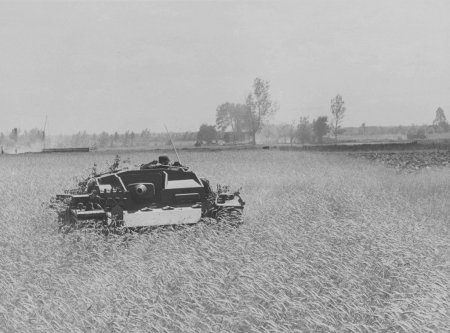
StuG III low sihouette
The low silhouette of the StuG is a tactical advantage in this wheatfield. Versions A through E would enjoy a 5 cm. armoured hull.

General Heinz Guderian (who in Operation Barbarossa commands the 2. Panzergruppe in Army Group Centre) is credited with the paternity of this new concept. Guderian writes about the need of fielding detachments of 6 assault guns for infantry formations. These have to be capable of breaking through the enemy defenses for the good progression of the foot soldiers. Guderian’s thesis are taken into account and as a result an Army requirement is issued in 1936 for the acquisition of a vehicle fitted with a 7.5 cm cannon. This should be capable for direct/indirect fire up to 6,000 metres and to be able to defeat enemy armour with special piercing projectiles.

The PzKpfw. III chassis is chosen for the series production. In May 1940 the first StuG III Ausf. A (Ausführung or version A) rolls out from factory ready for the French campaign. Its cannon is the Krupp 7.5 cm. Kanone L/24 (24 calibre). This in turn is a modified KwK L/24 fitted already in the PzKpfw. IV series. But the former is meant for the destruction of enemy defenses and bunkers.

stug iii ukraine
This StuG III is asigned to a Waffen SS division in the Ukraine 1941. In the background a Panzerjäger can be seen.

At Barbarossa start the standard series is already the StuG III Ausf. D. There are already 11 battalions and 9 independent batteries. Each battalion (Sturmgeschütz Abteilungen) consists of 3 batteries (Sturmgeschütz Batterien) each (6 vehicles per battery). They are a good symbiosis with the infantry. The Landser (as the German foot soldier is known) welcomes its near protection and the StuG’s need them for its immediate defense (they will lack machine guns until the version E and their rear armour is weak). The StuG’s are meant to advance at the speed of the Landser. They are even successful against the T-26’s and BT’s. In spite of the low muzzle velocity of its 7.5 cm. gun, it still has a «punch» against light and medium tanks.

After the Ausf. F (spring 1942) they will be fitted with a powerful “long barrel” anti-tank 7.5 cm. cannon. As a matter of fact they will be credited with more «kills» than all the Panther‘s and Tiger‘s together. Other nations will use them like Spain, Finland, Italy, Hungary, Bulgaria and Romania. 9,250 StuG’s will be produced…

Order of battle of StuG units assigned to fighting formations at Barbarossa start:

Stg.Abt.190 (11. Armee)
Stg.Abt.243 (17. Armee/IV. Armeekorps)
Stg.Abt.197 (1. Panzergruppe/XXXXVIII. Armeekorps (mot.))
Stg.Abt.191 (1. Panzergruppe/III. Armeekorps (mot.))
Stg.Abt.192 (2. Panzergruppe/XII. Armeekorps) (?)
Stg.Abt.226 (4. Armee/IX. Armeekorps)
Stg.Abt.201 (4. Armee/XII. Armeekorps)
Stg.Abt.203 (4. Armee/VII. Armeekorps)
Stg.Abt.210 (9. Armee/XX. Armeekorps)
Stg.Abt.184 (9. Armee/VIII. Armeekorps)
Stg.Abt.185 (18. Armee/I. Armeekorps)
Stg.Bttr.659, 660, 666 (mit Stab 600 (16. Armee/II. Armeekorps))
Stg.Bttr.665 (16. Armee/XXVIII. Armeekorps)
Stg.Bttr.667 (16. Armee/XXVIII. Armeekorps)
Stg.Bttr.1./190 (11. Armee/XI. Armeekorps)

Glossary of terms:

Armee: Army

Armeekorps: Army corps

Abteilung (Abt.): Battalion

Batterie: Battery

Panzergruppe: Armoured group

Stab: Staff

StuG III footage [Courtesy Panzer Picture]

Did you find this article interesting? Leave your comments below…

Follow other articles in Twitter @barbarroja0300h

BM-13 «Katyusha»

[English version at the end]

 ARMAS DE BARBARROJA

¡Ya a la venta Barbarroja 03:00 hrs!


SISTEMA MÓVIL LANZADOR DE COHETES BM-13


bm-13-katiusha-bm13
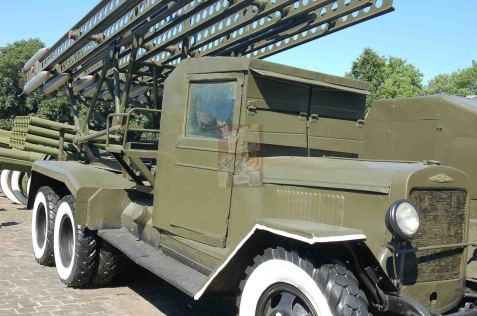
Denominado «órgano de Stalin» por los alemanes o «Katyusha» por el RKKA, es un éxito como arma desde el primer momento de su empleo en los combates en la región de Orsha. A las 15:15 horas del 14 de julio, una batería al mando del capitán Flyorov del modelo BM-13 entra en acción. Se convierte en ese mismo momento en una de las armas más temidas de los Landser. [Museo de la Gran Guerra Patria de Kiev].

El 14 de julio de 1941 en la región de Orsha (sudoeste de Smolensk) tiene lugar el bautismo de fuego de una nueva arma. El mando germano recibe un inquietante informe del frente respecto a la misma: “Los rusos utilizaron baterías de un número inusualmente elevado de piezas. Las tropas bajo fuego de los rusos son testigos: la cascada de fuego era similar a un huracán. Pérdidas entre el personal significativas”.

En realidad se trata de una sola batería (7 vehículos) del sistema reactivo BM-13 al mando del capitán Flyorov, en evaluación del equipo. Pronto los alemanes los van a llamar “órganos de Stalin” por el agudo silbido característico que emite en los lanzamientos. Los soviéticos lo denominarán «Katyusha».

La idea de estos montajes móviles de cohetes (82 y 132 mm.) se origina en la URSS en 1930. Coincidiendo con el comienzo de la Operación Barbarroja, se inicia la producción en serie del sistema lanzador de cohetes BM-13.

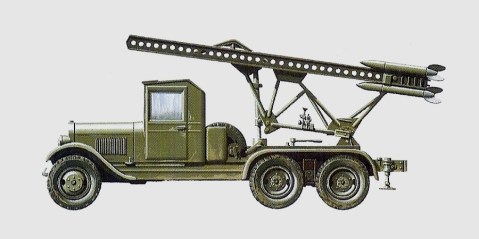
El BM-13 consta de un doble rail capaz de albergar 16 cohetes de aviación RS-132 de 132 mm. con un alcance máximo de más de 8 km. El conjunto se soporta sobre el camión estándar ZIS-6 del Ejército Rojo. Son proyectiles de 42,3 kg. cada uno. La salva se dispara en un intervalo de entre 7 a 10 segundos y la acción conjunta de una sola batería es capaz de crear el mismo efecto de saturación que 75 piezas de artillería en un sector de 4 kilómetros cuadrados.

perfil BM-13
Sistema móvil lanzador de cohetes múltiple BM-13. Está basado en el camión normalizado del RKKA ZIS-6.

Informe del General Yeremenko de los resultados del primer ensayo en combate del «Katyusha», que apoya la defensa de la tenaz 73ª División de Fusileros (coronel Akimov):

“…probamos la nueva arma cerca de Rudnya. Los cohetes surcaban por el cielo con un ruido atronador. Subían como cometas con una cola roja y después explotaban como un rayo. El efecto de la explosión de 320 artefactos en un período de 26 segundos en un área muy limitada sobrepasaron todas las expectativas. Los alemanes huyeron aterrados. Tengo que aseverar que nuestras tropas huyeron de la misma forma. Por razones de seguridad no les habíamos informado de antemano acerca del uso de la nueva arma…”.


¿Querrías conocer los detalles día a día de la Operación Barbarroja? Deja tu comentario abajo…

¡Adquiere la obra cronológica Barbarroja 03:00h en edición de coleccionista!


Comprar Ahora Button

Sigue interesantes referencias también en Twitter @barbarroja0300h


[English version]

BARBAROSSA’S WEAPONS


MOBILE ROCKET LAUNCHER SYSTEM BM-13

Katyusha rockets
Detailed picture of the 16×132 mm. rocket salvo.  Range 7,900 metres.[Great Patriotic War museum in Kiev].

On July 14th, 1941 in the Orsha region (SW of Smolensk) takes place the baptism of fire of a new weapon. The German HQ receives an alarming front report: “The Russians used an unusual number of artillery pieces. The eye-witnesses under Russian fire state: The sea of fire was similar to a hurricane. Severe casualties…”.

As a matter of fact just one battery (7 vehicles) is responsible for this. It is the secret first field test of the BM-13 rocket launcher system under command of Captain Flyorov. Soon the Germans will learn to call them «Stalin’s organs» due to their characteristic whistle when fired; the Soviets, «Katyusha».

The idea of these mobile rocket launchers (82 and 132 mm.) is conceived in the USSR in 1930. Coinciding with the start of Operation Barbarossa the new BM-13 system rolls out from factory.

The BM-13 system consists of a double rail structure over a lorry, capable of firing 16xRS-132 aviation rockets (132 mm.) up to a range of almost 8,000 metres. The array is supported over a Red Army standard ZIS-6 lorry. These rockets weigh 42.3 kilograms each. The salvo interval takes 7-10 seconds and the unified action of a single battery equates the saturation effect of 75 artillery pieces over a 4 square kilometre sector.

Report by General Yeremenko in regards of the first operational use of the «Katyusha», an ultra-secret weapon in support of the 73rd Fusiliers Division (Col. Akimov):

«…we tested the new weapon in the vicinity of Rudnya. The rockets streaked across the sky with a deafening noise. They climbed like comets with a trailing red tail and then exploded like thunder. The effect of 320 devices bursting within 26 seconds in a very confined area greatly surpassed all expectations. The germans fled in panic. I must state that our troops fled likewise. For secrecy reasons we did not inform them beforehand about the use of the new weapon…».

Did you find this article interesting? Leave your comments below…

Follow other articles in Twitter @barbarroja0300h

Dornier Do-17

[English version at the end]

 MÁQUINAS DE BARBARROJA

¡Ya a la venta Barbarroja 03:00 hrs!

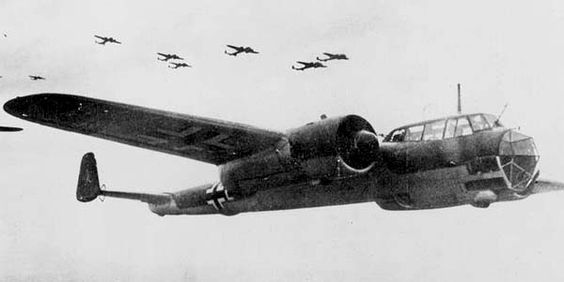
BOMBARDERO BIMOTOR DORNIER Do-17

dornier do-17z2
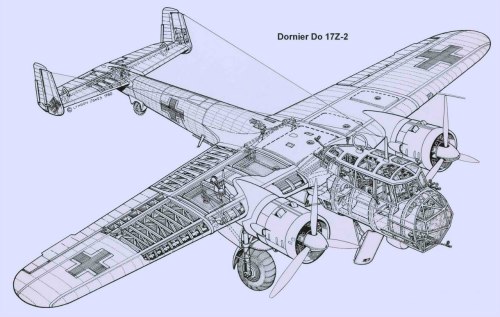
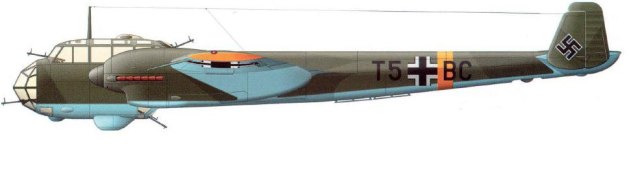
Diagrama del bombardero Dornier Do-17Z-2. Esta versión, con motores sobrepotenciados Bramo 323P Fafnir, es capaz de trasportar hasta 1.000 kg. de bombas. Es el doble que las versiones anteriores, pero a costa de reducir su radio de acción a sólo 330 km.

Inicialmente concebido en 1933 como avión de pasaje y carga, es rechazado por la compañía Deutsche Lufthansa, que había encargado el proyecto, por ser demasiado exigua su cabina. Pero por su velocidad y características se le adapta como aparato de bombardeo rápido (420 km/h. en altura). Como muchos otros diseños de la época participa en la Guerra Civil Española y en las primeras fases de la Segunda Guerra Mundial. No obstante ya en la Batalla de Inglaterra pone en evidencia su inadecuado armamento defensivo y poca carga bélica, por lo que lentamente se le va relegando a misiones de reconocimiento. La variante más producida puede transportar hasta 1.000 kg. de carga bélica. Hasta 23 Staffeln (escuadrillas) de reconocimiento de largo alcance se equiparán con este tipo. Por su característico fuselaje estilizado adquiere el apelativo de «Lápiz Volador».

En el asalto a la Unión Soviética el 22 de junio de 1941 participan versiones Do-17Z-2 asignados al I. y III./KG 2 y al III./KG 3 operando en el sector del Grupo de Ejércitos Centro. Concretamente bajo el 2. Luftflotte (2ª Flota Aérea) de Kesselring. Hay un total de 98 aparatos en plantilla y 62 operativos. Las primeras salidas de los Dornier vuelan contra los aeródromos soviéticos, contra los cuales lanzan pequeñas bombetas de 2 kilogramos de explosión retardada. Son las SD-2. Mientras los bimotores Heinkel del KG 53, desde bases cercanas a Varsovia, se encargan de los aeródromos entre Bielostok y Minsk, los Dornier Do-17Z del KG 2 lo hacen con aquellos más al norte entre Grodno y Vilnius. En el sector sur el KG 3 despega de Demblin en curso a objetivos entre Brest y Kobrin… Sus tripulaciones vuelan entre cuatro y seis misiones, mientras que los bombarderos en picado y cazas realizan hasta ocho; el esfuerzo físico es extenuante para los aviadores.

Do-17Z-2 ilmavoimat sa-kuva
Otros paises tienen en inventario al Do-17Z-2. En este caso, la Fuerza Aérea Finlandesa (Ilmavoimat). También Croacia volará este modelo en la campaña del este integrados en el 10.(Kroat)/KG 3. [Cortesía SA-Kuva].

La Operación Barbarroja cambia de fase aérea y se produce el primer gran bombardeo de Moscú en julio. A las 22:25 horas (hora de Moscú) 127 aparatos Junkers Ju-88, Heinkel He-111 y Dornier Do-17Z de nueve diferentes Kampfgeschwader (alas de bombardeo), lanzados en cuatro oleadas consecutivas desde pistas próximas a Minsk, Orsha, Vitebsk y Chatalovska (Bielorrusia), sobrevuelan la capital de Stalin. Es un intento por iniciar una campaña estratégica, pero la Luftwaffe no está concebida como una fuerza de estas características, ni es capaz de mantener el esfuerzo indefinidamente. La aviación militar del Reich se ha gestado con carácter táctico de apoyo a las operaciones en tierra.

El Oberfeldwebel (brigada) Broich, miembro de la tripulación de un Do-17 del 3./KG 2 describe su primera noche sobre los cielos de Moscú:

«Nachtangriff auf die Stadt Moskau (Ataque aéreo sobre la ciudad de Moscú). Altitud del bombardeo de 3.000 metros. Esas eran nuestras órdenes. Nuestros Do-17 no habían sido camuflados de negro para operaciones nocturnas y no nos encontrábamos particularmente entusiasmados por ello. Había una evidente cierta inquietud entre la tripulación ya que esto era algo totalmente diferente a nuestras misiones normales.

Nuestro vuelo hasta el objetivo nos pareció muy largo, sin duda porque estábamos persiguiendo el amanecer, cuyos resplandores ya podíamos ver en el cielo.  Al aproximarnos a Moscú nos apercibimos de que el ataque ya se estaba llevando a cabo delante de nosotros.

do-17-z-2 formacion
Una formación de «Lápices voladores», como se les conoce por su alargado y estrecho fuselaje. En el verano-otoño de 1940 en la ofensiva aérea contra Gran Bretaña pone en evidencia sus limitaciones como aparato de bombardeo.

En cuanto lanzamos las bombas sobre nuestra designada zona de objetivos un reflector nos iluminó. Casi instantáneamente treinta más se concentraron sobre nosotros y los primeros proyectiles empezaron a detonar a nuestro alrededor. Lanzamos el resto de las bombas y empezamos una carrera para zafarnos de la artillería antiaérea. Nuestro piloto, el Unteroffizer (subteniente) Heimann lo intentó todo para despistarla…virajes fuertes, cambios de altura, cortes de motor, todo ello mientras nuestro ingeniero de vuelo, Hans, empezaba a lanzar por la borda periódicos y octavillas (como solíamos hacer sobre Inglaterra) pero nada daba resultado. Peter [Heimann] nos sacó de aquello lanzando al aparato en un picado pronunciado y saliendo hacia un sector menos defendido de la ciudad…” .

¿Querrías conocer los detalles del día a día de la Operación Barbarroja? Deja tu comentario abajo…

¡Adquiere la obra cronológica Barbarroja 03:00h en edición de coleccionista!

Comprar Ahora Button

Sigue interesantes referencias también en Twitter @barbarroja0300h


[English version]

BARBAROSSA’S MACHINES

TWIN ENGINE BOMBER DORNIER Do-17

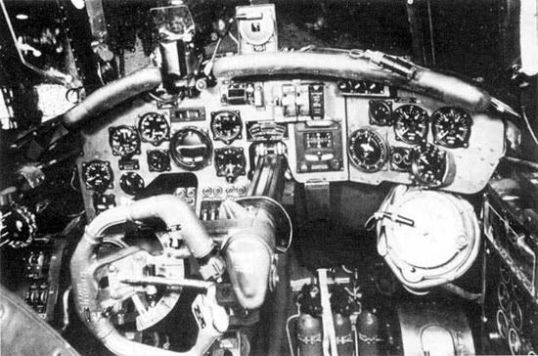
Do-17 cockpit
Dornier Do-17 cockpit. Note the single control column. The right hand side post is devoted for the bombardier.

In spite of being initially designed in 1933 as a passenger and cargo aircraft, it is rejected by the civilian company Deutsche Lufthansa (the petitioner of the project) due to its too narrow passenger cabin. But because of its speed and overall performance it finds a quick role as a fast bomber (420 km/h.). Like many other types of the time, it participates in the Spanish Civil War (1936-39) and the first stages of WWII. However, already during the Battle of Britain, it shows weaknesses due to its insufficient self-defense  armament and a limited bomb load. The most manufactured version, the Do-17Z-2 is able to carry up to 1,000 kg of warload. Slowly it will yield the job to the heavier Junkers Ju-88, taking itself the reconnaissance role. There will be 23 long-range Staffeln (squadrons) equipped with this type. Due to its slenderness it gains the nickname of «Flying pencil».

In the assault to the USSR on the 22nd of June 1941, Do-17Z-2‘s assigned to I., III./KG 2 (Kampfgruppe<>Bomber Group) and III./KG 3 will fly in the Army Group Centre’s theatre of operations. These are under Kesselring‘s 2. Luftflotte (2nd Air Fleet). Out of 98 in total, 62 are airworthy on the 22nd of June 1941. The first Dornier sorties are launched against the Soviet aerodromes where they drop small 2 kg. bomblets with delay fuzes. They are called SD-2. While the Heinkels from the KG 53, take care of those bases between Bielostok and Minsk, Dornier Do-17Z from the KG 2 work out those between Grodno and Vilnius. More to the south the KG 3 take off from Demblin (Poland) against targets between Brest and Kobrin…They will carry out 4-6 missions a day, while dive bombers and fighters do up to 8; the physical and mental strain for the crews is maximum.

do-17z-2 downed 7aug41
This Do-17Z-2 has been shot down on the 7th of August 1941. It belongs to a long-range reconnissance squadron. The yellow band and wingtips identify the machine as participating in the Eastern Front.

Operation Barbarossa shifts into a new air phase soon as the Moscow bombing campaign starts in July 1941. At 22:25 hours (Moscow time) 127 Junkers Ju-88, Heinkel He-111 and Dornier Do-17Z belonging to 9 different bomber wings fly 4 consecutive waves from runways near Minsk, Orsha, Vitebsk and Chatalovska towards the Soviet capital city.

Oberfeldwebel Broich, one of the 3./KG 2 crew members describes his first night over Moscow:

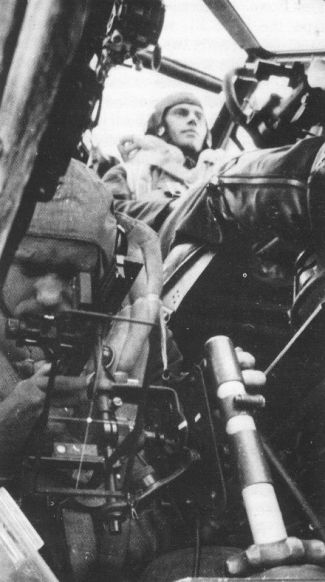
do-17z bombardier
Interesting view of the narrow cockpit where the pilot and bombardier work shoulder to shoulder. Note the Lotfe bomb sight.

“Nachtangriff auf die Stadt Moskau” (air raid against Moscow city). Altitude 3,000 meters. Those were our orders. Our Do-17’s hadn’t been painted black for night operations and we were not happy about it. There was some restlessness amongst the crews due to this, being this task way different from our standard missions.

Our flight towards the target seemed to us excessively long because we were chasing the sunrise, its glare already seen in the sky. Approaching Moscow we realized that the bombing had already taken place in front of us. As soon as we dropped the bombs on our target area a searchlight found us. Almost at once 30 more homed in on us and the first antiaircraft projectiles started exploding around us. We launched the rest of the bomb load and started a race against the antiaircraft  artillery. Our pilot, Unteroffizier Heimann tried everything to dodge it…tight turns, altitude changes, power changes, all of that as our flight engineer, Hans, commenced to dump overboard newspapers and leaflets (as we used to do over England), but to no avail. Peter [Heimann] got away with it diving  the machine steeply and levelling it off over a less defended sector of Moscow…”.

Did you find this article interesting? Leave your comments below…

Follow other articles in Twitter @barbarroja0300h
Desastre soviético 1941…¿Por qué?

[English version below]


Jamás sabremos cuán cerca o lejos estuvo el III Reich de provocar el colapso completo del RKKA (Ejército Rojo de Trabajadores y Campesinos) en el verano de 1941. Tal pretendido colapso, que hubiera podido traer como consecuencia el descabezamiento del sistema comunista en la URSS, era el objetivo prioritario de la Operación Barbarroja. Pero nunca se produjo. La Historia se condujo por otros derroteros como conocemos. No obstante el descalabro sin precedentes del ejército de Stalin fue un hecho durante los primeros meses de la campaña de invasión de Adolf Hitler…¿Pero cómo fue posible que sucediera en el ejército más grande del mundo en ese momento?

Coincidiento con el 75 aniversario de la mayor guerra relámpago de todos los tiempos, encuestas recientes en la Federación Rusa arrojan los siguientes resultados:

47% opina que el desastre fue debido a la mejor preparación de la Wehrmacht

21% achaca el desastre al mismo Stalin

10% a la dirección militar y política del estado y…

3% al mismo pueblo soviético

[ Fuente: revista DILETANT. Nº007 julio 2016. Federación rusa. http://diletant.media ]


¿Estás de acuerdo?

¡Vota y comenta tu respuesta al final de esta misma página!


[English version]

Soviet disaster 1941…Why?

We will never know how close or far was the III. Reich to provoke the total collapse of the RKKA (Red Army of Workers and Peasants) in the summer of 1941. This desired collapse, as the main objective of Operation Barbarossa, could have triggered the disappearance of the Communist regime. But this never happened. The course of History followed another line of events as we know. Nevertheless the unprecedented misfortune of Stalin’s Army was a fact during the first months of Hitler’s invasion campaign…But, how was this possible in the largest army of the world at its time?

Recent polls coinciding with the 75th anniversary of the largest Lightining War of all times show the following results:

47% think the disaster was due to the best quality of the Wehrmacht

21% blame Stalin himself

10% blame the top political and military direction of the State

3% blame the very same Soviet people

[ Source: magazine DILETANT. No. 007 July 2016. Russian Federation. http://diletant.media ]


Do you agree?

Vote and comment your choices right at the bottom of this page!


PTUKHIN, Evgenyi Savvich. General-leitenant.

[English version at the end]

 PERSONAJES DE BARBARROJA

¡Ya a la venta Barbarroja 03:00 hrs!


GENERAL-LEITENANT EVGENYI SAVVICH PTUKHIN (1902-1942)

ptukhin vvs-kovo
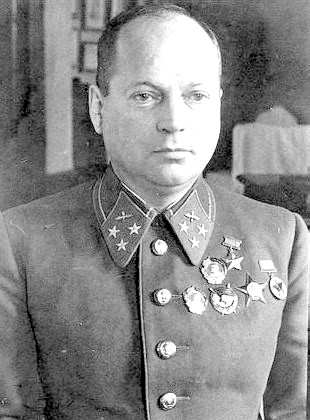
Retrato del Jefe de las fuerzas aéreas del Distrito Militar Especial de Kiev. General Evgenyi Savvich Ptukhin. Veterano de la Guerra Civil Española, acabará trágicamente su carrera como consecuencia de los desastrosos eventos del verano de 1941.

Como su camarada de armas, el Comandante de las fuerzas aéreas del Frente Occidental, el general-maior Ivan Ivanovich Kopets, Ptukhin es un veterano de la Guerra Civil Española. En la primavera de 1937 Ptukhin es destacado a España como asesor militar del gobierno republicano hasta su retorno a la URSS al año siguiente. Se le conoce con el sobrenombre de «General José» estando además al mando 26º Grupo de Caza. Se le atribuyen 2 derribos compartidos en el área de Madrid y Segovia. Es condecorado como Héroe de la Unión Soviética en 1940. Tambien participa en el conflicto ruso-finés como Comandante de las fuerzas aéreas del Frente Noroccidental, la Guerra de Invierno 1939-40.

En la histórica fecha del 22 de junio de 1941, Evgenyi Savvich Ptukhin es el Comandante del VVS-KOVO (fuerzas aéreas del Distrito Especial Militar de Kiev). Sus unidades aéreas dependen del Jefe del mencionado Distrito, general Kirponos. Dispone de la impresionante cifra de 2.061 aeronaves (entre ellas hay 466 bombarderos y 1.343 cazas, de los que casi 200 son del nuevo modelo MiG-3) [fuente: http://www.v3let.ru/]. La fuerza a la que se van a enfrentar son los aparatos del 4. Luftflotte del Generaloberst Alexander Löhr, que cuenta con 390 bombarderos y 321 cazas [Fuente http://www.lexikon-der-wehrmacht.de]. La relación de efectivos es desfavorable para el Eje, pero la efectividad  y los resultados conseguidos por la Luftwaffe serán espectaculares.

Mientras las unidades de la VVS  están siendo en gran medida neutralizadas por los ataques sorpresa de la Luftwaffe en el sector septentrional y central del extenso «frente ruso», en el sur la aviación roja aún permanece activa y con capacidad de devolver los golpes. El primer ataque alemán ha sido serio, pero existen docenas de aeródromos dispersos por toda Ucrania, muchos de los cuales ni siquiera están en las carpetas de objetivos de los pilotos germanos. Ptukhin reacciona. Ha dado instrucciones desde las primeras horas de atacar aeródromos enemigos, áreas de concentración de tropas y de defender con cazas a las unidades de primera línea.

La cantidad de aparatos soviéticos destruidos en sus mismas bases aumenta a cada hora que pasa, pero desde los más alejadas pistas de las unidades de bombardeo de Ptukhin se planea ya un segundo ataque. En el Frente Sudoccidental (de Distrito Militar pasa a constituirse en «Frente» en la misma jornada) la VVS presenta cara. A pesar de todo y del arrojo de sus aviadores las pérdidas aumentan y las misiones de bombardeo se suelen saldar con numerosos derribos de sus aparatos Tupolev SB. Su fuerza aérea al igual que en los otros teatros de operaciones también se desangra.

Así el 24 de junio (algunas fuentes señalan días más tarde) es relevado del mando y puesto bajo arresto, siguiendo la “expeditiva vía” de Moscú de dar ejemplo en los campos de batalla. Será fusilado en 1942. Tras la muerte de Stalin, como en otros casos, su nombre será rehabilitado en 1954…


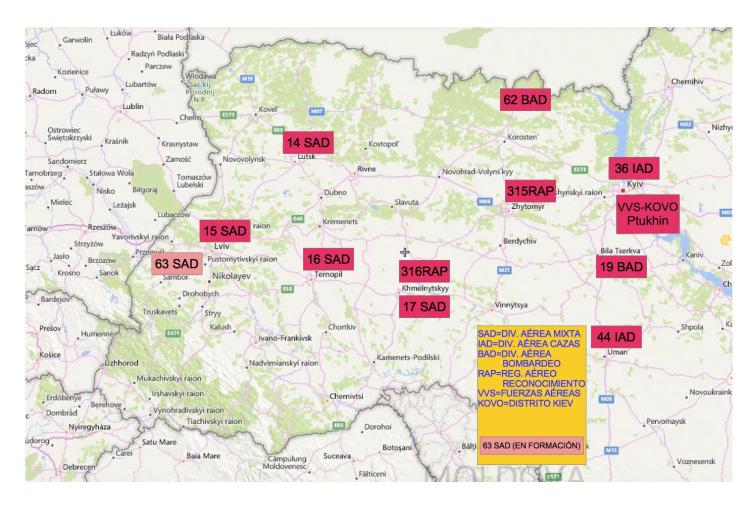
vvs-kovo
Unidades aéreas del Distrito Especial Militar de Kiev a disposición de Ptukhin. Diferentes fuentes señalan diferentes dislocaciones y unidades. [fuente: «Aviación Soviética durante la Gran Guerra Patria en cifras». 1962].

¿Querrías conocer los detalles del día a día de la Operación Barbarroja? Deja tu comentario abajo…

¡Adquiere la obra cronológica Barbarroja 03:00h en edición de coleccionista!


Comprar Ahora Button

Sigue interesantes referencias también en Twitter @barbarroja0300h


[English version]

BARBAROSSA’S PROTAGONISTS


LIEUTENANT-GENERAL EVGENYI SAVVICH PTUKHIN (1902-1942)


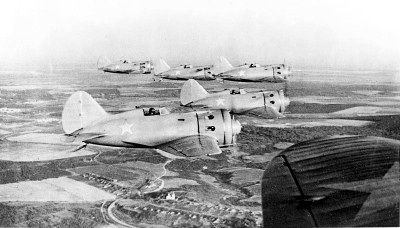
i-16 formation
Ptukhin’s large fighter force is mainly comprised by obsolete Polikarpov’s, like the I-16’s depicted.

Like his ill-fated comrade, Ivan Ivanovich Kopets, general-maior and Commander of the Western Front air forces (VVS-Zapadnyi Front), Ptukhin is too a veteran of the Spanish Civil War. In spring 1937 Ptukhin is detached to Spain serving as a military advisor for the Republican Government, until his return to the USSR on the next year. He is known by the nickname «General José» and he is given the command of the 26th Fighter Group as well. During the air combats in the area of Madrid and Segovia he claims 2 shared air victories. In 1940 he is decorated as Hero of the Soviet Union. He also participates in the russo-finnish conflict (Winter War 1939-40) as the Commander of the Northwestern Front air forces.

On the dramatic 22nd of June 1941, Evgenyi Savvich Ptukhin is this time the Commander of the VVS-KOVO (Kiev Special Military District air forces). His numerous air units depend on the Commander of the aforementioned District, General Kirponos. His powerful command consists of 2,061 airplanes (amongst them 466 bombers and 1,343 fighters, out of the latter almost 200 belong to the modern type MiG-3) . He will be forced to fight off Alexander Löhr’s 4. Luftflotte, which add up to 390 bombers and 321 fighters . The ratio of assets are quite unbalanced, but the results will be quite succesful for the German wings.

While the VVS squadrons have been greatly decimated by the Luftwaffe’s surprise attacks in the central and northern theatres of operations, in the south the «red air force» is still active and capable to fight. The German blow has been serious, but the Soviets have dozens of aerodromes spread out across the Ukraine and not all of them are in the German target folders. Ptukhin reacts. He issues orders from the early morning hours to attack adversaries’ aerodromess, troop assembly areas and to defend the army on the front lines.

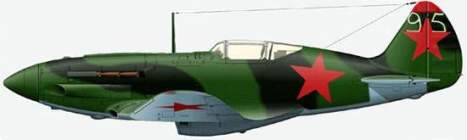
mig-3 1941
Ptukhin has almost 200 modern MiG-3’s. One of his units equipped with this new type, the 15 SAD (15th Mixed Air Division), is based too close to the border in the Lvov area. It will suffer great losses within the very first hours of the German onslaught.

The number of destroyed Soviet aircraft increase by the hour; the German punishment starts again and again in consecutive waves, but Ptukhin has ordered already a second attack from his far still untouched bases. In the Southwestern Front the VVS flies and fights. However, and in spite of the courage of its pilots, the losses grow relentlessly to alarming proportions. Bombing missions usually end up with too many Tupolev SB’s shot down. Like on the other sectors of the front, his air forces bleed off slowly…

This way, on the 24th of June 1941 (this vary according to different sources) he is arrested and relieved from command following «the expeditious Moscow style» in order to set an example for the other commanders. He will face the execution squad in 1942. As in other cases, his name will be rehabilitated in 1954 after Stalin’s death…


Did you find this article interesting? Leave your comments below…

Follow other articles in Twitter @barbarroja0300h
Kleist, Ewald von. Generaloberst.

[English version at the end]

 PERSONAJES DE BARBARROJA

¡Ya a la venta Barbarroja 03:00 hrs!


GENERALOBERST EWALD VON KLEIST (1881-1954)

kleist-panzer-iii
Impersión artística de Ewald von Kleist en su vehículo de mando en la operación de invasión de la URSS. [Juan Carlos Ciordia].

El Generaloberst Ewald von Kleist va a constituirse en la pieza clave de la estrategia de ruptura de la línea defensiva del Frente Sudoccidental soviético (Yugo-zapadnyi front). Esta es la zona de responsabilidad del general Kirponos. El 1. Panzergruppe «Kleist» está encuadrado en el Grupo de Ejércitos Sur (Heeresgruppe Süd), uno de los tres grupos de ejército que abarcan el extenso frente desde el Mar Báltico hasta el Mar Negro. El grupo Panzer cuenta con 3 cuerpos motorizados y, entre ellos, con 5 divisiones acorazadas (728 blindados). A estas hay que sumar la Waffen SS Motorisierte Division “LSSAH” (Leibstandarte SS Adolf Hitler) y la Waffen SS Motorisierte Division  “Wiking”, ambas unidades móviles de élite.

Kleist, capitán en la época de la Primera Guerra Mundial, ya está retirado a mediados de los años 30. Pero los acontecimientos en los que se ve envuelta Alemania en 1939 hacen que vuelva a ser incorporado al servicio activo. Así participará en la campaña polaca de 1939 como jefe de un cuerpo motorizado y posteriormente en 1940 en la campaña de Francia al mando del famoso Panzergruppe «Kleist». En abril de 1941 interviene en la campaña yugoslava.

panzergruppe kleist on the march across ukraine
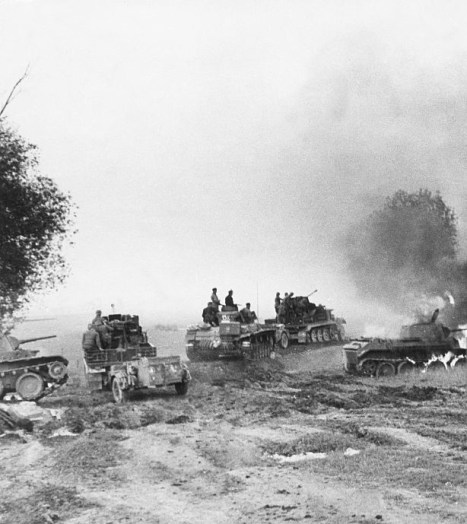
Blindados del 1. Panzergruppe «Kleist» a través de Ucrania. Dos carros soviéticos BT-5 fuera de combate.

El 22 de junio de 1941 Kleist es la principal baza del Grupo de Ejércitos Sur del mariscal de campo von Ründstedt. Penetra en cuña en la zona adyacente entre el general Potapov (5º Ejército) y Muzychenko (6º Ejército). La maniobra resulta exitosa y los Panzer se internan peligrosamente sin el apoyo de los Landser (apelativo común del soldado alemán). La infantería de a pie no puede seguir el ritmo de las fuerzas móviles. En este momento de la guerra, la Wehrmacht no está motorizada en su mayoría. Es una fuerza hipomóvil. Debido a la inferioridad numérica de Kleist contra las fuerzas acorazadas del general Kirponos (3.400 carros de combate) y su desprecio por la seguridad de sus flancos en su carrera hacia el interior de Ucrania, va a estar en un serio aprieto en la primera semana de la Operación Barbarroja. Para suerte del germano, los soviéticos, a pesar de superarle en casi 4 a 1 en número de carros de combate, están mal coordinados en la ejecución del contraataque. Van llegando al combate escalonadamente. Kleist supera además en la táctica de la maniobra a Kirponos y recibe el apoyo vital de la Luftwaffe (4. Luftflotte). Kleist saldrá airoso en última instancia tras varias jornadas de la mayor batalla de carros de combate de la historia hasta la fecha: La batalla del triángulo Brody-Lutsk-Dubno.

Resuelta la crisis, una vez capturado Zhitomir y con sus Panzer ya próximos a Kiev, va a recibir la sorpresiva orden de no asaltar la capital de Ucrania, sino de girar 90 grados a la derecha y dirigirse hacia el sureste, dejando al gran río Dnieper a su izquierda. El objeto es embolsar a un gran contingente soviético. La orden sorprenderá tanto a alemanes como al estado mayor soviético, que ya se preparaba para la defensa a ultranza. Hasta ese momento, von Ründstedt, no ha sido capaz de asestar un golpe decisivo al enemigo del estilo de las bolsas en el sector bielorruso. Von Kleist consiguirá finalmente poner el cerrojo a 90.000 adversarios en la famosa bolsa de Uman en la primera semana de agosto de 1941.

Acto seguido en septiembre, una gigantesca maniobra en tenaza entre su grupo acorazado y el 2. Panzergruppe de Guderian conseguirán el mayor embolsamiento de la historia de las guerras: más de 600.000 soviéticos quedarán copados al este de Kiev…


¿Querrías conocer los detalles día a día de la Operación «Barbarroja»? Deja tu comentario abajo…

¡Adquiere la obra cronológica Barbarroja 03:00h en edición de coleccionista!


Comprar Ahora Button

Sigue interesantes referencias también en Twitter @barbarroja0300h

[English version]

BARBAROSSA’S PROTAGONISTS


COLONEL-GENERAL EWALD VON KLEIST (1881-1954)


Kleist portrait
Portrait of the Knight’s Cross of the Cross of Iron’s holder, Colonel-General Ewald von Kleist.

Generaloberst Ewald von Kleist becomes himself the key of the rupture strategy of the Southwestern Front defensive lines (Yugo-zapadnyi front). This is the area of responsibility of General Kirponos. His 1. Panzergruppe is under the hierarchy of Army Group South (Heeresgruppe Süd), the force in charge of the southern sector of the vast Eastern Front. It stretches from the Baltic Sea to the Black Sea. 1. Panzergruppe  consists of 3 motorized corps and within them, 5 armoured divisions (728 tanks). In addition he will be assigned the Waffen SS Motorisierte Division “LSSAH” (Leibstandarte Adolf Hitler) and the Waffen SS Motorisierte Division  “Wiking”, both elite mobile units.

Kleist, already a Captain during the First World War, is retired in the 30’s. But the evolving circumstances affecting Germany shortly after will see him recalled to active duty. Thus, he will command a motorized corps during the Polish campaign in 1939 and later in 1940 a full armoured group, the famous Panzergruppe «Kleist» in France. He will also participate in April 1941 in the Yugoslavian campaign.

panzergruppe kleist
One of the Panzer divisions  belonging to the 1. Panzergruppe «Kleist» across the Ukraine. The highly visible «K» painted on the vehicles identify his forces. [Inventar-Nr.: Gm WII0035-15A]

On the 22nd of June 1941, Kleist is the main asset of von Ründstedt’s Army Group South. As a wedge he pierces the adjacent area between General Potapov (5th Army) and Muzychenko (6th Army), launching his tanks in a successful breakthrough. The Panzer move forward withouth the help pf the slow moving Landser (usual nickname of the German soldier). Contrary to the common knowledge the Wehrmacht is not a motorized force at this stage. Still relies on horses and the feet of its soldiers. Due to the numerical inferiority of Kleist versus Kirponos’ armoured units (+3,400 tanks) and ignoring his flanks in his penetration throughout the Ukraine, he will face the first crisis during the first week of Operation Barbarossa. Luckily and in spite of being overnumbered 4-1 in tanks, the Soviets launch their counter-attack uncoordinatedly and piece-meal. Kleist is tactically superior to Kirponos and enjoys a tremendous air superiority (4. Luftflotte). After a few critical days, he will have the upper hand in the largest up to-date tank battle in History: the battle of the triangle Brody-Lutsk-Dubno.

Kleist briefings Italian allies

Kleist briefs his Italian allies

Once the crisis is resolved and Zhitomir is captured, approaching his Panzer to Kiev he will receive the surprising order of not to assault the Ukraine’s capital city but to turn 90 degrees to the right and head to the southeast (leaving the Dniepr river left to the East). The purpose: To encircle a vast enemy force. This order will surprise either Germans and Soviets, the latter already consolidating Kiev’s defenses. Up to this moment von Ründstedt has not been able to deliver a decisive blow to the enemy as von Bock has done in Belarus. Von Kleist will lock up a force of 90,000 enemy troops in the famous Uman “cauldron» within the first week of August 1941.

Shortly therefter in September, a gigantic pincer maneouvre between his armoured group and Guderian’s 2. Panzergruppe will manage to encircle the largest enemy contingent of troops: More than 600,000 soviet soldiers will be trapped due East of Kiev…


Did you find this article interesting? Leave your comments below…

Follow other articles in Twitter @barbarroja0300h