¿Hitler Contra Stalin?

[English version at the end]


Los Mitos de Barbarroja (III)
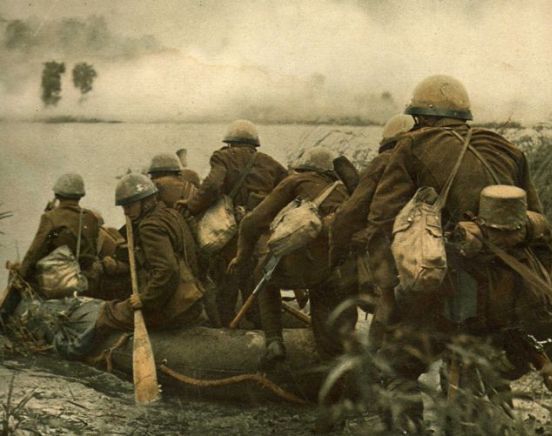
Tropas eslovacas en el cruce del río Dnieper al amparo de cortinas de humo.

La Operación “Barbarroja” fue una campaña multinacional liderada por el Tercer Reich. Al decir “multinacional” nos referimos a que hubo diferentes estados participantes al lado del Eje. Naturalmente se asocia a la tradicional idea de la lucha titánica entre Hitler y Stalin, pero de los 3,5 millones de combatientes que el 22 de junio de 1941 asaltaron las fronteras de la URSS a las 03:00 horas, aproximandamente 500.000 soldados vestían un uniforme diferente del de la Wehrmacht. Al ser el frente de batalla tan extenso, desde las aguas del mar Blanco al norte de Finandia hasta las costas del mar Negro al sur, este hecho no podía ser de otra manera. En la reciente historia del Viejo Continente, en especial desde la conclusión de la Primera Guerra Mundial en 1918 hasta 1941, el mapa había cambiado de manera drástica.
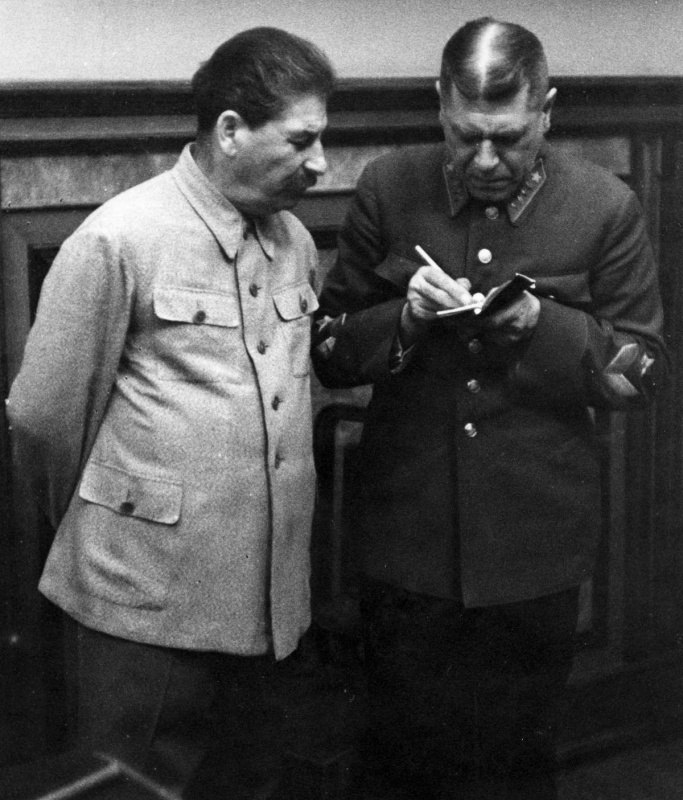
Stalin con el mariscal Shaposhnikov en la firma del tratado de no agresión el 23 de agosto de 1939. La firma de este tratado determinará para siempre el desarrollo de la Segunda Guerra Mundial y el futuro de Europa. A pesar de sus antecedentes como oficial zarista, Shaposhnikov sobrevivirá a las purgas en el Ejército Rojo y se ganará el respeto de Stalin, quien de manera particular lo tratará como «Camarada Boris Mikhailovich»,

Adolf Hitler supo aglutinar en esta descomunal campaña las aspiraciones políticas, territoriales y sociales de muchos de los contendientes para constituir un frente común contra la Unión de Repúblicas Socialistas Soviéticas. Los trazados de las fronteras habían cambiado de manera caprichosa en muchas ocasiones, separando nacionalidades o reuniendo a grupos étnicos rivales en un mismo estado. Por tanto no nos referimos a que todos los países intervinientes (Finlandia, Rumanía, Hungría, Eslovaquia, España, Croacia y tantos otros voluntarios a nivel personal) compartieran el mismo objetivo. Así es. Por ejemplo, la participación española plasmada en la División Española de Voluntarios (“División Azul”) y la «Escuadrilla Azul» no persiguió fines raciales o de conquista territorial u otros sino los puramente ideológicos (destrucción del comunismo). Los finlandeses tuvieron aspiraciones territoriales limitadas, por ejemplo; y otras naciones se «enrolaron» en este hecho de armas por motivos diversos. El Führer alemán presentó al mundo la campaña como una “cruzada contra el bolchevismo” y encontró eco en muchas naciones europeas. Según se iba desarrollando la batalla en el este y la necesidad de más y más soldados se hizo aguda se formaron unidades voluntarias de las Waffen SS en Bélgica, Holanda, países nórdicos, Francia. Incluso británicos se enrolaron. También, mientras la campaña progresaba por tierras de la «Madre Rusia», hubo otros miles que se unieron: ucranianos y bálticos e incluso rusos se volvieron contra Stalin.

La embestida del Eje encontró cierto apoyo popular en las regiones más occidentales de la URSS, principalmente en el oeste de Ucrania y repúblicas bálticas. No obstante conforme la ofensiva se internó más hacia el corazón de Rusia, la hostilidaad de civiles y resistencia del Ejército Rojo se hizo más y más patente. En las filas estalinistas combatieron multitud de diferentes grupos étnicos (no sólo rusos), al ser la URSS un gigantesco estado multicultural. Cuando se habla de «rusos», más bien habría que referirse a «soviéticos», acepción más genérica que engloba a todos los ciudadanos de la Unión de Repúblicas Socialistas Soviéticas. No se debe atribuir completamente al régimen a Moscú el mérito de haber podido aglutinar bajo un mando único la volutad de resistencia del pueblo (militares y civiles), sino que en gran medida se explica por al tradicional arraigo de la población a su tierra. Al igual que en la campaña napoleónica de 1812, este sentimiento de arraigo exaltó dicha voluntad de resistencia que convirtió esta lucha titánica en algo singularmente dramático.

Continuará…

¡Ya a la venta Barbarroja 03:00 hrs!

¿Te ha resultado de interés este artículo? ¿Querrías conocer los detalles de esta y las demás operaciones?

¡Adquiere la obra cronológica Barbarroja 03:00h en edición de coleccionista!

Comprar Ahora Button


Deja tu comentario abajo y sigue CONQUISTAR RUSIA punteando en la opción «SEGUIR / FOLLOW» a la izquierda de la página


[English version]

Myths of Barbarossa

THIRD myth: HITLER vs. STALIN?
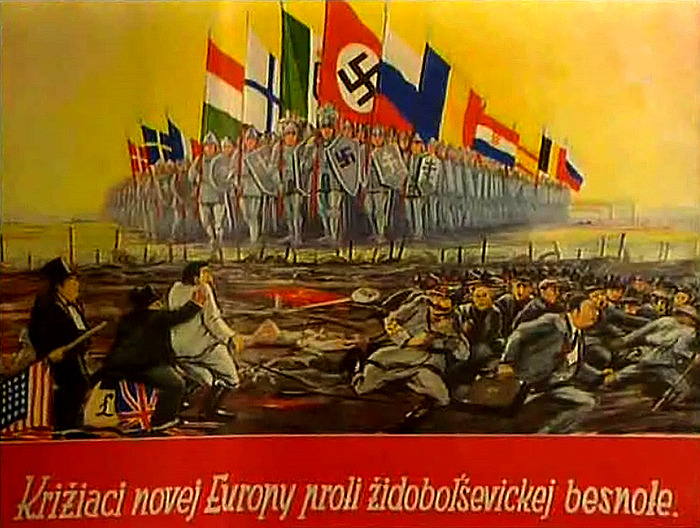
 

First Slovak Republic propaganda poster. “Crusaders of a new Europe against ziobolshevic madness.”

Operation Barbarossa was as a matter of fact a multinational campaign lead by the Third Reich. With this word «multinational» we mean that there were other participant states joining the Axis struggle. Traditionally we think about the classical titanic duel between Hitler against Stalin, but from the initial 3,5 million troops that at 03:00 hours, 22nd of June 1941 assaulted the USSR borders, about 500,000 soldiers did not wear Wehrmacht uniforms. Being the frontline amazingly long, from the White Sea (North of Finland) to the shores of the Black Sea (Romanian coast) this fact couldn’t be otherwise. In the recent History of the Old Continent, especially since the end of World War I in 1918 until 1941, the map had changed too dramatically.
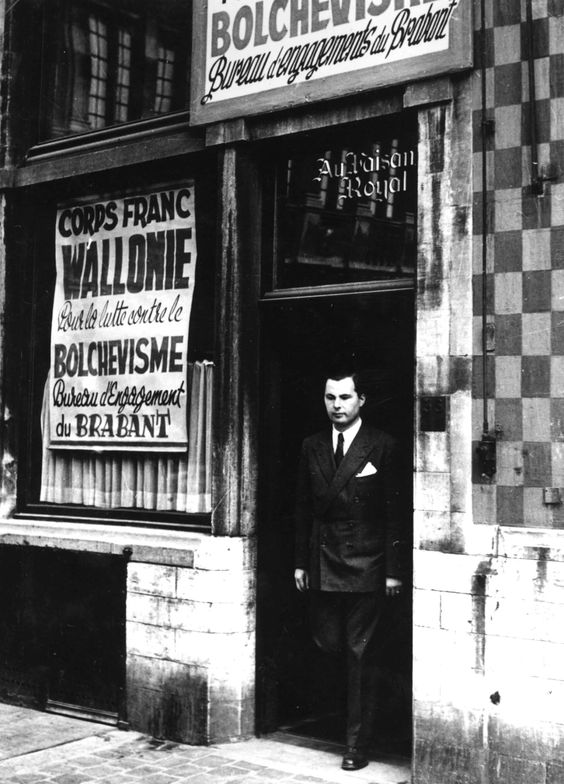
Léon Degrelle leaving the draft office for the Wallonian Legion in the summer of 1941. When Germany assaults the Soviet Union on the 22nd of June, 1941 Adolf Hitler will call for a ‘Crusade against Bolshevism’. Over 1000 Walloons will volunteer almost immediately, among them Degrelle himself. Pleased at having such an important figure, and as the leader of the Rexists, the Germans will grant Degrelle permission to raise a Waffen SS unit comprised only of Belgian volunteers, the Corps Franc Wallonie or Legion Wallonie. Degrelle and his supporters were fiercely anticommunist, anti-Semitic and antibourgeois and quickly capitalized not only on internal ethnic tensions within Belgium but also on the population’s widespread dissatisfaction with the nation’s governing parties.

Adolf Hitler managed to agglutinate in this enormous campaign different political, territorial and social aspirations of many of the combatants in order to build a common front against the Union of Soviet Socialist Republics. The shape of the borders had changed too capriciously in many occasions dividing nations or reuniting rival ethnics into single new states. Consequently we don’t mean that all the participating countries (Finland, Romania, Hungary, Slovakia, Croatia and many other volunteers) fought after the same objective. For instance, the Spanish contribution (División Española de Voluntarios or «Blue Division» and the «Blue Squadron») did not pursue racial or territorial conquest, but purely ideologic (annihilation of Communism). The Finnish, for instance, had limited territorial demands; and other nations «enlisted» in this operation for various reasons. The German Führer presented Operation Barbarossa as a «crusade against Bolshevism» and found support in many European countries. As the battle in the East progressed and the need for more soldiers became acute, volunteer foreign Waffen SS units were formed from Belgium, Holland, Nordic countries, France, even Great Britain…While the hitlerite armies advanced throghout Mother Russia thousands joined too: Ukranians, Baltics…even Russians decided to fight Stalin.


The Axis onslaught met some popular support in the mostwestern regions of the USSR, especially those of the Ukraine and the Baltic Republics. Relentlessly and as long as the ofensive drove deeper into the heart of Russia, the hostility of civilians and the RKKA (Red Army of Workers and Peasants) became patent. In the Stalinist ranks fought many different ethnical groups, being the USSR a gigantic multicultural state. When we talk about «Russians», we should more correctly refer to «Soviets», a more ample name that encompases all the citizens of the Union of Soviet Socialist Republics. In this author’s opinion, it was not only the merit of Moscow’s regime to agglutinate the military and civilians (partisans) under Stalin’s command the will to resist the invaders, but the traditional deep-rooted character of the inhabitants into «Mother Russia». This feeling, as it already happened during the Napoleon campaign in 1812, ignited this will of victory and resistance that transformed this titanic struggle in something dramatic.
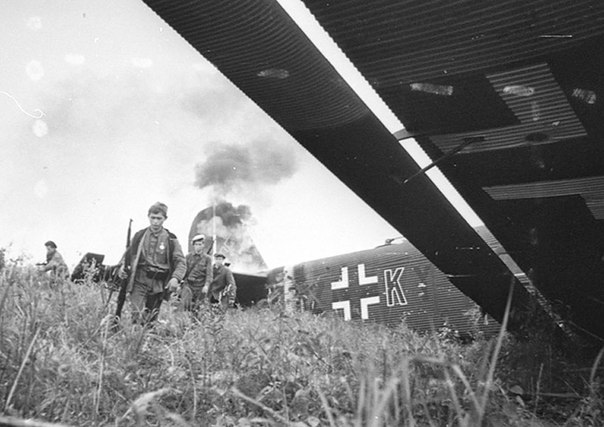
Partisans near a Junkers Ju-52 wreck. The action of these groups of guerrillas was not at all negligible as they harrassed the rearguards, ambushed detachments of troops, demolished war infraestructure, attacked convoys and raildroads, hampering the free flow of much needed Wehrmacht logistics into the front. Using hit-and-go tactics these groups (unorganized at the beginning of operation Barbarossa), were comprised of civilians and Red Army troops cut out from their lines and operated from the safety of the endless masses of woods of «Mother Russia».


To be continued…

Did you find this article interesting? Leave your comments below and follow us clicking on «SEGUIR / FOLLOW» at the left of the page
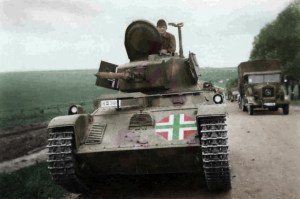
38.M TOLDI

[English version at the end]

LAS MÁQUINAS DE BARBARROJA

¡Ya a la venta Barbarroja 03:00 hrs!


toldi carro de combate hungaro
Un 38M/43M «Toldi» en columna de viaje junto a tropas germanas en algún lugar de la URSS.

CARRO DE COMBATE LIGERO 38.M TOLDI

El carro de combate húngaro Toldi porta su nombre en honor al histórico caballero medieval del siglo XIV, Miklos Toldi.  El diseño deriva de un modelo sueco, el Landsverk L-60 (uno de los más avanzados diseños del mundo en 1934), que se empieza a producir bajo licencia en Hungría en 1937. Siendo Checoslovaquia la amenaza nacional considerada del momento, Hungría estima que un carro ligero es más que adecuado para sus fuerzas blindadas y se le equipa con un pequeño cañón 36M de 20 mm. Con una tripulación de 3 hombres, también se le monta una radio de 30 kilómetros de alcance.

En diciembre de 1940 el regente húngaro, el almirante Miklos Horthy y Hitler mantienen un tratado de Paz duradera y amistad eterna y en base a esto y un «extraño» ataque aéreo acaecido el 26 de junio a la ciudad de Kassa (supuestamente por la aviación de Stalin), Hungría se lanza a la guerra contra el bolchevismo. En la misma jornada la aviación húngara ((Magyar Királyi Honvéd Légierő (MKHL)) bombardeará Stanislav (actual Ivano-Frankivsk) y la declaración de guerra se hará formalmente al día siguiente.

A principios de 1941 el 38.M Toldi cambia de denominación y pasa a ser el Toldi I. Para el comienzo de la intervención húngara en la Operación Barbarroja 81 unidades están listas de la variante Toldi I. Como vehículo ligero, veloz y maniobrero, demuestra buenas cualidades en el campo de batalla. No obstante, naturalmente su cañón de 20 mm. es totalmente ineficaz contra T-34 y carros pesados KV. Esta es quizá su mayor limitación. Seguirán otras versiones, el Toldi II y III, pero su escasa potencia de fuego será casi una constante en las series producidas.

Toldi tank
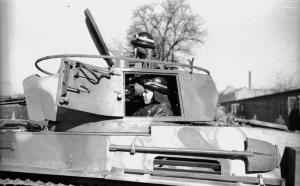
Toldi I. A pesar de ser un carro de combate de apreciables características, su cañón de 20 mm. es demasiado limitado como para ser usado en batallas entre blindados.

Como nueva aliada del III Reich, Hungría decide lanzar su Grupo de Ejército de los Cárpatos, bajo mando del teniente general Ferenc Szombathelyi, contra la URSS el 1 de julio de 1941 (bajo dependencia operativa del Grupo de Ejércitos Sur del mariscal Gerd von Ründstedt). Los Toldi estarán encuadrados en su Gyorshadtest o Cuerpo de Ejército Móvil (1ª Brigada Motorizada, 2ª Brigada Motorizada y 1ª Brigada de Caballería). Cada una de estas brigadas dispone de un batallón de reconocimiento, con diversos modelos de blindados más los Toldi I.

El 13 de julio de 1941 el 9º Batallón Acorazado del la 1ª Brigada Motorizada entra en combate con elementos del RKKA cerca de Antonovka. El Toldi del jefe de unidad es alcanzado por fuego de una pieza contracarro y al acabar la jornada otros 6 Toldi son destruidos igualmente.

En su progresión a través de Ucrania sus tripulaciones se verán involucradas en combates entre blindados, principalmente contra los T-26 y BT. Pero este diseño húngaro puede ofrecer sólo maniobrabilidad y, por contra, poca potencia de fuego y blindaje (33 mm. de espesor de coraza en su parte frontal y 13 mm. en la lateral). No siendo estos modelos del RKKA (Ejército Rojo) especialmente notables, pero al contar ellos con el cañón estándar de 45 mm., los Toldi no pueden competir. Participarán en combates junto a la 16. Panzer Division (Generalmajor Hans-Valentin Hube) y la Waffen SS Leibstandarte Adolf Hitler (Obergruppenführer-SS Josef «Sepp» Dietrich) en la zona de Kharkov. La tasa de pérdidas será prohibitiva y así, para 1942, los Toldi supervivientes serán relegados a tareas de reconocimiento, servicio para el cual su radio demostrará ser idónea para la transmisión de los movimientos adversarios…


¿Te ha resultado de interés este artículo? Deja tu comentario abajo…

¡Adquiere la obra cronológica Barbarroja 03:00h en edición de coleccionista!


Comprar Ahora Button

Sigue interesantes referencias también en Twitter @barbarroja0300h


——————————-[English version]——————————

BARBAROSSA’S MACHINES


LIGHT TANK 38.M TOLDI

toldi hungarian tank turret detail
Turret detail of the Hungarian light tank TOLDI. The type is designed for a crew of 3 men: Commander, gunner and driver.

The Hungarian light tank Toldi is named after the famous XIV century medieval knight, Miklos Toldi. The design derives from a license-built Swedish type, the Landsverk L-60 (one of the world’s most advanced designs in 1934) and is tested in 1937. Being Czechoslovakia the assessed threat to Hungary at the time, the Military is just satisfied with a light tank design for its armoured forces and it is fitted with a small 36M 20mm. gun. Crewed by 3 men, it is also equipped with a 30 km. range radio set.

In December 1940, the Hungarian Regent, Admiral Miklos Horthy and Adolf Hitler are bound by a treaty of constant peace and eternal friendship between the two countries. Based on this and a «bizarre» air raid suffered on the Hungarian city of Kassa on June 26th (allegedly by the Stalinist Aviation), Hungary joins the struggle against the Bolshevism. On this very same day the Hungarian Air Force ((Magyar Királyi Honvéd Légierő (MKHL)) bombs Stanislav (today Ivano-Frankivsk). The war will be declared to the USSR on the 27th.

toldi diagrams
Toldi tanks I and II.

In the first quarter of 1941, the 38.M Toldi changes its name into Toldi I. For Operation Barbarossa Hungary’s participation will count on 81 units ready for action (Toldi I). It proves then to be a maneuverable, fast and light tank in the battlefield. However, its 20mm. gun is totally ineffective versus T-34’s and KV’s. This is its major shortfall. However, even though other upgunned versions will follow, Toldi II’s and III’s, their lack of effective fire-power will be almost a constant.

As a III Reich‘s new ally, Hungary decides to launch its Carpathian Army Group, under Lieutenant-general Ferenc Szombathelyi‘s orders, against the USSR on the 1st of July 1941 in support of  Hitler’s Operation Barbarossa. This force is in turn under von Ründstedt’s Army Group South and the Toldi’s will be fielded in its Gyorshadtest or Mobile Corps (1st Motorized Brigade, 2nd Motorized Brigade and 1st Cavalry Brigade). Each one of the brigades counts with a recconaissance battalion with different types of armour plus the Toldi I.

On the 13th of July 1941, the 9th Armoured Batallion of the 1st Motorized Brigade engages the RKKA (Red Army) near Antonovka. The unit commander’s Toldi is hit by an anti-tank cannon and at the end of the day six additional  Toldi‘s are taken out too.

During their combat duty across the Ukraine their crews will experience tank versus tank action, mostly against T-26’s and BT’s, where their best maneuverability and performance will be tested. Nevertheless, they will always be outgunned and almost defenseless lacking adequate protective armour (33 mm. on the front quarter and 13 mm. on the sides). These Soviet tanks are outdated at Barbarossa start, but their standard 45 mm. gun makes the Toldi vulnerable at a good distance. The Hungarian light tank will participate in combats in the area of Kharkov, along with the 16. Panzer Division (Generalmajor Hans-Valentin Hube) and the Waffen SS Leibstandarte Adolf Hitler (Obergruppenführer-SS Josef «Sepp» Dietrich). Its attrition rate will be unacceptably high and by 1942 the remaining Toldi’s will be relegated to the reconnaissance role. For this task, its radio set will prove helpful to report enemy troop movements…


Did you find this article interesting? Leave your comments below…

Follow other articles in Twitter @barbarroja0300h