Kliment Voroshilov KV-2

[English version at the end]

MÁQUINAS DE BARBARROJA

¡Ya a la venta Barbarroja 03:00 hrs!


CARRO DE ASALTO PESADO KLIMENT VOROSHILOV KV-2
KV-2
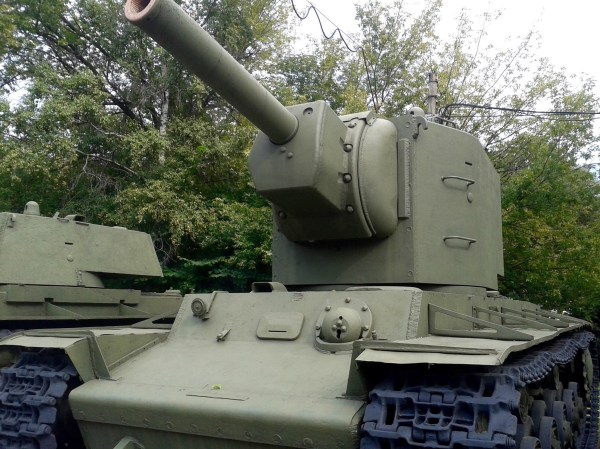
KV-2 la solidez del carro de combate es evidente así como el ancho de su tren de rodadura, indispensable para la masa que desplaza en el escenario de batalla de la URSS. Museo de las Fuerzas Armadas de la Federación Rusa, Moscú. [Cortesía Pablo G. Romero]

El programa de construcción KV es decidido por el Comité de Defensa de la URSS el 19 de diciembre de 1939, siendo la fábrica de Kirov-Leningrado la responsable de la producción inicial de prototipos. Responde el diseño de estas máquinas súperpesadas al concepto doctrinal del Ejército Rojo de la «batalla en profundidad». En síntesis, carros de combate fuertemente artillados y acorazados, capaces de penetrar incólumes en las defensas y retaguardias adversarias. En estos momentos la URSS está en guerra contra Finlandia, conflicto del que enseguida se empiezan a extraer enseñanzas operativas. Las pruebas comienzan en febrero de 1940 bajo la dirección del ingeniero jefe Kotin.

El nuevo vehículo KV-2 mide 3,3 metros de alto (comparado con los 2,7 metros del KV-1) y pesará 52 toneladas en los modelos ulteriores de serie. El equipo de diseño decide compensar la desventaja táctica de su descomunal volumen con un grosor de coraza nunca visto hasta el momento: 75 mm. de blindaje. Tal masa, no obstante, le hace víctima de una falta de movilidad notable en el campo de batalla como pronto se constatará.
KV-2 dibujo
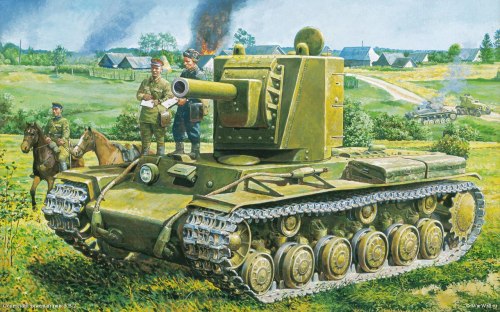
El tamaño descomunal del vehículo es evidente en relación a uno de los sirvientes en pie junto a la torreta. Esto es una desventaja, pero en el escenario de 1941 ni el PaK 35/36 de 3,7 cm. ni el PaK 38 de 5,0 cm. tenían ninguna posibilidad contra él.

Durante la experiencia de dicha “Guerra de invierno” de 1939-40, se decide proyectar una variante del modelo Kliment Voroshilov KV-1, capaz de portar un obús efectivo contra fortines y otras defensas. En la mencionada planta Kirov se diseñan tres prototipos, el U-0, U-1 y U-3 con un impresionante obús M-10 de 152 mm. y el U-2 con el cañón de 76 mm. Antes de alto el fuego con Finlandia se envían los prototipos a primera línea (istmo de Carelia) y se empiezan a detectar los primeros problemas de esta serie de carros de combate tan pesados. En esencia, sobrecalentamiento de la planta motriz y un sistema de transmisión y caja de cambios deficiente. Enseguida el prototipo siguiente U-5 será revisado en todo su mecanismo. No obstante, la producción final nunca se librará totalmente de estos fallos. La planta de Kirov siempre estará empeñada en la corrección de deficiencias de estos vehículos y desde marzo de 1941 (a tres meses de la Operación Barbarroja), entre un sinfín de mejoras, se decide la instalación de un motor diésel V-5 de 600 C.V.

Al comienzo de Barbarroja la inteligencia militar de la Wehrmacht desconoce de la existencia de este carro de combate y constituirá el KV-2, como es el caso del KV-1 y del T-34, una amarga sorpresa para la Panzerwaffe (Arma Acorazada). El episodio de los combates en Raseiniai (junio de 1941) da testimonio de la solidez de este monstruo de 53 toneladas. Pero en números relativos, no hay muchos de estos colosos. De los 29 cuerpos mecanizados (Mekhanizirovannye Korpusy) y 7 divisiones acorazadas independientes (Tankovye Divizie) en el orden de batalla del RKKA (a 22 de junio de 1941), sólo existen en plantilla 831 modelos KV. 18 de estos cuerpos y ninguna de estas divisiones independientes están ni siquiera equipados con los KV. Compárese esta cifra con el total de más de 18.000 carros de combate de todos los tipos en los distritos militares occidentales al comienzo de la campaña de invasión de Hitler, para entender el escaso número relativo de ellos en servicio. El mejor dotado de estos es el 6º Cuerpo Mecanizado, que de sus 1.021 carros de combate, 228 son tipos KV. Es la unidad del general-maior Mikhail Gueorguievich Khastkilevich (10º Ejército / Distrito Especial MIlitar Occidental).

El incidente de Raseiniai

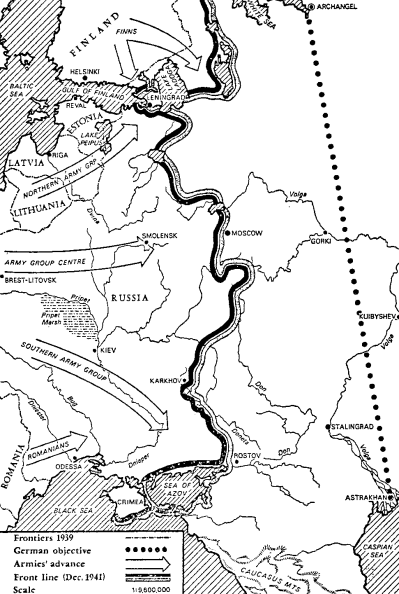
Es literalmente invulnerable al fuego de las armas contracarro germanas incluso a quemarropa. La única posibilidad es intentar inmovilizar el carro de combate con disparos al tren de rodadura o bien el uso de obuses en tiro directo con munición especial perforante o el empleo del excelente cañón FlaK 18/36 de 8,8 cm. Aún así la mayoría de las pérdidas de los KV-2 se deberán no al fuego alemán sino a averías o falta de combustible. La mayor parte del material gráfico publicado sobre este gigante acorazado es de fuentes alemanas al capturar muchos vehículos abandonados en las condiciones mencionadas.
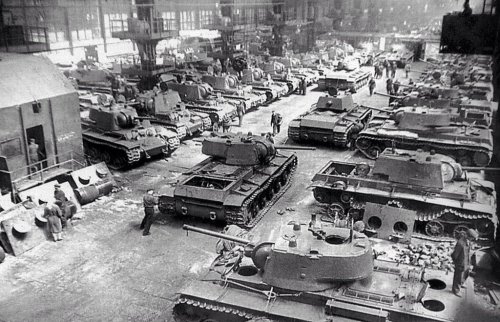
fábrica Chelyabinsk
Fábrica de blindados Kliment Voroshilov en la ciudad de Chelyabinsk. Conocida popularmente como «Tankogrado», en la foto se aprecian modelos KV-1 en diversas fases de montaje. El traslado de toda la industria de la Rusia europea en el verano de 1941 más allá de los Urales, es uno de los hechos más singulares de la historia en lo que se refiere a redistribución estratégica de recursos bélicos.

A finales de agosto de 1941, el Grupo de Ejércitos Norte del mariscal de campo von Leeb amenaza directamente la gran ciudad de Leningrado desde el sur. Los finlandeses lo hacen por le norte. Es entonces cuando El GKO (Comité de Defensa del Estado) decide en última instancia el traslado de la fábrica Kirov a la ciudad de Chelyabinsk (será popularmente conocida como «Tankogrado»), más allá de los Urales. Esto produce un consecuente impacto en la producción en un momento crítico de los combates, pero la planta de Kirov seguirá activa, pues en septiembre de 1941 aún se las arregla para suministrar al RKKA (Ejército Rojo de Trabajadores y Campesinos) 81 carros de combate. Esto es en un momento en que la capital cultural de Rusia se encuentra bajo asedio y cercada, de no ser por los suministros que le llegan a través del lago Ladoga o por aire. No obstante, en octubre la producción baja a una treintena de unidades de todos los tipos KV. Para final de año, en los peores momentos del cerco de Leningrado y estando la urbe sometida a castigo aéreo y artillero, 811 máquinas KV salen de la planta Kirov, de las que 100 son KV-2.

Un buen número de ellos caerán en manos germanas. Serán enviados a Berlín para su evaluación y se les modificará con la adición de una cúpula de PzKpfw III para el comandante y serán incorporados al inventario de la Wehrmacht con la designación (Sturm)Panzerkampfwagen KV-II 754(r)


Video cortesía de @Panzerpicture KV-2


¿Te ha resultado de interés este artículo? ¿Querrías conocer los detalles de esta y las demás operaciones?

¡Adquiere la obra cronológica Barbarroja 03:00h en edición de coleccionista!


Comprar Ahora Button

Deja tu comentario abajo y suscríbete a CONQUISTAR RUSIA punteando en la opción «SEGUIR / FOLLOW» a la izquierda de la página


[English version]

BARBAROSSA’S MACHINES


HEAVY ASSAULT GUN KLIMENT VOROSHILOV KV-2
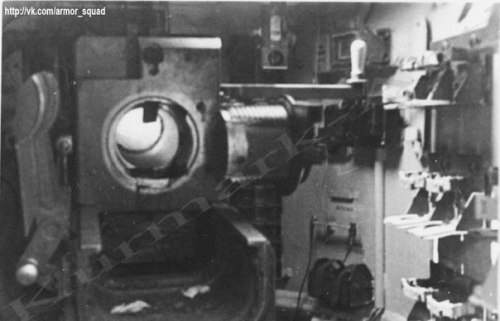
A view from the gunner’s post inside a KV-2

The KV program is decided by the USSR Defence Committee on the 19th of December, 1941, being the Leningrad-Kirov factory the one appointed for the initial production of prototypes. This type of machines are meant to respond to the Red Army doctrinal concept of «deep battle». In synthesis, a heavily armoured fighting vehicle with high firepower, capable to survive a break through the enemy defenses. At this time the USSR is at war against Finland, a conflict that is teaching valuable operative lessons. The tests commence in February, 1940 under the direction of the chief engineer Kotin.

The new vehicle KV-2 is 3.3 meters tall (compared to the 2.7 meters of the KV-1) and will weigh 52 tonns in the further series versions. Being this notable size a tactical disadvantage, the engineering team decides to balance this fact with a thickened armour second to none: a frontal and lateral 75 mm. armor plate. But this mass will make it sluggish in the battlefield with many transmission system problems, as very soon the operational evaluations will prove.

During the aforementioned russo-finnish “Winter War” in 1939-40, it is decided to begin the project of a KV-1 variant, capable of carrying a large caliber howitzer powerful enough to take out bunkers and other fortified defenses. Three prototypes are designed in the Leningrad-Kirov plant, the U-0, U-1 and U-3 fitted with the impressive 152 mm. M-10 howitzer and the U-2 with a 76 mm. gun. Before the ceasefire with Finland the prototypes undergo a combat test and are sent to the frontline (Carelian Isthmus) where soon the first mechanical deficiences are detected. In essence, they suffer from engine overheating and troublesome transmission and gear-box systems. The next U-5 is consequently troubleshot thoroughly. But all in all the series production will always suffer from these shortcomings. As a matter of fact the Kirov factory will never cease to work on these issues and in March, 1940 (just 3 months before Operation Barbarossa), after endless enhancements, the 600 H.P. V-5 diesel powerplant is installed in these tanks.
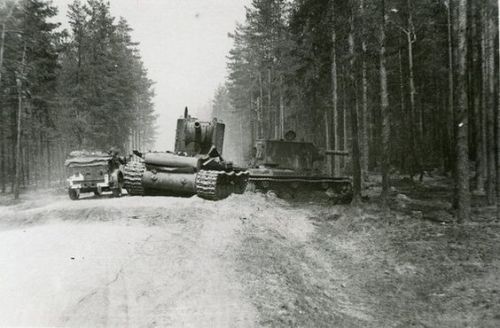
Somewhere in the ex-Baltic republics a Horch command vehicle bypasses two abandoned KV-2’s during the Wehrmacht onslaught in summer, 41 (Army Group «North»). The picture clearly shows the relative sizes between them.

At “Barbarossa” start the German Military Intelligence is unaware of the existence of this juggernaut, as well as of the KV-1 and the T-34, all of them becoming immediately a nasty surprise for the Panzerwaffe (Armoured Arm). It is literally invulnerable to any german anti-tank fire even at point-blank range. The only chance for the Wehrmacht is to try to immobilize it with shots in its tracks or the use of high calibre howitzers in direct fire employing special piercing shells or the use of the outstanding Flak 18/36 8.8 cm. cannon. Nevertheless, most of the KV-2 losses are due not to enemy fire, but to mechanical breakdowns or fuel starvation. Most of the KV-2 published graphic material come from German hands with units of this model captured after such events.

The battle for Raseiniai episode is a clear example of the strengh of this 53-ton monster. But there are not many of these colossus in relative numbers. Out of the 29 armoured corps (Mekhanizirovannye Korpusy) and 7 independent armoured divisions (Tankovye Divizie) in the RKKA‘s order of battle (22nd of June, 1941) there are only 831 KV types. 18 of these corps and none of the independent divisions count on them. The relative numbers are evident when compared this latter figure with the more than 18,000 tanks fielded in the Stalin’s western districts by the commencement of the USSR invasion campaign. The best fitted of those is the 6th Armoured Corps under general-maior Mikhail Gueorguievich Khastkilevich (10th Army / Western Special Military District).

The Raseiniai event

In this case, a captured KV-2 is put back in service fielded by a Panzerdivision, after being retrofitted.The new commander’s cuppola is evident. It is the (Sturm)Panzerkampfwagen KV-II 754(r).

By the end of August, 1941, Field Marshall von Leeb‘s Army Group North directly threatens the enclave of Leningrad from the south. The Finns are blocking the northern access. Under these circumstances the GKO (State Defence Comitte) orders the evacuation of the Kirov factory to Chelyabinsk (popularly known later as «Tankograd«). This decision degrades obviously the production rythmn in the climax of the fight, but the facility will still be able to supply the RKKA (Red Army of Workers and Peasants) with 81 units. A figure to take into account as the cultural capital city of Russia is under siege (except by the nimble Lake ladoga supply lines). However, in October, 1941 the production will fall to just 30 machines (of all KV types). By the end of the year, in the worst moments of the Leningrad blocade 811 KV’s roll out from the production chain, including 100 KV-2‘s.

Watch this video courtesy @Panzerpicture KV-2

A good number of them will fall in German hands. They will be sent to Berlin for testing. They will be modified with a PzKpfw III commander’s cuppola and then fielded in some Panzer divisions renamed as (Sturm)Panzerkampfwagen KV-II 754(r)


Did you find this article interesting? If so leave your comments below and follow us clicking on «SEGUIR / FOLLOW» at the left of the page

Volver

Se ha enviado tu mensaje
Advertencia
Advertencia
Advertencia

¡Aviso!


HÖPNER, ERICH. GENERALOBERST

[English version at the end]

PROTAGONISTAS DE BARBARROJA

¡Ya a la venta Barbarroja 03:00 hrs!

TENIENTE GENERAL ERICH HÖPNER (1886  – 1944)

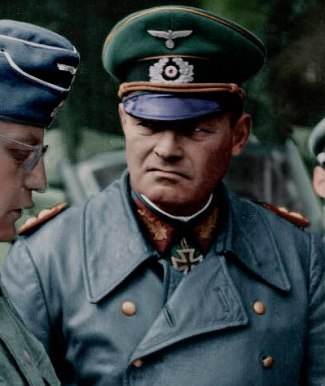
Generaloberst Erich Höpner durante la Operación Barbarroja conferencia con el comandante de la  Waffen-SS Polizeidivision. A pesar de mostrar su oposición frontal a las obligaciones del Tratado de Versalles, que obligaba a Alemania a gravosas reparaciones de guerra tras la Primera Guerra Mundial, también la muestra contra Adolfo Hitler. Esto y tras su cese por contravenir órdenes en el campo de batalla (Operación Taifun) y sus actividades subversivas contra la persona del Führer, le harán caer en desgracia, reservándole la historia un destino fatal.

Der alte Reiter (el Viejo Caballero) como se le llega a conocer, comienza su carrera operativa en la Primera Guerra Mundial como oficial de estado mayor del 16º Cuerpo de Ejército. En el periodo de entreguerras será uno de los pocos en integrar el Reichswehr en una sección del Ministerio de la Guerra de inspección de caballería. En abril de 1939 será promovido al empleo de general de caballería (General der Kavallerie) y destinado al 16º Cuerpo Motorizado.

Al comenzar la Segunda Guerra Mundial participa en la campaña polaca y francesa, concluida la cual será ascendido a teniente general (Generaloberst), habiendo ocupado el puesto de jefe del estado mayor del mariscal de campo Rundstedt.

Desde febrero de 1941 ostenta el mando del 4. Panzergruppe, el cual para el inicio de la campaña de invasión de la URSS, Operación Barbarroja, será asignado bajo dependencia operativa del Grupo de Ejércitos Norte del Mariscal von Leeb. Su misión: la captura de Leningrado a través de las antiguas repúblicas bálticas. Sus fuerzas consisten en:

XLI. Armeekorps (mot.)> Reinhardt

-1. Panzer Division

-6. Panzer Division

-36. Infanterie Division (mot.)

-269. Infanterie Division

LVI. Armeekorps (mot.)>Manstein

-8. Panzer Division

-3. Infanterie Division (mot.)

-290. Infanterie Division

(Reservas: Waffen-SS Motorisierte Division «Totenkopf»)

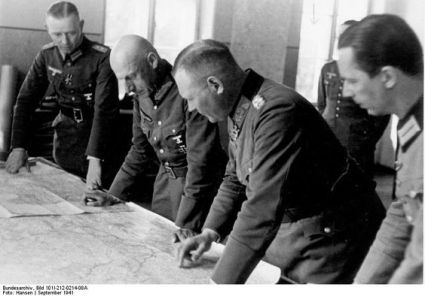
El mariscal de campo von Leeb y el teniente general Erich Höpner tratan los detalles del asalto a Leningrado en septiembre de 1941. Von Leeb, jefe del Grupo de Ejércitos Norte, a sabiendas de que se le va a desposeer de los Panzer de Höpner y del VIII. Fliegerkorps, intentará una embestida final con estas tropas a la gran urbe. [Cortesía Bundesarchiv]

Su progresión a través de las ex-repúblicas bálticas, Lituania, Letonia y Estonia, ahora todas ellas territorio de la URSS desde su ocupación militar en el invierno 1939-40 (en virtud de las cláusulas secretas del Pacto de No-Agresión Hitler-Stalin), no va a estar exenta de serias reacciones del Frente Noroccidental (Kuznetsov). Sus Panzer serán la punta de lanza encargada de tomar los pasos sobre el río Dvina Occidental a toda velocidad, penetrando a través de 3 ejércitos del adversario (, 11º y 27º). No pierde de vista que su objetivo final (Directiva nº 21 del Führer) es Leningrado y Arkhangelsk. Este último enclave constituye la última y deseada línea geográfica (Arkhangelsk-río Volga) de ocupación en territorio ruso.

En tiempo récord captura los puentes sobre el río Niemen, con tanta presteza que aún están intactos y sin respiro y sin cuidarse de la protección de sus flancos, sigue hacia adelante. Pero no va a ser un paseo militar. La primera crisis la va a tener que sortear en la región de Raiseniai, hacia donde Kuznetsov pretende enviar una tenaza acorazada para estrangular el avance de los Panzer. Así pues su 6ª División Panzer recibe la embestida de la 2ª División Acorazada del RKKA, cuando los primeros intentan sortear el río Dubissa y se ven obligados a replegarse en circunstancias muy adversas hacia Raiseniai. Es aquí donde se encuentran por primera vez con un modelo de carro de combate secreto: el Kliment-Vosroshilov, una máquina de 52 toneladas contra la que los blindados y la artillería contracarro germana son impotentes.

daugavpils aerofotografia
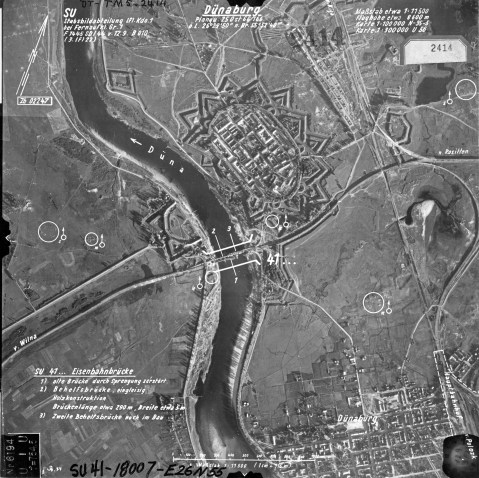
Aerofotografía de la Luftwaffe del enclave de Daugavpils. Es uno de los principales pasos sobre las aguas del Dvina Occidental y la primera cabeza de puente capturada por las tropas de Höpner.

Resuelta la crisis en Raiseniai, no sin pérdidas importantes, alcanza fulgurante el curso del Dvina Occidental y se establece en dos cabezas de puente  (Jekavpils y Daugavpils). La primera etapa de su misión está cumplida. El general Lelyushenko intenta en vano destruir esas cabezas de puente, pero los germanos han sido demasiado rápidos antes de que el soviético haya tenido tiempo de consolidarse tras las aguas del Dvina.

Los riesgos siguen presentes, ya que el RKKA se las arregla para lanzar nuevas unidades a la batalla. Ya en la región del este del lago Pskov (sector de Soltsy), su 8ª División Panzer avanza tan velozmente y en solitario, que esta vez el Ejército Rojo consigue coparla. Su jefe, Brandenburger, tendrá que dar media vuelta y forzar una retirada desesperada con grandes pérdidas. Milagrosamente se salva de la aniquilación completa gracias a la intervención, entre otras unidades, de la Waffen SS Motorisierte Division “Totenkopf”. Tras la batalla la 8ª de Panzer quedará en retaguardia.

Höpner fuerza la línea del Luga (este del lago Pskov) y última línea defensiva del General Popov (Frente Norte). Es el 14 de julio de 1941 cuando Reinhardt, jefe del XLI Cuerpo de Ejército (motorizado), se establece a sangre y fuego en una cabeza de puente, pero de repente llegan órdenes de un parón operativo. Leningrado parece tan cercano, que sus comandantes se exasperan aguardando y viendo impotentes pasar la oportunidad que se les podría brindar. Reinhardt se desespera contando cómo los días pasan sin recibir órdenes de reanudar el asalto (la luz verde llegará el 8 de agosto). Finalmente llegará a las puertas de Leningrado. Pero Hitler no autorizará la toma de la gran urbe. El 6 de septiembre de 1941, el Führer del III. Reich emite la instrucción número 35 (Weisung nummer 35) para detener la ofensiva a gran escala sobre Leningrado del Grupo de Ejércitos Norte y asignar los Panzer de Höpner al Grupo de Ejércitos Centro como refuerzo para la ofensiva sobre Moscú. No obstante von Leeb contará con un número importante medios blindados hasta la mitad de septiembre. Leningrado será sometida a asedio…Durará 900 días…

En diciembre de 1941, en el momento cumbre de la batalla de Moscú, incumplirá las órdenes del Führer de resistir en las posiciones a toda costa e iniciará por su cuenta una retirada. Caerá en desgracia. El 8 de enero de 1942 será relevado del mando de su Panzergruppe. Involucrado en la trama de intento de asesinato de Hitler del 20 de julio de 1944, será arrestado, juzgado y condenado a morir en la horca.

¿Te ha resultado de interés este artículo? ¿Querrías conocer los detalles de esta y las demás operaciones?

¡Adquiere la obra cronológica Barbarroja 03:00h en edición de coleccionista!


Comprar Ahora Button

Deja tu comentario abajo y sigue CONQUISTAR RUSIA punteando en la opción «SEGUIR / FOLLOW» a la izquierda de la página


[English version]

BARBAROSSA’S PROTAGONISTS

COLONEL-GENERAL ERICH HÖPNER (1886  – 1944)

hoepner-color
Colonel-General Höpner in the summer, 1941 somewhere in the ex-Baltic Republics during his advance towards Leningrad. First mission: to take the passes over the Dvina river.

As known as «Der alte Reiter» (the Old Knight) Colonel-General Erich Höpner starts his operational career during World War I as a staff officer in the 16th Army Corps. In the inter-war period he will be one of the few to belong to the Reichswehr in the Cavalry Inspection, a part of the Ministry of War. In April, 1939 he will be promoted to Cavarly General (General der Kavallerie) and assigned to the 16th Motorized Corps. At the start of World War II Höpner will participate in the Polish campaign (1939) and in the French one (1940). Once both victoriously concluded he will become Colonel-General (Generaloberst) having occupied the job of Chief-of-Staff in Field Marshall von Rundstedt‘s headquarters.

Since February, 1941 he is in command of the 4. Panzergruppe, part of Field Marshall von Leeb’s Army Group North at the start of Operation Barbarossa. His mission: the capture of the historical city of Leningrad (today Saint Petersburg) through the old Baltic Republics. He counts on the follwing forces:

XLI. Armeekorps (mot.)> Reinhardt

-1. Panzer Division

-6. Panzer Division

-36. Infanterie Division (mot.)

-269. Infanterie Division

LVI. Armeekorps (mot.)>Manstein

-8. Panzer Division

-3. Infanterie Division (mot.)

-290. Infanterie Division

(Reserves: Waffen-SS Motorisierte Division «Totenkopf»)

Hoepner, Reinhardt, von Schoen Angerer
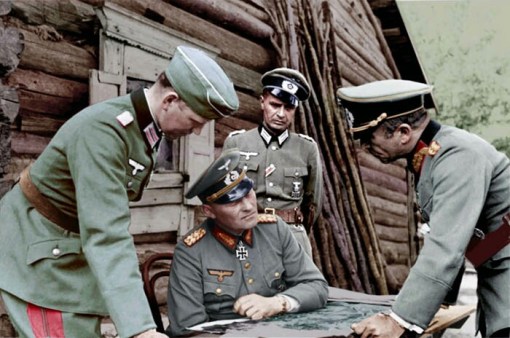
(left to right) Colonel-General Erich Höpner, General der Panzertruppe Reinhardt (41st Mot. Army Corps) and Major Schön-Angerer (Operations Officer Ia). Reinhardt will be the first to force the Luga defensive line just to be ordered to halt in hastily defended bridgeheads. Many days will pass before he is given again a «go» to resume the offensive against Leningrad.

His advance through the ex-Baltic Republics, Lithuania, Latvia and Estonia, now USSR territory after its military occupation in the winter, 1939-40 (by virtue of the Non-Aggression Pact‘s secret protocols, agreed between Hitler and Stalin), Höpner will face several serious Soviet counterattacks from Kuznetsov’s Northwestern Front. The German is the armoured spearhead in charge of taking bridgeheads over the Western Dvina river at full speed. He will make his way across 3 Soviet armies (8th, 11th and 27th). Höpner has in mind his final objectives as per the Führer’s Directive no. 21, Leningrad and Arkhangelsk. The latter is the final and desired geographical line (Arkhangelsk-Volga river) to be secured in «Mother Russia».

He swiftly captures the still intact bridges over the Niemen river and without respite and no major concerns about his exposed flanks, continues racing forward. But things won’t be then as easy. Der alte Reiter will sort out his first crisis in the area of Raiseniai, where Kuznetsov pretends to pincer Höpner in order to strangle his advance. His 6th Panzer Division will endure the assault of the RKKA’s 2nd Armoured, when the former attempts to cross the Dubissa river. The situation becomes immediately critical as they are forced back again towards Raiseniai. Here Höpner‘s men fight off a new secret tank model: The Kliment-Voroshilov type, a 52-ton juggernaut. None of his Panzer and antitank cannons have any chance against them.

Once sorted out at Raiseniai with severe losses, he will capture two bridgeheads over the Western Dvina river (Jaukavpils and Daugavpils). The first stage of his mission is accomplished. RKKA General Lelyushenko tries to destroy these bridgeheads but to no avail, as the Germans have been too fast. Leluyshenko has simply have no time to consolidate his defenses behind the waters of the large river.

daugavpils arde
Daugavpils is direct witness of the battle for the Dvina river bridgehead. Lelyushenko versus Höpner.
t-26-12mk-riga
Street fighting in Riga. A destroyed T-26 belonging to the 12 Mekhanizirobannyj Korpus (mechanized corps) blocks the tram rails. One of its crewmembers is seen killed in action. Actually these men taking the capital city of Latvia belong to the 18th Army, the «slow» infantry progressing on Höpner’s left flank.

Nevertheless the risks for the advancing Colonel-General are still looming because the RKKA manages to throw into the fray new fresh units out of the reserves. Due east of lake Pskov (Soltsy sector), his 8th Panzer Division advances too quickly and alone that this time the Red Army manages to encircle it. Under Branderberger’s command, the division of tanks will force his way back to its own lines with high losses (miraculously without being fully annihilated), thanks to the help, amongst others, of the Waffen SS Motorisierte Division “Totenkopf”. After the desperate encirclement battle the Panzer unit will remain in the rearguard for rest and refit.

Hoepner in Volksgerichtshof
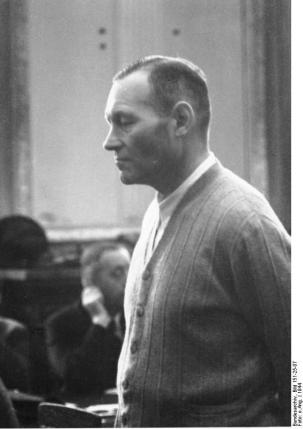
Erich Höpner, sacked from the Wehrmacht is being tried in August 1944 under charges of having participated in the assassination complot against the German Führer. He will be sentenced to death and hanged in the Plötzensee prison (Berlin) on the 8th of August 1944. [Courtesy Bundesarchiv]

However Höpner will pass the Luga line, the last defensive line of General Popov (Northern Front). It is actually his Commander of the 41st Motorized Army Corps, Reinhardt, who furiously establishes himself on bridgeheads over the Luga river. But suddenly new orders arrive for an operational halt. It is the 14th of July, 1941. Reinhardt desperately counts the passing days losing his opportunity to enter in the historical enclave (the «green light» will come on the 8th of August). Höpner‘s Panzer commanders enrage already seeing Leningrad at the reach of their hands. Eventually they will advance up to the gates of Leningrad when the offensive is reassumed. But then Hitler orders a stop in order to besiege the city. The city cradle of Bolshevism will not be assaulted, but razed. On the 6 of September, 1941 Hitler issues his instruction (Weisung nr. 35) to stop the full-scale advance of Army Group North onto Leningrad and to send Höpner‘s 4th Panzer Corps to strengthen Army Group Center‘s offensive on Moscow. Nevertheless, many of the Corps’ tanks will remain at Leeb’s disposal up to the second half of September. Thus Leningrad becomes under siege. …it will last 900 days…

In December, 1941, during the apex of the Battle for Moscow, Colonel-General Höpner will ignore Hitler‘s orders to stand fast ordering a retreat in desperate circumstances. He will fall in disgrace. On the 8th of January, 1942 he is relieved from Command. Under charges of having participated in the assassination attempt of Hitler on the 20th of July, 1944, he will be arrested and tried. History will spare for him a tragic fate.

Did you find this article interesting? Leave your comments below and follow us clicking on «SEGUIR / FOLLOW» at the left of the page

Volver

Se ha enviado tu mensaje
Advertencia
Advertencia
Advertencia

¡Aviso!

POPOV, Markian Mikhailovich. General-leitenant.

[English version at the end]

PROTAGONISTAS DE BARBARROJA

¡Ya a la venta Barbarroja 03:00 hrs!

TENIENTE GENERAL MARKIAN MIKHAILOVICH POPOV (1902 -1965)

popov jefe distrito militar leningrado
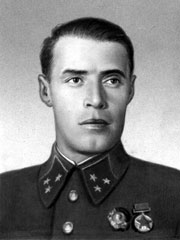
Teniente general Markian Mikhailovich Popov es el jefe del Distrito MIlitar de Leningrado. Los diferentes distritos militares en los que se dividen las regiones militares de la URSS cambian de designación tras el inicio de la Operación Barbarroja y se constituyen en «frentes». El suyo adopta la designación inicial de Frente Norte el 24 de junio de 1941.

De la plantilla de generales rusos quizá sea uno de los grandes desconocidos, por no tomar parte inmediata en los combates de la campaña de invasión de la URSS ordenada por Adolfo Hitler. Se alista como voluntario en el RKKA (Ejército Rojo de Trabajadores y Campesinos) en 1920 en plena guerra civil rusa, combatiendo en el Frente Occidental y se une un año después al Partido Comunista. Es herido en combate. Se gradúa en la prestigiosa academia militar del RKKA de Frunze en 1936 y pasa destinado a tropas mecanizadas.

Al comienzo de la Operación Barbarroja ejerce el mando del Distrito Militar de Leningrado, cargo que ostenta desde el mes de enero de 1941. Tal designación administrativa se transforma al comienzo de las hostilidades por la más operativa de Frente Norte. Un «frente» equivale aproximadamente a un grupo de ejércitos de la Wehrmacht. En este olvidado, pero no menos importante sector del vasto teatro de operaciones soviético, ejercerá Popov su mando en una extensa línea de frente que transcurre desde el Mar Blanco, combatiendo a las tropas alemanas en Noruega y hacia el sur, hasta el istmo de Carelia a los finlandeses y aún más al sur de Leningrado, al Grupo de Ejércitos Norte del mariscal von Leeb.


El orden de batalla a 22 de junio de 1941 es el que sigue:

7º Ejército (Finlandia, teniente general F. D. Gorelienko)
14º Ejército (Murmansk, teniente general V. A. Frolov)
23º Ejército (Viborg, teniente general P. S. Pshennikov)
PVO <> Defensa Anti-aérea (Leningrado, general de brigada F. Ya. Kryukov)
VVS <> Fuerza Aérea Frontal (Leningrado, general de brigada A. A. Novikov)

leningradskij voenyj okrug
Escudo de armas del Distrito Militar de Leningrado. La región militar comprende una extensa área que engloba desde la península de Kola hasta la isla de Nueva Zembla y más al sur, regiones adyacentes a los Urales.

La fuerza aérea de la que dispone el teniente general Popov totaliza unos 1.500 aviones, como arriba mencionado, al mando de Novikov. Una fuerza esta indudablemente a tener en cuenta, pero en su inmensa mayoría se compone de aparatos anticuados Polikarpov I-15 e I-16 entre los de caza y los Tupolev SB, DB-3 y TB-3, entre los de bombardeo. Tal fuerza queda dislocada en aeródromos cubriendo el suroeste de Leningrado, próximos a Pskov, Novgorod, Lish y Gatchina, pero también al norte de Leningrado y el istmo de Carelia. En cuanto a la defensa anti-aérea (PVO) de la capital cultural de Rusia, recibe Popov un importante empuje al incorporar en plantilla nuevas y potentes piezas de 85 mm.

Desde la finalización de la «Guerra de Invierno» contra Finlandia en 1940, el Leningradskij Voyenno Krug <> Distrito Militar de Leningrado construye tres sectores defensivos en su zona norte (istmo de Carelia), obras iniciadas desde el otoño de 1940. Estos están en Viborg, Keksgolm y Sortaval. La idea es impedir cualquier progresión de los fineses hacia Leningrado y Petrozavodsk. No obstante, para el comienzo de las operaciones de Barbarroja, las defensas distan mucho de estar acabadas y son deficitarias en armamento contracarro. También en la zona suroccidental del Distrito (Pskov y antigua frontera con Estonia), las zonas defensivas tienen aún poca entidad.

El teniente general Popov es sorprendido por la Operación Barbarroja el 22 de junio de 1941 a las 03:00 horas (Berlín) en Petrozavodsk de regreso a Leningrado, tras una visita a la Flota Norte; pero no será hasta su arribada a Leningrado cuando reciba noticias de que la guerra con Alemania ha comenzado. Exactamente a esa hora aeroplanos de la Luftwaffe sobrevuelan la base de la Flota Norte en Polyarny. No obstante Markian Mikhailovich Popov no tiene que lamentar daños por ataques aéreos ni en Leningrado, ni en otros objetivos importantes de su Distrito Militar. El principal frente de batalla de la campaña de invasión de la URSS se concentra por el momento en la antigua república Lituana, Bielorrusia y Ucrania. A su llegada por fin al cuartel general, Popov no tarda en recibir una directiva ordenando llevar a cabo ataques aéreos contra aeródromos del adversario y concentraciones de tropas, aunque la directiva no permite acciones ofensivas ni contra Finlandia ni Rumanía.

Respecto a su adversario del norte, las tropas finesas del mariscal Mannerheim, el jefe del Frente Norte estima que el grueso de estos efectivos se concentran en el istmo de Carelia y la región adyacente a Petrozavodsk (12-14 divisiones de infantería y otras 4-5 brigadas). Iniciada la Operación Barbarroja, Popov se extraña de que Mannerheim no se lance a la vez a la ofensiva junto con la Wehrmacht de manera coordinada. Al final del 22 de junio, todas las fuerzas del Distrito Militar de Leningrado están ocupando ya puestos defensivos a la espera de órdenes ulteriores.

rio luga
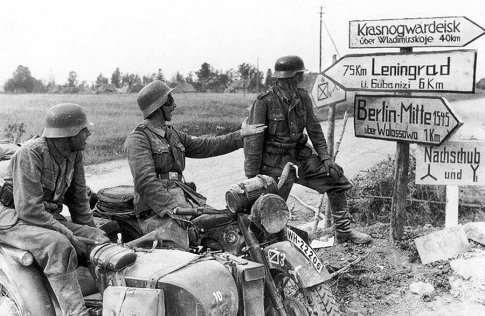
Motociclistas pertenecientes a la 1ª División Acorazada (Friedrich Kirchner) próximos a la línea defensiva del río Luga (sur de Leningrado). El parón operativo sufrido por el comandante del cuerpo de tropas Panzer, Reinhardt, durante un tiempo demasiado valioso posiblemente haya sido la causa de no poder capturar Leningrado antes de que Popov se reorganizara.

Durante el día siguiente Popov va recibiendo informes inquietantes de su Distrito vecino hacia el oeste. Es el nuevo Frente Noroccidental. Los ejércitos y 11º, a pesar de estar considerados como formaciones con gran nivel de alistamiento, están siendo incapaces de hacer retroceder al Grupo de Ejércitos Norte, bajo constante castigo artillero y aéreo y siendo sorprendidos por avances imprevistos de formaciones acorazadas y motorizadas. En estas circunstancias Popov se prepara y a las 48 horas del comienzo de la invasión ordena el establecimiento de líneas defensivas en su zona sur. La primera de ellas se debe desplegar a lo largo del río Luga. La segunda, desde Peterhof a Gatchina y Kolpino. Ya este día 24 Popov ve con preocupación como las vanguardias de von Leeb están llegando a las aguas del Dvina Occidental, ya casi a las puertas de Pskov. Y esto ya sería su responsabilidad.

El 25 de junio en acción conjunta de la Aviación Frontal (Novikov), más la naval del las flotas del Báltico y Norte, se lleva a cabo un ataque contra bases en territorio finlandés (el mismo Popov lo justifica en sus memorias como una acción de represalia por intentos de la Ilmavoimat (aviación militar finlandesa) de bombardear Leningrado, Kronstadt y otras localidades de la URSS). En total se atacan 20 bases del adversario. En Leningrado en casi todas las plazas, parques y numerosos tejados de edificios se despliegan piezas antiaéreas y globos de barrera. Por primera vez desde el comienzo de Barbarroja en la ciudad se respiran finalmente aires de guerra.

3 octubre 1941
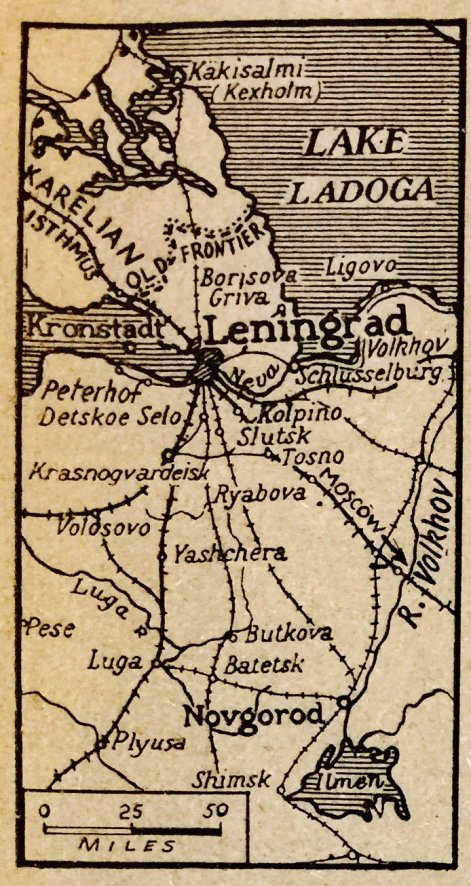
Publicado por el diario Melbourne Sun el 3 de octubre de 1941, el mapa muestra el importante enclave de Leningrado (actual San Petersburgo) y zonas adyancentes. Entre ellas son de destacar la ciudad de Luga, al sur y por el norte, el istmo de Carelia y el Lago Ladoga (líneas de frente con el ejército finés).

El 26 de junio Finlandia declara la guerra a la Unión de Repúblicas Socialistas Soviéticas. El 29 el comandante del 14º Ejército, general V. A. Frolov, informa que tras una intensa preparación artillera los fineses están llevando a cabo una gran ofensiva en dirección a Murmansk. Popov siente la presión lentamente desde el norte y también desde el sur, pues el 5 de julio el 4. Panzergruppe de Höpner captura Ostrov y ya se encamina hacia Pskov irremisiblemente. Después de Pskov lo único que puede detener a la Wehrmacht es la línea defensiva del Luga, pero esta está lejos de estar lista. No sólo eso, las divisiones de voluntarios «Opolchenye» que está previsto ocupen las posiciones a lo largo de las riberas del río Luga, están aún en fase de formación y adiestramiento.

El mariscal Voroshilov se presenta entonces en Leningrado con un pequeño estado mayor y toma el control el 10 de julio de una nueva estructura de mando deniminada GLAVKOM. Son unos mandos de teatro de operaciones gestados por el Comité de Defensa del Estado (GKO<>Gosudarstvennyj Komitet Oborona). En concreto a Voroshilov, hombre de gran confianza de Stalin, se le asigna el GLAVKOM noroccidental, que engloba a los antiguos frentes Noroccidental (F. I. Kuznetsov) y Norte (M. M. Popov), así como a la flotas del Norte y Báltico. Un día antes el Ostheer (el ejército alemán del frente del este) toma Pskov y este mismo día 10 el mariscal Mannerheim inicia su ofensiva hacia Petrozavodsk.

El día 12 de julio la vanguadia de von Leeb ya está en la carretera Pskov-Luga. Después de la precaria línea defensiva del Luga, Leningrado es el siguiente objetivo al norte ya muy cerca. Popov lamenta que sus fuerzas estén divididas hacia el sur y hacia el norte para defender el gran enclave de Leningrado, la capital cultural de Rusia y cuna del bolchevismo. Otro de los problemas del teniente general es el 8º Ejército, que en la práctica ha quedado copado en la antigua República de Estonia y queda ahora dependiente de su mando al serle transferida esta agrupación desde el Frente Noroccidental. Popov no ignora que la ocupación de Estonia por los germanos supondrá la pérdida de una importante base naval de la Flota del Báltico y abrirá una nueva vía de aproximación del adversario desde el oeste hacia Leningrado, a través de Narva y Kingisepp.

Los trabajos defensivos de la línea fluvial del Luga prosiguen frenéticamente contrarreloj, pero ya el día 13, las tropas motorizadas/mecanizadas de Höpner establecen contacto con los defensores en el sector. Al día siguiente los alemanes se establecen, imparables, en una cabeza de puente en la ribera del Luga. Popov refuerza las líneas con reservas extraídas en la práctica de la nada…Es entonces cuando el general Reinhardt, al mando del XLI. Armeekorps (mot.) siente que Leningrado ya está al alcance de la mano…¡pero se produce un parón operativo! Reinhardt cumple lo ordenado pero se exaspera y Popov respira por unos días.

Así a partir de agosto de 1941 su Frente se unirá al esfuerzo principal de los otros que pugnan por frenar el avance de von Leeb hacia Leningrado. Hacia el noroeste apuntalará las líneas para impedir el acceso finlandés hacia la gran capital. Es en este mes cuando el Frente Norte cambia de denominación y pasa a llamarse Frente de Leningrado. En noviembre de 1941 será relevado y pasará a ostentar el mando del 61º Ejército, que toma parte en la batalla de Moscú.

¿Te ha resultado de interés este artículo? ¿Querrías conocer los detalles de esta y las demas operaciones?

¡Adquiere la obra cronológica Barbarroja 03:00h en edición de coleccionista!


Comprar Ahora Button

Deja tu comentario abajo y sígue CONQUISTAR RUSIA punteando en la opción «SEGUIR / FOLLOW» a la izquierda de la página


[English version]

BARBAROSSA’S PROTAGONISTS

LIEUTENANT-GENERAL MARKIAN MIKHAILOVICH POPOV (1902 -1965)

map continuation war
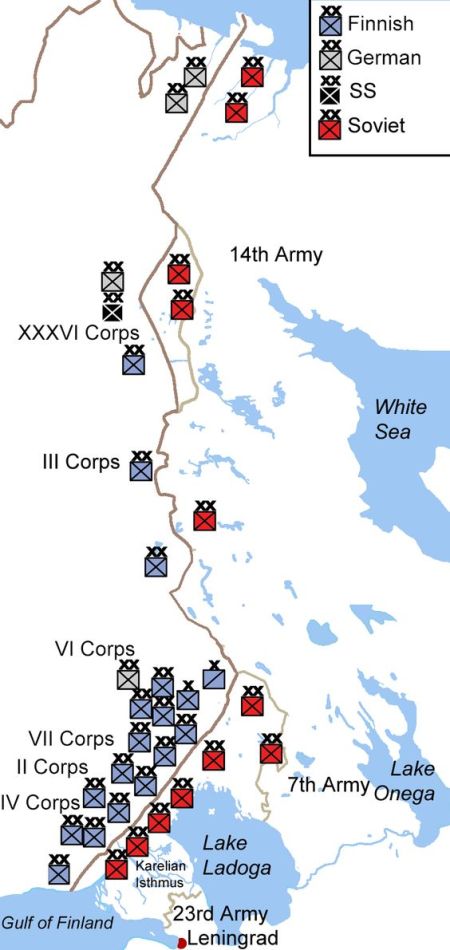
The map depicts General Popov’s deployment of forces from the top north Norwegian borders to the Gulf of Finland. The importance of keeping the vital port of Murmansk in Soviet hands will be paramount for the continuation of the struggle against the Axis forces, due to the continuous arrival by sea of essential supplies from the USA and Great Britain. This is thanks to the Lend-Lease Agreements between those powers and Stalin.

He volunteers for the ranks of the RKKA (Red Army of Peasants and Workers) in 1920 during the Russian Civil War. He fights in the Western Front and a year later joins the Communist Party. He is wounded in action. In 1936, he will graduate from the prestigious Frunze RKKA Military Academy and is assigned to mechanized troops.

At the commencement of Operation Barbarossa Markian Mikhailovich is (from January 1941) in command of the Leningrad Military District. Right after the breakout of the war against Germany, this administrative designation changes its name for the more operational «Northern Front». A «front» equates in aproximate terms a Wehrmacht army group. This is possibly one of the least famous sectors of the vast Russian theatre of operations, but the frontlines stretch from the White Sea waters, where he will have to oppose the German forces stationed in Norway, towards the south (Carelian isthmus) against the Finnish and still further south of Leningrad, facing von Leeb’s Army Group North.

As of the 22nd of June, 1941 the order of battle is as follows:

7th Army (Finland, Lieutenant-General F. D. Gorelienko)
14th Army (Murmansk, Lieutenant-General V. A. Frolov)
23rd Army (Viborg, Lieutenant-General P. S. Pshennikov)
PVO <> Anti-Air Defense (Leningrad, Brigade-General F. Ya. Kryukov)
VVS <> Frontal Air Force (Leningrad, Brigade-General A. A. Novikov)

The number of airplanes that Lieutenant-General Popov‘s assigned Frontal Air Force (VVS) counts on reaches 1,500. This is a numerous force to bear in mind, but the majority are obsolescent Polikarpov fighters I-15’s and I-16‘s and Tupolev bombers SB‘s, DB’s and TB-3‘s. Such a contingent is deployed covering the southwestern approaches to Leningrad near Pskov, Novgorod, Lish and Gatchina, but also to the north throughout the Carelian Isthmus. Good news is that Popov receives a full suppy of new powerful anti-aircraft 85 mm. cannons for the defense of the capital city (PVO).

Since the end of the Winter War against Finland in 1940, the Leningradskij Voyenno Krug <> Leningrad Military District builds three defensive areas in its northern approaches on the Carelian isthmus. The works start in Autumn, 1940 and are located in Viborg, Keksgolm and Sortaval. The intention is to stop any Finninsh possible aggression towards Leningrad and Petrozavodsk. However, at Barbarossa start these defenses are far from being finalized and are still lacking antitank weaponry. Likewise the defensive belts on the southern and southwestern approaches, those around Pskov and the former Republic of Estonia, are weak.

The war against Hitler surprises Lieutenant-General Popov in Petrozavodsk after a meeting held with the Northern Fleet, on his way back to Leningrad. But it won’t be until he arrives in his headquarters when he receives the news of the conflict against Germany. During those moments Luftwaffe airplanes overfly Polyarny, the Northern Fleet base. Nevertheless Popov doesn’t need to regret any attacks neither in Leningrad nor in any other relevant targets of his Military District. The main battle front of the invasion campaing of the USSR affects so far the former Republic of Lithuania, Belarus and the Ukraine. Upon his arrival in his command post, Popov receives a Directive that orders air strikes against enemy aerodromes and troop concentrations. However, so far the document prevents any offensive actions against Finland or Romania.

mig-3 7IAK
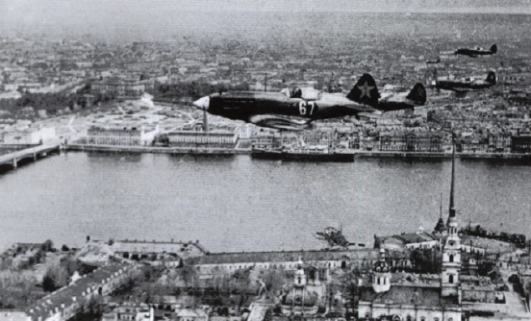
A flight of MiG-3 fighters belonging to the 7 IAK (7th Fighter Air Corps) patrol de skies of Leningrad over the famous Peter and Paul fortress. It is the 1st of August, 1941. Von Leeb’s vanguards are still 75 km. south of it.

Regarding his northern adversary, Marshall Mannerheim’s Finnish army, Markian Mikhailovich Popov estimates that the brunt of these forces are deployed mainly on the Carelian isthmus and the adjacent zones to Petrozavodsk (12-14 infantry divisions plus 4-5 brigades). Once Operation Barbarossa starts, Popov will be amazed about the fact the Finns haven’t coordinated with the Germans a common offensive effort. At dusk the 22nd of June, 1941 all Leningrad Military District forces are already manning their defensive stations waiting for further orders.

During the next day, Popov reads non-reassuring reports of his westernmost neighbouring District. It is the new Northwestern Front. The 8th and 11th Army, in spite of being considered first class and well supplied units, are not capable to withstand the onslaught of Army Group North, under non-stop artillery and aerial punishment and being outmaneouvered by sneak flank attacks of motorized and armoured divisions. In these circumstances Popov starts getting ready 48 hours after the invasion campaign for any future contingency and orders the building of defensive lines due south of Leningrad. The first of those must run along the Luga river waters. The second one is from Peterhof to Gatchina and Kolpino. On this very same day the Commander of the Northern Front learns about von Leeb’s swift approach towards the Western Dvina river, threatening soon Pskov. And this already lays under his resposibility.

On the 25th thanks to a joint mission of Popov‘s Frontal Aviation (Novikov) and those of the Baltic and Northern Fleet, Finnish bases are attacked. This is the initial stage of a new russo-finnish war. Lieutenant-General Popov justifies the action as a retaliation operation against the repeated attempts of the Ilmavoimat (Finnish Air Force) to raid Leningrad and Kronstadt as well as other key targets in the USSR. In all 20 bases are on the target lists. In Leningrad in almost all squares, parks and roofs anti-aircraft artillery and barrage ballons are deployed. For the first time since the start of Operation Barbarossa the cultural heart of Russia and cradle of Bolshevism breathes air of tragedy.

Continuation war map
Main Finnish offensive axis. This «northern» front will be less spectacular than its counterparts through Belarus, the Baltic Republics and the Ukraine, with more modest advances from either side, in spite of Mannerheims promising start. Nevertheless its importance is as paramount as the rest with targets like the vital port of Murmansk or the same Leningrad. Those will never be taken.

On the 26th of June, 1941, Finland declares war on the Union of Soviet Socialist Republics. On the 29th, the Commander of the 14th Army, General Frolov, reports that after a strong artillery barrage the Finns are advancing towards the vital port of Murmansk. Popov starts feeling the pressure from the north and from the south too, because on the 5th of July Höpner’s 4. Panzergruppe seizes Ostrov and heads relentlessly to Pskov. After Pskov the only obstacle in the German’s path is the Luga defensive line, but this is still far from being ready. Not only that, the volunteers divisions «Opolchenye», that foreseebly will man these defensive positions, are still under formation and training.

Marshall Voroshilov shows up in Leningrad with his core staff and takes control on the 10th of July of a new command structure called GLAVKOM. These are theatre of operation operational commands organized by the State Defense Commitee GKO<>Gosudarstvennyj Komitet Oborona. In the case of Voroshilov, a close friend of Stalin‘s, he is given the Northwestern GLAVKOM that emcompasses the Northwestern (F. I. Kuznetsov) and Nothern Front (M. M. Popov) along with the Baltic and Northern Fleet. Just the day prior the Ostheer (the German Army in the East) captures Pskov and on the very same 10th, Marshall Mannerheim goes on the offensive towards Petrozavodsk.

On the 12th of July von Leeb’s vanguards are already on the Pskov-Luga road. After the hastily prepared Luga defense line, Leningrad is next. Popov largely regrets that his forces are split up in two fronts covering the northern and southers approaches to Russia’s cultural enclave. One another problem the Lieutenant-General has to deal with is the reassignment of the Northwestern Front‘s 8th Army. This is in dire straights almost encircled in the former territory of the Baltic Republic of Estonia and now it is under his orders. Popov is well aware that the loss of Tallin will represent the loss of one the the main bases of the Baltic Fleet and will open a new approach to Leningrad from the west, through Narva and Kingisepp.

opolchenye
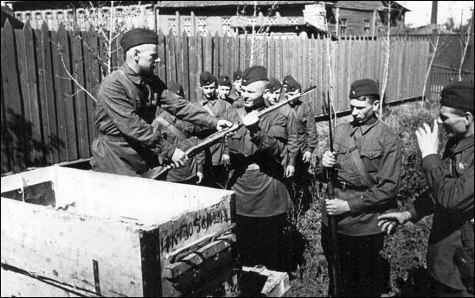
People’s militiamen «Opolchentsy» in the Kirov factory (Leningrado) receive Mosin rifles. The combat quality of these men are not much as they have been hastily recruited and poorly instructed. However their main value resides in their motivation.

The defensive works along the shores of the Luga river feverishly continue day after day, but as early as the 13th of July Höpner’s motorized/mechanized troops make contact with the first defenders of the line. The next day the unstoppable German vanguards establish the first bridgehead on the Luga banks. Popov reinforces his lines with whatever he can find…This is when General Reinhardt, Commander of the XLI. Armeekorps (mot.) feels Leningrad at the touch of his fingertips…But an operational halt is ordered and stops his Panzer‘s on their tracks! An enraged Reinhardt obeys orders and Popov breathes for a few days.

This way and after August 1941 his Front will join common efforts along with others to stop von Leeb’s assault on Leningrad. Towards the Nortwest he will strenghthen the sector to prevent the Finns advance onto the capital city. In this month the Northern Front changes its desigation and becomes the Leningrad Front. In November, 1941 Popov is relieved from command and he will be assigned to the 61st Army, taking part in the Battle for Moscow.

Did you find this article interesting? Leave your comments below and follow us clicking on «SEGUIR / FOLLOW» at the left of the page

Volver

Se ha enviado tu mensaje
Advertencia
Advertencia
Advertencia

¡Aviso!

FRANCOTIRADORES EN COMBATE

francotirador
[Cortesía ww2enimagenes.com]

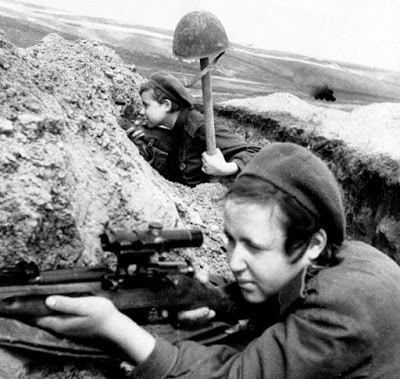
FRANCOTIRADORES EN COMBATE. ¿SABÍAS QUE…? Normalmente los francotiradores se dividían en grupos de dos, su principal objetivo eran los oficiales de alto rango, los nidos de ametralladoras y los francotiradores. Cuando un francotirador eliminaba un soldado raso por equivocación o queriendo, éste no era bien recibido una vez reunidos en los búnkeres, ya que ese no era…

a través de FRANCOTIRADORES EN COMBATE. ¿SABÍAS QUE…? — WW2 en Imágenes – Blog Segunda Guerra Mundial


Comprar Ahora Button

Deja tu comentario abajo y sígue CONQUISTAR RUSIA punteando en la opción «SEGUIR / FOLLOW» a la izquierda de la página

Volver

Se ha enviado tu mensaje
Advertencia
Advertencia
Advertencia

¡Aviso!

Panzerkampfwagen I

[English version at the end]

MÁQUINAS DE BARBARROJA

¡Ya a la venta Barbarroja 03:00 hrs!

PANZERKAMPFWAGEN I (Sd.Kfz. 101)

panzerkampfwagen I ausf.a
Panzerkampfwagen I Ausf.A. Algo más corto y ligero que su versión posterior, el Ausf.B, es más fácilmente distinguible por los tres bogíes superiores de sujeción de las cadenas.

Uno no puede dejar de sorprenderse, teniendo como referencia este vehículo ligero y los últimos diseños de carros de combate súper-pesados de la Segunda Guerra Mundial, del salto tecnológico acaecido en sólo 6 años de conflicto.

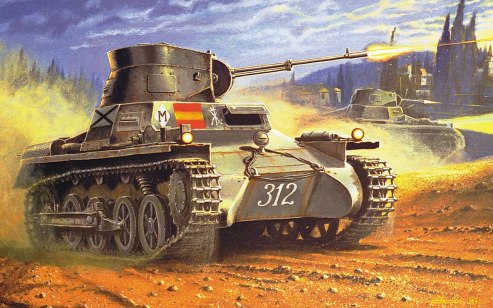
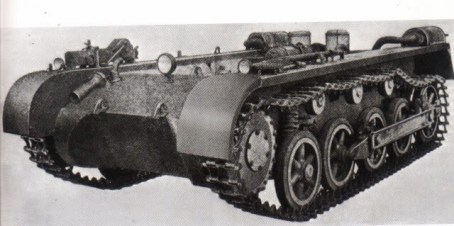
El PzKpfw. I es concebido tan sólo como un entrenador para tripulaciones de carros de combate. Su orígen se remonta al Kleintraktor de Krupp, una máquina maniobrable, muy ligeramente acorazada pero con un cañón de 2,0 cm. Comienza la producción del nuevo tipo en 1933 denominándose Sd.Kfz.101 (Sonderkraftfahrzeug-vehículo de propósito especial), debido a las limitaciones del Tratado de Versalles, que tras la Primera Guerra Mundial impedían a Alemania la construcción de carros de combate. La firma Daimler-Benz también intervendrá en la producción posteriormente. Se la adapta una torreta que aloja dos ametralladoras MG-13 k de 7,92 mm. (2.250 cartuchos) y un visor telescópico de puntería de la casa Zeiss. Es justo el año en que Adolfo Hitler se convierte en canciller de Alemania y decide comenzar una velada carrera armamentística. No obstante ya desde 1925, el Reichswehr inicia estudios secretos sobre el diseño de carros de combate ligeros. No será hasta 1936 que este  Sonderkraftfahrzeug adquiera su verdadera denominación: Panzerkampfwagen I Ausführung A (Carro de combate blindado I versión A). Va a ser el primer vehículo acorazado sobre orugas alemán de producción de serie. Un blindado de 5,4 toneladas y el padre de los carros alemanes, la saga Panzer que llega hasta nuestros días envuelta en una aureola de invencibilidad.

panzer I 1panzergruppe kleist ucrania 1941
Panzerkampfwagen I Ausf.B perteneciente al 1.Panzergruppe «Kleist» en el verano de 1941. Ucrania. Como se menciona en la aterior ilustración los cuatro bogíes son la más clara referencia para diferenciar a esta versión con respecto del Ausf.A.

Como blindado, cuyo papel como se menciona va a ser el de entrenamiento, su blindaje es casi de compromiso, sólo 13 mm. en su parte más gruesa frontal (lo suficiente para protegerse de armas ligeras de infantería). Desarrolla 37,5 km/h. y está operado por sólo 2 hombres (el jefe de carro hace las veces de ametrallador y cargador además de las propias). En 1936 se comenzará la producción del Ausf.B, un desarrollo repotenciado gracias a un motor Maybach NL 38 Tr de 100 C.V., del que se producirán 675 unidades hasta 1938. Llega a las 5,8 toneladas de peso y es algo más veloz que el Ausf.A, alcanzando los 40 km/h. De este se derivará una versión contracarro con cañón checo de 4,7 cm., el Panzerjäger I, y un obús autopropulsado, el 15 cm sIG 33 (Sf) auf Panzerkampfwagen I Ausf B (Bison).

Alemania enviará a la Guerra Civil Española aproximadamente cuarenta PzKpfw. I Ausf.A, seguidos por 77 Ausf.B, como parte del contingente terrestre de la Legión Cóndor (al mando el Oberst Wilhelm Ritter von Thoma). No obstante estarán en inferioridad de condiciones contra los T-26 entregados por la URSS al gobierno republicano español. La diferencia entre ambos blindados en cuanto a potencia de fuego es evidente, al comparar el cañón normalizado del Ejército Rojo de 45 mm. con las dos ametralladoras de 7,92 mm. del carro germano. Ambos modelos se enfrentan por primera vez en la Batalla de Madrid. En España se iniciará en 1937 una muy limitada serie de Panzer I modificados con un cañón italiano Breda de 20 mm.

Panzer I breda 20 mm
Esta interesante modificación del Pzkpfw. I se realiza durante la Guerra Civil Española en Sevilla. Se dota a la torreta de una súperestructura capaz de alojar un cañón italiano Breda de 20 mm. que sustituye al montaje de dos ametralladoras MG de 7,92 mm. La producción, tras unas pocas unidades, es detenida al disponer las fuerzas nacionales de un número importante de carros soviéticos capturados T-26.[cortesía autor desconocido].

El PzKpfw. I intervendrá en la campaña de Polonia, Dinamarca, Noruega y Francia. Principalmente actuarán en misiones de reconocimiento y apoyo a la infantería. También en 1941 será enviado a los balcanes y desiertos del norte de África como integrantes de la 15. Panzer Division del afamado general Erwin Rommel. A pesar de sus obvias limitaciones, los Panzer I participan en la campañas iniciales de la Wehrmacht donde su movilidad y buenas comunicaciones les hace partícipes de la Blitzkrieg.

Al comienzo de la Operación Barbarroja aun hay 152 unidades distribuidas en 5 regimientos Panzer y una brigada Panzer. Los remanentes, tras el duro verano de 1941, son prácticamente relegados a tareas de entrenamiento, anti-partisanos o apoyo. Los soviéticos lo conocerán como el T-1.

¿Te ha resultado de interés este artículo? ¿Querrías conocer los detalles de esta y las demas operaciones?

¡Adquiere la obra cronológica Barbarroja 03:00h en edición de coleccionista!


Comprar Ahora Button

Deja tu comentario abajo y sígue CONQUISTAR RUSIA punteando en la opción «SEGUIR / FOLLOW» a la izquierda de la página


[English version]

BARBAROSSA’S MACHINES

PANZERKAMPFWAGEN I (Sd.Kfz. 101)

kleintraktor krupp
Kleintraktor by Krupp. It serves as the chassis for the future tank, the Panzerkampfwagen I Ausf. A.

Having in mind this tank and the superheavy late-war models, one definitely gets amazed realizing the technological leap developed in just 6 years of conflict.

The Panzer I is conceived just as a trainer for tank crews. It is based on Krupp‘s Kleintraktor, a highly maneouvreable vehicle, lighly armoured but fitted with a 2.0 cm gun. The Panzer production commences in 1933 as Sd.Kfz.101 (Sonderkraftfahrzeug/Special Purpose vehicle), due to the limitations of the Versailles Treaty, that after WWI forbade Germany to have any kind of armoured forces. Daimler-Benz will take part in the production process at a later stage as well. The vehicle is fitted with a turret that lodges 2xMG-13 k 7.92 mm. machine guns (with 2,250 projectiles) and a Zeiss aiming telescope. This is the year when Adolf Hitler becomes Germany’s Chancellor and is determined to start a veiled rearmament program. However already in 1925 the Reichswehr (Armed Forces) commences secret studies for the development of light armoured vehicles. It won’t be until 1936 when the “special purpose machine” acquire its “tank” designation: Panzerkampfwagen I Ausführung A (armoured fighting vehicle version A). It is indeed the first German series production tracked type. It is a 5.4 tonn tank and the father of the famous Panzer saga that even today is surrounded by an aura of invincibility.

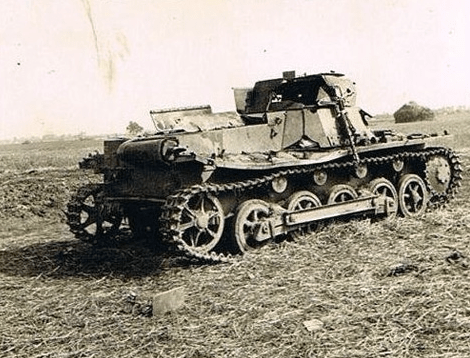
panzer I destroyed in Ukraine
This Panzerkampfwagen I Ausf.B has been hit by a 45 mm. anti-tank shell somewhere in the Ukraine in summer’ 41. The design is by no means meant to endure anything more powerful than light infantry arms. It belongs to von Kleist’s 1st Armoured Group.

As a trainer, its armor is almost symbolic: 13 mm. in its broader front plates (just enough to endure infantry light arms). It develops 37.5 km/h. and it is crewed by just 2 men (the commander serves as loader and gunner too). In 1936 will commence the production of the Ausf.B, a more powerful variant thanks to its 100 H. P. Maybach NL 38 Tr engine. 675 units will be produced until 1938. It weighs 5.8 tonnes and is slightly faster than the Ausf. A, reaching 40 km/h. After this later version a tank-destroyer named Panzerjäger I (with a Czech 4.7 cm. gun) and a self-propelled howitzer, 15 cm sIG 33 (Sf) auf Panzerkampfwagen I Ausf B. (Bison) will be developed.

Germany will send to the Spanish Civil War 40+ Panzer I Ausf.A’s followed by 77 Ausf.B’s as part of the Legion Condor’s ground contingent (under command of Oberst Wilhelm Rittter von Thoma). However, they will be a generally inferior match to their Soviet counterparts, the T-26’s, delivered by the USSR to the Spanish Republican Government. The difference in firepower between the two tanks is outstanding, comparing the standard Soviet 45 mm. gun and the modest 2 machine guns offered by the Panzer I. Their first engagement will take place in the Battle for Madrid. A very interesting but limited modification will commence in 1937 in Seville, Spain, when a handful of them will be fitted with the Italian 20 mm. Breda gun.

befehlspanzer
Modified as a command vehicle by Daimler-Benz, the Panzer I Ausf.B replaces the turret by a fixed facility fitted with a single 7.92 mm. machine gun. It is the Panzer Befehlswagen I (Sd.Kfz. 265). 200 of them are produced and the last units are seen until 1943 in rearguard duties.

The PzKpfw. I will take part in the campaigns of Poland, Denmark, Norway and France. It will mainly perform reconnaissance or support missions. It will be sent to the Balcans in 1941 and to the African deserts as part of the reputable General Erwin Rommel’s 15. Panzer Division. In spite of its lack of firepower and modesty, due to its mobility and a good communication system, it contributes to the initial success of the German lighning war, the Blitzkrieg.

At Operation Barbarossa start there are still 152 of them in service, fielded by 5 armoured regiments an 1 armoured brigade. After the harsh summer of 1941 the remaining will be withdrawn to rearguard, training or antipartisan duties. Soviet literature refers it to as the T-1.

Did you find this article interesting? Leave your comments below and follow us clicking on «SEGUIR / FOLLOW» at the left of the page


Volver

Se ha enviado tu mensaje

Advertencia
Advertencia
Advertencia

¡Aviso!


BA-3/6/10

[English version at the end]

 MÁQUINAS DE BARBARROJA

¡Ya a la venta Barbarroja 03:00 hrs!


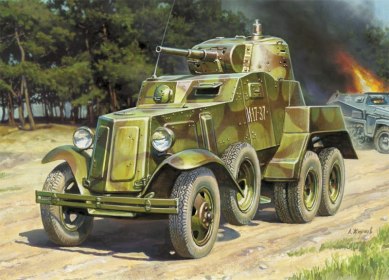
AUTOMÓVIL BLINDADO DE RECONOCIMIENTO BA-3/ BA-6/ BA-10


BA-3 ejercito popular mongolia
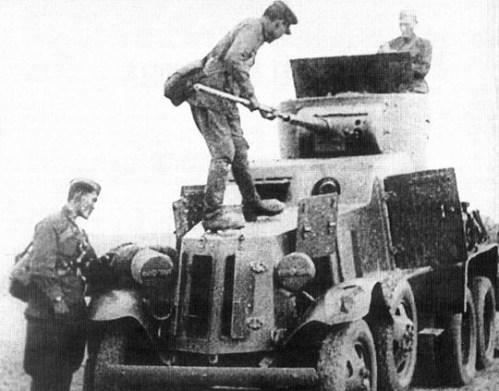
Dotación de un BA-3 en plenas labores de mantenimiento y policía en servicio en el Ejército Popular de Mongolia. El sirviente sobre el capó del motor limpia el ánima del cañón de 45 mm. mod. 1932 20k.

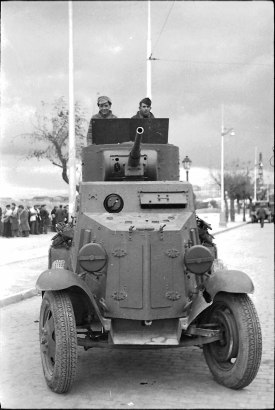
Finalizada la Guerra Civil Rusa en octubre de 1922 existen ya 300 coches blindados en el nuevo Ejército Rojo, bien provenientes de inventarios de la Gran Guerra o bien de fabricación posterior. Es una mezcolanza de 22 tipos diferentes que el RKKA (Ejército Rojo) decide modernizar y normalizar en un parque móvil tan variopinto. Tales son los orígenes del concepto de vehículo de reconocimiento BA (Broneavtomobil<>coche blindado) cuando el equipo de diseño de la fábrica de LeningradoIzhorskij comienza en 1932 un nuevo tipo basado en el chasis del Ford-Timken estadounidense. Es el BAI (Broneavtomobil Izhorskij).

Con estos orígenes y el antecedente del BA-3 (designed in 1934), dicha factoría estrena la nueva serie BA-6; es una versión de chasis reforzado y motor de 40 C.V. Sorprende que con una masa de 5,12 toneladas y tripulación de 4 hombres sea capaz de desarrollar 60 km/h. en carretera, pero se consigue gracias a «aligerar» en casi una tonelada al BA-3. Su carga de combate la completan 60 proyectiles de cañón de 45 mm. y 53 cargadores para sus ametralladoras DT de 7,62 mm. tal y como el BA-3. Es equipado además con neumáticos a prueba de munición de pequeño calibre. Una interesante variante semioruga basada en el chasis del GAZ-AA «Kegress» dará como resultado el BA-6C.

BA-10M
Impresión artística del BA-10M. Es reconocible por sus depósitos adicionales de combustible sobre los guardabarros traseros. [Cortesía autor desconocido]

El BA-10 es un desarrollo continuado de la serie de blindados de ruedas BA-6 (a su vez del BA-3, como vemos, cuya diferencia principal con el BAI es la torreta con cañón de 45 mm. mod. 1932 20K del carro de combate T-26). El BA-10, heredero de todos ellos,  es en realidad menos blindado que su antecesor (6-15 mm.), pero goza de planchas más inclinadas que lo hace igualmente resistente al fuego ligero enemigo. La nueva variante pesa 5,1 toneladas y tiene una dotación igualmente de 4 hombres. Su armamento lo compone el clásico cañón normalizado de 45 mm. esta vez mod. 1934 y dos ametralladoras DT, una de ellas solidaria con la torreta y la otra frontal operada por el conductor.

En sus diversas modificaciones son vehículos muy usados en el rol de reconocimiento en el periodo de entreguerras, que verán acción hasta la misma finalización de la Segunda Guerra Mundial (e incluso mucho después en otras naciones). La familia BA verá también acción en la Guerra Civil Española (en donde se fabricará una versión similar con cañón de 37 mm.). 7 BAI y 80 BA-6 se envian para apoyo a la República española donde quedan registradas varias acciones exitosas de estos automóviles contra carros de combate adversarios. En España será precisamente el debut del BA-6. La 1ª Brigada Acorazada equipada con este material y al mando de D G. Pavlov entra en combate en 1937 en Madrid y en la batalla de Teruel. Al final del conflicto los restantes BA en engrosarán las filas de las nuevas Fuerzas Armadas españolas hasta principios de los años 50.

BA-10 3 cuerpo mecanizado
Perfil de un BA-10 perteneciente al 3er Cuerpo Mecanizado. Un vehículo potentemente armado en el periodo de entre-guerras y el escenario inicial de la Operación Barbarroja

Los Broneavtomobil también participan en el conflicto de Khalkhin Gol en 1939 contra tropas japonesas (brigadas de reconocimiento 7ª, 8ª y 9ª, cada una con 80 máquinas) y todas las demás operaciones militares soviéticas entre 1939 y 1940 (Polonia y Finlandia). Su cañón de 45 mm. demuestra ser efectivo contra los blindados nipones, aunque su débil blindaje lo hace a su vez vulnerable, no sólo a los carros de combate enemigos, sino también a ametralladoras de grueso calibre. Se entregan a los regimiento de exploración de las unidades acorazadas, caballería e infantería.

Es una plataforma más que aceptable para tareas de exploración, con protección contra las armas ligeras de infantería. De hecho son los vehículos de exploración mejor armados del mundo en el periodo de entreguerras. El primer prototipo del BA-6 sale de factoría en 1935, como se ha mencionado, pero la producción derivará enseguida hacia el BA-10. Al concluir 1938 de la factoría de Leningrado-Izhorskij ya salen 489 BA-10, que se entregan al RKKA.

Para el comienzo de la Operación Barbarroja el 22 de junio de 1941 ya hay una buena cantidad de BA-10 en inventario. La última variante es el BA-10M. Para noviembre de 1941, cuando se interrumpa su producción, se habrán construido 3.331 de variantes A y M. Merece la pena destacar al BA-10-ZhD, que no es otro que un modelo normalizado adaptado sobre raíles y que sobre este medio ideal alcanza hasta los 90 km/h. Una veintena de ellos ven la luz.

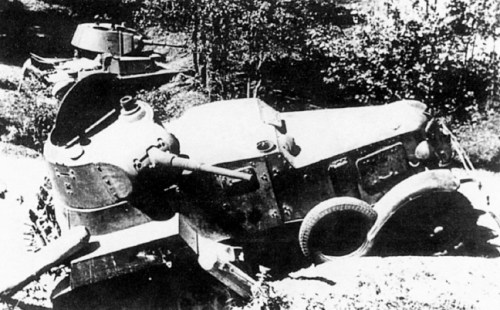
Un BA-10 puesto fuera de combate en los primeros días de la campaña de invasión de la URSS. En segundo plano un T-26 que ha corrido la misma suerte. A pesar de estar bien armados, los Broneavtomobil no están pensados para enfrentamientos directos contra blindados.

En el caótico verano soviético de 1941 se perderán multitud de estos coches de exploración en combate. Muchos de ellos son empleados en acciones ofensivo/defensivas en misiones que no les son propias, incluso en enfrentamientos desesperados contra blindados. En uno de estos encuentros no tan infrecuentes en el teatro de operaciones del Frente Sudoccidental/Grupo de Ejércitos Sur, el general jefe del 22º Cuerpo Mecanizado, Kondrusev, lanza un contraataque desesperado en el área de Aleksandrovka. Según van llegando elementos de su 19ª División Acorazada y sin esperar al grueso de la misma, ordena el avance a las 13:30 horas del 24 de junio con 45 T-26 y 12 BA-10. Ante la embestida soviética, la infantería germana se repliega hasta que los blindados atacantes encuentran una fuerza de Panzer de tipo «medio» (así descrito en los informes del RKKA). Después de 2 horas y media de combate y la pérdida desastrosa del 50% de sus vehículos, los soviéticos se retiran. Los germanos encajan la pérdida de 8 Panzer «medios» y 2 «pesados» (posiblemente los informes del RKKA hacen referencia a modelos PzKpfw III y IV). Entre el material gráfico recopilado tras la batalla existen fotografías que muestran tanto a T-26 como BA-10 destruidos en el campo de batalla…

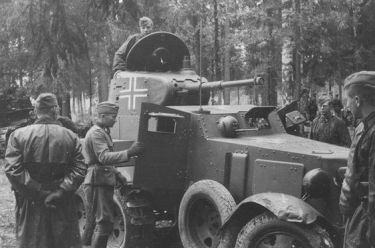
La Wehrmacht empleará pronto un número de ellos capturados, integrados en fuerzas anti-partisanas con la designación de Panzerspähwagen BA 203(r).


¿Te ha resultado de interés este artículo? ¡Adquiere la obra cronológica “Barbarroja 03:00h” en edición de coleccionista!


¿Querrías conocer los detalles de esta y las demas operaciones?

¡Adquiere la obra cronológica Barbarroja 03:00h en edición de coleccionista!


Comprar Ahora Button

Deja tu comentario abajo y síguenos haciendo click en la opción al final de la página


[English version]

BARBAROSSA’S MACHINES


RECONNAISSANCE ARMOURED CAR BA-6/BA-10


BA-10 invasión Irán anglo-soviética
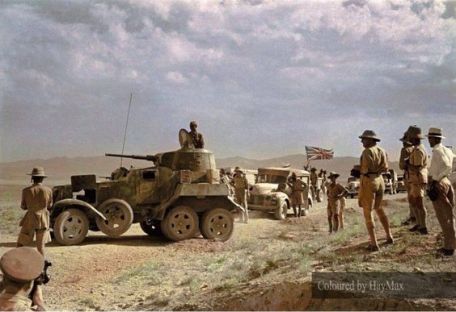
BA-10 in escort duties for a British column in September, 1941 during the anglo-soviet invasion of Iran. [Courtesy by Hay Max]

Once the Russian Civil War finishes in October 1922 there are in the USSR already 300 armoured cars from either World War I stocks or later production outputs. This a picturesque array of 22 different brands that the RKKA (Red Army) is poised to update and standardize. Thus are the origins of the BA scout cars (Broneavtomobil<>armoured car) when the Leningrad-Izhorskij factory engineering team creates eventually in 1932 a new type. This is based in the USA lorry Ford-Timken chassis and is to be known as the BAI (Broneavtomobil Izhorskij).

With these line of ancestors and the precedent of the BA-3 (designed in 1934), the aforementioned factory releases the new BA-6 series. It enjoys a reinforced chassis with a 40 H.P. power plant. It is indeed surprising that it can still develop 60 km/h. on road with a total mass of 5.12 tonnes (with a 4-man crew), but this is achieved thanks to remove almost 1,000 kilograms of extra weigh off the BA-3. Its combat load is completed with 60×45 mm. cannon rounds and 53 magazines for its 7.62 mm. DT machine guns (so as the BA-3). It is fitted with bullet-proof wheels. An interesting sub-variant based on the GAZ-AA “Kegress” half-track chassis will be known as the BA-6C.

BA-3 over rails
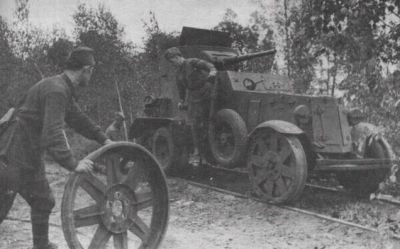
BA-6-ZhD. The suffix «ZhD» refers in Russian to «Railroad». A few of them are produced. The advantage of using this machines pose an obvious increase in top speed.

The BA-10 is a further development of the BA-6 scout car (in its turn from the BA-3, as seen above, that was fitted at last with a T-26 turret armed with the 45 mm. mod. 1932 20K gun). The BA-10 the heir of the family saga, is less armoured than its predecessor (6-15 mm.), but thanks to slant plates it is in practical terms as resistant to light enemy fire as always. The new version weighs 5.1 tonnes and has as well a crew of 4 men. Its enhanced power plant develops this time up to 50 H.P. It is fitted this time with a 45 mm. mod. 1934 gun plus 2 DT machine guns, one synchronized with the turret and the other operated by the driver on the frontal glacis.

ba-6 spanish civil war
One of the 80 BA-6’s sent to Spain in support of the Republican Government in 1937. Initially with Soviet crews, soon they will have Spanish crewmembers on board.

All in all they are widely used in the reconnaissance role in the inter-war period and will see full action until the very end of World War Two (and even further still in service in other nations). The BA family will see combat in the Spanish Civil War, 1936-39, where an interesting 37 mm. gunned modification will be produced. 7 BAI‘s and 80 BA-6‘s are sent in support of the Spanish Republic in 1937. The BA-6 will indeed receive its baptism of fire precisely in Spain. Some successful tank versus tank engagements are reported to have taken place with these machines in the Battle for Madrid. The 1st Armoured Brigade under the command of D. G. Pavlov is fielded with this materiel and participates in actions in the battles for Madrid and Teruel. At the end of the Spanish war the remaining BA’s will enlarge the ranks of the Spanish new army until the beginning of the 50’s.

The 1939 conflict in Khalkhin Gol becomes a new “proving-ground” for all the Broneavtomobil against the Imperial Japanese Army. 3 armoured reconnaissance brigades are used (7th, 8th and 9th). Each of those units field an average of 80 machines. Its gun proves to be powerful enough against Japanese tanks, but at the same time they are vulnerable even against heavy machine guns. It participates as well in all the remaining military Soviet operations between 1939 and 1940 (Poland and Finland).

The BA’s are definitely a more than an acceptable reconnaissance platform, resistant to light infantry arms. It actually outguns any vehicle of its kind in the world during the inter-war period. The first BA-6 prototype will be released from factory in 1935, as seen above, but the production will swiftly favor the BA-10. Already by the end of 1938 the Leningrad-Izhorskij factory will have produced 489 BA-10’s for the tank, cavalry and infantry reconnaissance battalions of the RKKA.

Panzerspähwagen BA 203 (r)
A captured Broneavtomobil put in service in the Wehrmacht as Panzerspähwagen BA 203 (r).

At Operation Barbarossa start on the 22nd of June 1941 there’s already a good number of BA’s in inventory. The last of the variants at that precise time is the BA-10M. By November, 1941 there will be 3,331 BA-10A’s and M’s. It is worth mentioning a rare sub-type, the BA-10-ZhD, which is an adaptation on rails, able to achieve up to 90 km/h over this ideal way. There will be just 20 of them.

In the mayhem of the Soviet summer of 1941 many of these scout cars will be lost in combat. But many of them are employed in actions for which they are not deviced (even in daredevil tank versus tank engagements). In one of those not-so-rare-actions on the 24th of June in the Southwestern Front/Army Group South theatre of operations, General Kondrusev, Commander of the 22nd Mechanized Corps launches a hopeless counterattack in the area of Aleksandrovka. Urging the attack and without having concentrated the full strength of his 19th Tank Division, launches a piece-meal counter-stroke at 13:30 hrs with 45 T-26’s and 12 BA-10’s. In the ensuing action, the German infantry starts to retreat until the Soviet armour faces unexpectedly medium Panzer types (as such reported in RKKA files). During the course of 2.5 hours of combat, and after grievous 50% losses, the Soviets start to withdraw the remaining forces. The Germans suffer in turn the loss of 8 «medium» and 2 «heavy» tanks (the files possible refer to PzKpfw III’s and IV’s). German after action battle-assessment imagery shows T-26’s as well as BA’s knocked out in the battlefield…

The Wehrmacht will soon use a number of captured ones for anti-partisan/rearguard duties, re-designed as Panzerspähwagen BA 203 (r).


Did you find this article interesting? Leave your comments below and follow us clicking on «SEGUIR» at the end of the page

Grupo de Ejércitos «Norte» 22-27 junio 1941

 PARTICIPANTES DE BARBARROJA

¡Ya a la venta Barbarroja 03:00 hrs!


HEERESGRUPPE «NORD» Y SU OFENSIVA DE RUPTURA (CORTESÍA DE MISTER X)

Teatro operaciones grupo ejercitos norte
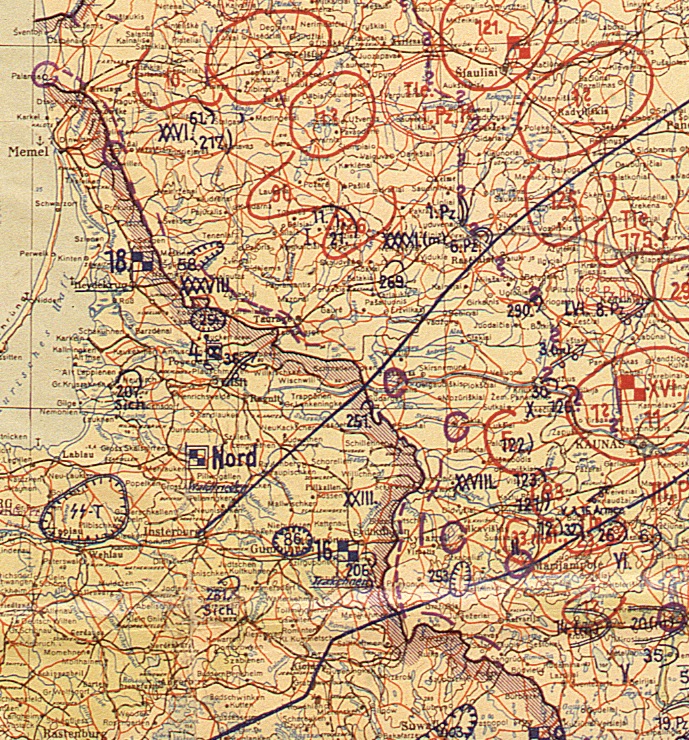
Detalle de una carta de situación del estado mayor alemán mostrando la dislocación de fuerzas propias y adversarias en el sector de Prusia oriental y Lituania. Es el campo de batalla de von Leeb contra el soviético Kuznetsov.

INTRODUCCIÓN


22 JUNIO 1941: PRUSIA ORIENTAL


¿Querrías conocer los detalles de esta y las demas operaciones?

¡Adquiere la obra cronológica Barbarroja 03:00h en edición de coleccionista!


Comprar Ahora Button

Deja tu comentario abajo y síguenos haciendo click en la opción al final de la página


Finlandia

[English version at the end]

 PARTICIPANTES DE BARBARROJA

¡Ya a la venta Barbarroja 03:00 hrs!

FINLANDIA

Suomi mod. 1931
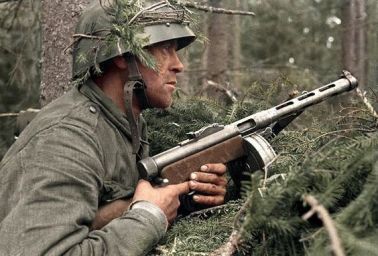
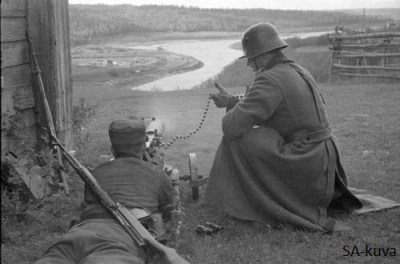
Infante finés portando un subfusil Suomi modelo 1931. El escenario boscoso con infinidad de lagos y marismas determina la naturaleza y tácticas en estas latitudes.

La mayor operación militar de todos los tiempos está rodeada de mitos. Esta, la Operación Barbarroja, que de hecho determina la suerte de la Segunda Guerra Mundial en Europa, queda eclipsada por factores como el nuevo orden europeo tras el conflicto, el advenimiento de la Guerra Fría, o la fundación de la Unión Europea sobre los cimientos de un sistema democrático-liberal. Todo ello hace que para el público general quede relegada como una campaña «exótica» o menor o de manera oficial, en aquellas naciones que tomaron parte, sea «inconveniente» y por lo tanto silenciada como pasado «un tanto» comprometido.  Uno de estos mitos es que sólo el III Reich se lanza al asalto de la U.R.S.S. el 22 de junio de 1941. De hecho Finlandia es uno más de los contendientes, si no el principal aliado de Hitler en cuanto a número de tropas intervinientes. Bajo mando del mariscal Mannerheim, comandante en jefe de las Fuerzas Armadas Finesas, la joven nación tiene  un papel protagonista en el planeamiento de la Operación Barbarroja.

area operaciones
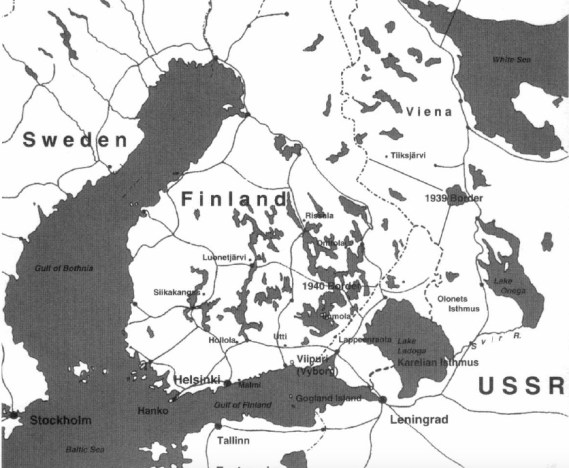
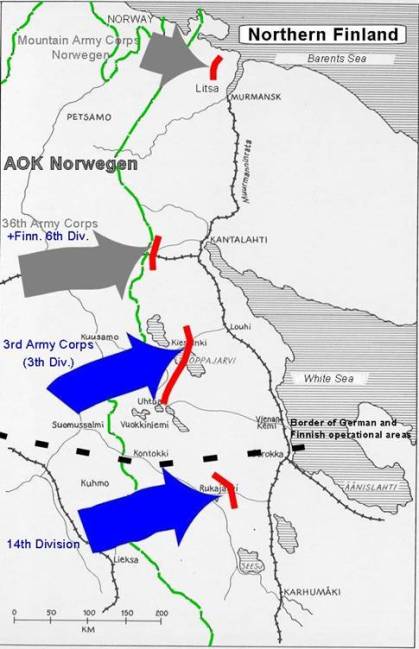
Area de operaciones del frente. En la zona sur, los istmos de Karelia y Olonets (ambos corredores entre los grandes lagos Ladoga y Onega) verán el avance de las tropas de Mannerheim en dirección a Leningrado y el río Svir.

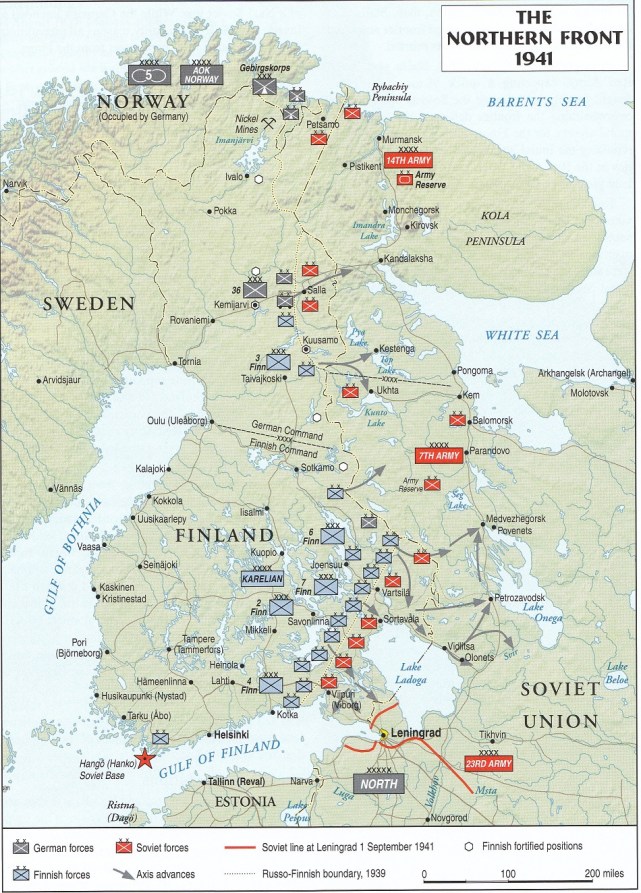
El 25 de junio de 1941, tan sólo tres días después de la ruptura de hostilidades con Hitler y otros aliados, Stalin, convencido de que su vecino del norte se encamina irremisiblemente a una nueva guerra contra la Unión Soviética, da el visto bueno a una operación de bombardeo preventivo de bases aéreas finesas y otros objetivos. Formaciones de bombarderos SB-2 vuelven a enfrentarse a la defensa aérea finlandesa. Al día siguiente, con dichos blancos aún humeantes, el primer ministro Johan Wilhelm Rangell se dirige a su parlamento para anunciar el nuevo estado de guerra. Finlandia es un estado recién independizado de la Rusia zarista en 1917 y no dispone de una gran fuerza aérea o unidades acorazadas, pero moviliza a nada menos que 475.000 soldados muy motivados que están listos para el combate. Son hombres que han aprendido las lecciones de hace poco más de un año en la llamada Guerra de invierno. A su finalización, cuando Finlandia, después de una defensa enconada, pierde territorios a manos de la U.R.S.S. en el invierno 1939-40, los fineses ven en esta ocasión y como aliados del Reich, la posibilidad de recuperar las áreas en disputa. Será ahora lo que ellos denominen la Guerra de Continuación (Jatkosota). El mariscal Mannerheim despliega su cuartel general a Mikkeli, como ya lo hizo durante la Guerra de invierno. Se suceden inmediatamente escaramuzas fronterizas y las tropas alemanas desplegadas en Laponia cruzan la demarcación ruso-finesa amenazando el vital puerto de Murmansk.

T-26
T-26 capturado por las tropas de Mannerheim durante la ofensiva del verano de 1941. La tripulación muerta en acción yace junto a su carro de combate.

Hitler tiene en mente una misión muy importante para el mariscal Mannerheim, que es la cooperación en la captura de Leningrado a su debido momento. Así se contempla en la Directiva número 21, que da paso al desarrollo de la campaña de invasión de la URSS, Operación Barbarroja. Mannerheim, por el contrario, después de un comienzo exitoso de las operaciones, no avanzará más de lo que le va a interesar. Así, el 10 de julio de 1941 el viejo mariscal pasa a la ofensiva con prometedores resultados. Goza de superioridad numérica en la zona y lo aprovecha. Su asalto se desarrolla en tres fases: una primera al norte del lago Ladoga, que divide a las fuerzas soviéticas (Severnyj Front<>Frente Norte) en dos mitades, hacia Karelia y Olonets. Una segunda, a través del istmo de Karelia, que recupera Viborg (Vijpuri, en finés) el 29 de agosto, perdida en la Guerra de Invierno, y amenaza directamente Leningrado desde el norte. Y una tercera, que hace retroceder al 7º Ejército soviético entre los lagos Onega y Ladoga hasta las aguas del Svir. Esto ya en septiembre de 1941, con la Wehrmacht asediando por el sur la capital cuna del bolchevismo, Leningrado. Las tropas del Severnyij Front contratacan en diferentes momentos pero son obligadas a retroceder sin remisión.

Brewster 239 Ilmavoimat
Un Brewster 239 del lote adquirido a la Armada de los EE.UU. de América. Llegarán tarde para combatir en la Guerra de Invierno, pero estarán listos para la Guerra de Continuación y alcanzarán un gran palmarés de victorias. La cruz gamada, en contra de lo que se pueda pensar, no tiene significación política alguna en la Ilmavoimat (fuerza aérea finesa), siendo un símbolo de fortuna.

El Ejército del Aire finlandés (Ilmavoimat) está sometido a un plan de reequipamiento de material desde 1937, pero al comienzo de la Segunda Guerra Mundial, este proceso deja aún mucho que desear. Cuenta con aparatos británicos Gloster Gladiator y Bristol Blenheim y holandeses Fokker C.X y D. XXI. distribuidos en un total de tres regimientos aéreos (Lentorykmentii). Son realmente insuficientes para cualquier enfrentamiento contra una potencia moderna. En este estado de cosas, el 30 de noviembre de 1939 y rotas las negociaciones sobre territorios con Stalin, se desencadena la ofensiva soviética en la mencionada Guerra de Invierno. Gran Bretaña, Francia y los Estados Unidos de América prestan apoyo militar con nuevos envíos de aeronaves. Los Brewster 239 de la U.S. Navy, parte de la ayuda internacional, llegarán demasiado tarde tras el armisticio del 13 de marzo de 1940, pero estarán listos para el siguiente conflicto. Cuando Mannerheim inicie su ofensiva, nuevos aparatos ya engrosarán las filas de la variopinta aviación militar finesa, con aviones ex-franceses Curtiss Hawk 75.

Para disgusto de Hitler, el mariscal Mannerheim detendrá su avance sin intención de ayudar en la captura de Leningrado. Para septiembre el finés ha restablecido las viejas fronteras de 1939 (excepto la base naval de Hanko) y no tiene más interés en proseguir ulteriores acciones. Sólo continuará en su frente más septentrional para recuperar aquellas áreas que se perdieron en la guerra de 1939-40; conseguido lo cual atrinchera el 6 de diciembre de 1941 a sus tropas en posiciones defensivas durante más de dos años y medio. Por presiones de Stalin a su aliado británico, el premier Churchill, receloso de que Mannerheim interrumpa la vía de suministro al vital puerto de Murmansk, Gran Bretaña declara la guerra a Finlandia ese mismo día de diciembre.

Tanto sobre tierra como en y sobre las aguas del Golfo de Finlandia, las fuerzas de tierra adversarias y la Ilmavoimat y la VVS (Voenno-Vozduzhnye Sily) establecen un sangriento campo de batalla. Desde el punto de vista aéreo y por el lado soviético, despuntarán «ases» como el capitán Antonenko y el teniente Brinko, que operan desde la base aeronaval de Hanko. Enfrente, hombres como Juutilainen amasarán también grandes cantidades de victorias aéreas, convietiéndose este en el mayor «as» de la historia de la aviación (no alemán) con 94 derribos oficiales.

El despliegue germano-finés de norte a sur consta de:

  • Cuerpo de montaña de la Wehrmacht, que desde Laponia actúa contra Petsamo-Murmansk, defendido por el 14º Ejército del RKKA.
  • 36º Cuerpo de Infantería de la Wehrmacht, que desde Rovaniemi combate en dirección a Kandalaksha, defendido por el 14º Ejército del RKKA.
  • 3er Cuerpo de Infantería finés, desde Kuusamo y hacia Ukhta-Kestenga, defendido por el 14º y 7º Ejército del RKKA.
  • Ejército de Karelia finés, compuesto por 4 cuerpos de infantería en un triple eje hacia la via de ferrocarril de Murmansk en dirección este, hacia Petrozavosk (orillas del Onega) y Viborg-Leningrado. De norte a sur defiende el 7º Ejército del RKKA  el 23º.
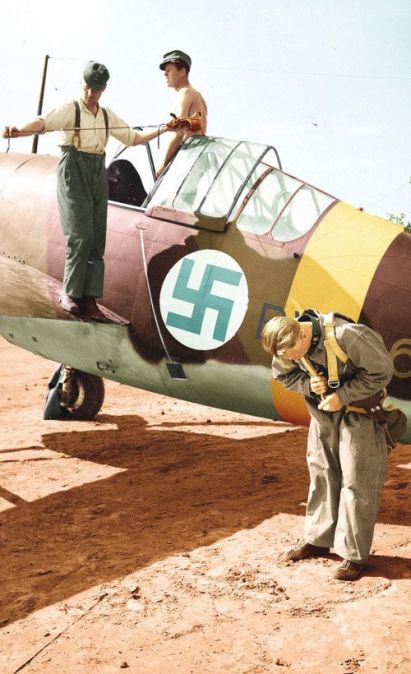
El éxito operacional de los finlandeses no acompaña a las tropas germanas que combaten desde su territorio hacia Murmansk. La resistencia soviética es superior a la esperada. Mannerheim les comunica que el enclave está en sus listas de objetivos, pero cambiará de opinión por temor a una declaración de guerra de los Estados Unidos de América, potencia aún neutral. Esta, junto con Gran Bretaña, surten por medio de los Acuerdos de Préstamo y Arriendo a Stalin miles de toneladas de cargamentos vitales para la continuación de la guerra contra Hitler principalmente a través de este puerto. Con otra suerte de circunstancias políticas y militares, los fineses 1944 romperán la alianza con el III Reich y se volverán contra sus antiguos aliados alemanes, expulsándolos con ayuda soviética del norte de su territorio hacia Noruega.

¿Querrías conocer los detalles de esta y las demas operaciones?

¡Adquiere la obra cronológica Barbarroja 03:00h en edición de coleccionista!

Comprar Ahora Button

Deja tu comentario abajo y síguenos haciendo click en la opción al final de la página


[English version]

BARBAROSSA’S PARTICIPANTS

FINLAND

Mannerheim HItler Ryti
Marshall Mannerheim (centre) with Adolf Hitler and Ryti in 1942.

The largest operation of all times is full of myths. Operation Barbarossa, that as a matter of fact determines the outcome of World War II in Europe, losses its due importance after a new post-war order is imposed over the devastated continent, the new Cold-War or, amongst other factors, by the foundation of the European Union. This, based on the principles of Liberal-Democracy makes the average citizen deem Operation Barbarossa as an «exotic» campaign or «secondary» and it is officially deliberately ignored by the nations that took part in it for having to recognize a «too compromising past». One of these myths is to believe that it was only the III Reich the one and only power that assaults the U.S.S.R. on the 22nd of June, 1941. However Finland takes part as well, becoming Hitler’s main ally regarding the number of troops. Under Marshall Mannerheim’s command, Commander-in-Chief of the Finnish Armed Forces, the young nation has an essential role in Barbarossa.

On the 25th of June’ 1941, just 3 days into de war against Hitler and his allies, Stalin, who is convinced that Finland is ready to wage war once again against him, clears pre-emptive strikes against Finnish air bases and other targets. Formations of Tupolev SB-2′s see new action versus Ilmavoimat fighters. With the still smoldering rubble Prime Minister Johan Wilhelm Rangell on the next day addresses the Parliament to announce the new state of war. Finland that recently received her independence from Czarist Russia in 1917, does not count on strong air or armoured forces. However manages to mobilize a motivated force of 475,000 men ready for combat. These are veterans of the last Winter War (1939-40) who have learned the hard way its lessons. After it, when after a significant resistance Finland is forced to hand in territories to the USSR, the Finns see this new cirucumstance as an opportunity to return those lands to their motherland. It will be known as the Continuation War (Jatkosota). Marshall Mannerheim deploys his HQ once again to Mikkeli, as he did during the Winter War. Clashes start along the fino-russian borders and the Germans, deployed as well in the Finnish Lappland launch an offensive in the direction of Murmansk.

Svir
Finnish machine-gun team covers a position in the area of river Svir. This will see the maximum advance of Mannerheim troops.[Courtesy SA-kuva]

Hitler has in mind a paramount role for his ally, which is the cooperation in the seizing of Leningrad in its due time. So it is written in the Directive no. 21, the document that unfolds the invasion campaing of the USSR, Operation Barbarossa. In spite of this, the old Marshall, after a very successful start of the offensive, will not advance further than what he deems is Finnish territory. Thus on the 10th of July, 1941, Mannerheim goes on the offensive with promising results.  He has numerical superiority and takes advantage of it. His assault follows 3 phases: The first one, due north of Lake Ladoga that splits up the Soviet forces of the Northern Front (Severnyj Front) into Karelia and Olonets. A second that advances through the Karelian isthmus and retakes Viborg on the 29th of August (Vijpuri in Suomi), lost in the previous Winter War; this maneouver also threats the cradle of Bolshevism, Leningrad. And finally a third phase that makes the RKKA (Red Army) 7th Army retreat between the waters of lakes Onega and Ladoga towards the river Svir line. This last one takes place already in September, 1941 when the Wehrmacht is already besieging Leningrad from the south. The Severnyij Front counter-attacks at different stages without much success…

BT tanks
A column of captured Soviet BT fast tanks. It is interesting to note the capability of this tank series to drive without tracks over prepared surfaces at faster speeds. Note as well the Svastika on the sides of the turrets for recognition purposes.

The Finnish Air Force (Ilmavoimat) follows a much needed acquisition program of aircraft since 1937, but at the start of World War II this process still lags way behind schedule. Her air forces count on British Gloster Gladiators and Bristol Blenheims and Dutch Fokker C.X y D.XXI. filling the ranks of 3 air regiments (Lentorykmentii). They are indeed insufficient for any modern conflict against any neighbouring power. Under these circumstances, on the 30th of November, 1939, once territorial negotiations  with Stalin stall, the USSR unleashes a military campaign that is to be known as the Winter War. Great Britain, France and the United States of America quickly sympathize with the Finns and send new airplane types. Out of those, the U.S. Navy Brewster 239 will arrive too late after the 13th of March, 1940 truce, but will be ready for the next conflict to come. When Mannerheim commences his offensive in the summer of 1941 a new array of aircraft are fielded in the Finnish picturesque Air Force, including ex-French Curtiss Hawk 75’s.

To Hitler’s disgust Marshall Mannerheim will put and end to his advances in the battlefields without helping in the seizing of Leningrad. By September 1941, the veteran Finnish Commander arrives to the old state frontiers before the Winter War (except Hanko aeronaval base) and has no further intentions. There are only a few zones in dispute on his northern flank and will continue offensive operations there, until those areas are retaken; thereafter he orders his troop entrench and go into a defensive stance for the next two and a half years. Due to Stalin‘s prussures over his ally, the Britsh Premier Winston Churchill threatens Finland and finally declares war on her on this very same day. Stalin fears the Finns might compromise the logistical lines to the vital port of Murmansk.

On the air, on the waters of the Gulf of Finland and over land the enemy ground troops and the air forces (Ilmavoimat and VVS<>Voenno-Vozduzhnye Sily) engage themselves in a bloody struggle. From the air point of view and Soviet side, men like Captain Antonenko and Lieutenant Brinko (Hanko aeronaval base) acquire air-kills and become «aces». In front, aviators like Juutilainen will claim impressive numbers of air victories, becoming Warrant Officer Eilo Juutilainen the History’s top scoring «ace» (non-German) with 94 credited official kills.

OOB
Deployment of opposing forces along the Russo-Finnish border. The numerical superiority and high motivation of his troops will translate in advances in all sectors. But Mannerheim will never dare to attack Leningrad.

The fino-german deployment of forces from north to south is as follows:

  • Mountain Corps (Wehrmacht), from Lappland against Petsamo-Murmansk, defended by the RKKA‘s 14th Army.
  • 36th Infantry Corps (Wehrmacht), from Rovaniemi fights towards Kandalaksha, defended by the RKKA‘s 14th Army.

  • 3rd Infantry Corps (Finnish), from Kuusamo towards Ukhta-Kestenga, defended by the RKKA’s 14th and 7th Army.
  • Finnish Karelian Army, composed by 4 infantry corps in a triple thrust towards Murmansk railroad on an easterly direction, towards Petrozavosk (by lake Onega) and Viborg-Leningrad. From north to south the defending forces correspond to the RKKA‘s 7th Army and the 23th.

The operational success of the Finns will not accompany their German allies who combat from their deployment areas towards Murmansk. The Soviet resilience is higher than expected. Marshall Mannerheim reports that this enclave is indeed in his target lists but will change his mind before the prospect of a USA war declaration (still neutral). This along with Great Britain are sending tons of valuable supplies thanks to the Lend Lease Agreements. These shipments are vital for the continuation of the was against Hitler mainly through this port.

In 1944, in a different political and military scenario, the Finnish alliance with the III Reich will be broken and Finland will turn this time against the Germans.

Did you find this article interesting? Leave your comments below and follow us clicking on «SEGUIR» at the end of the page

LaGG-3

[English version at the end]

 MÁQUINAS DE BARBARROJA

¡Ya a la venta Barbarroja 03:00 hrs!

CAZA SOVIÉTICO LaGG-3 (LAVOCHKIN-GORBUNOV-GUDKOV)


LaGG-3 despegue cohetes RS
LaGG-3 en configuración polivalente armado con cohetes RS-82. El aparato recién despegado pertenece a la Aviación de la Flota del Báltico. [autor desconocido]

La historia de este avión de caza se remonta a tan sólo tres años antes del comienzo de la Operación Barbarroja cuando V. P. Gorbunov y S. A. Lavochkin colaboran para la construcción de un monoplano moderno de caza. La URSS tiene la urgente necesidad de equiparse con nuevos diseños, ya que la experiencia obtenida durante la Guerra Civil Española pone de manifiesto la inferioridad de los Polikarpov I-16 e I-15 frente a los Messerschmitt Bf-109B y E. Posteriormente se une al equipo M. I. Gudkov. El Lavochkin-Gorbunov-Gudkov LaGG-3 no puede considerarse en sí mismo como un caza sobresaliente, pero su importancia radica en que es el primero de una larga línea de aviones de combate que sí serán excepcionales como el Lavochkin La-5,  La-7 y La-11 (último aparato de motor de pistón. Interviene en la guerra de Corea).

Cuidado desde el punto de vista aerodinámico, tiene estructura de madera (material no estratégico) y metálica en las superficies de mando. Una vez más se utiliza el motor Klimov de doce cilindros en «V» M-105P de 1.050 C.V. de potencia al despegue, que le dota de una velocidad de 575 km/h en altura de 5.000 metros. El primer prototipo, el I-301 realizará su primer vuelo de ensayos un año después (con la planta motriz mencionada pero sin el compresor TK-2). Para finales de 1939 un segundo prototipo del I-301 comienza los ensayos con dos turbocompresores. La producción comienza de inmediato en 1940 desde 4 factorías (nº 23 de Leningrado, nº 21 de Gorky, nº 31 de Taganrog y nº 153 de Novosibirsk). El 9 de diciembre de 1940 el I-301 pasa a denominarse LaGG-1 y a una modificación posterior con mayor alcance, LaGG-3.

material no estratégico
Uno de los requisitos de diseño del nuevo avión de caza es el uso de materiales no estratégicos, como la madera. En la foto se aprecia el uso de este material para conformar la estructura del fuselaje.

El primer aparato de serie despega por fin el 23 de enero de 1941, a tan sólo 5 meses de la campaña de invasión de la URSS. Su panoplia de armamento va cambiando según progresa la producción. El 24 IAP (Istrebitelnyj Aviatsionnyj Polk<>Regimiento Aéreo de Cazas) recibe las primeras unidades de serie en plantilla. Las series de inicio montan 5 ametralladoras, aunque serán más comunes posteriormente los aparatos con un cañón de 20 mm, una ametralladora de 12,7 mm. y dos ShKAS de 7,62 mm. sobre el capot del motor. En afustes bajo los planos puede cargar 6-8 cohetes RS-82 (tanto para uso aire-suelo como aire-aire) o dos bombas. Desde el punto de vista de potencia de fuego, el LaGG será superior al Messerschmitt Bf-109F, lo que le hace más efectivo contra aparatos más pesados como bombarderos o transportes.

La carlinga es amplia para el piloto, pero la capacidad de visión trasera («a las seis») es limitada, aunque tampoco el caza germano gozará de buena visibilidad en su sector posterior. No serán pocos los aviadores soviéticos que se enzarzarán en combate con la cúpula abierta, a sabiendas de perder 15 km/h. de velocidad. Pero con todo, el Bf-109F, con casi 300 kg. menos de peso y más de 300 C.V. de potencia, dispone de mayor aceleración y capacidad de trepada que el soviético. Como norma general los pilotos de Messerschmitt prefieren combatir con maniobras verticales al soviético, gracias a su ventaja de energía, con el objeto de «caer desde arriba». Uno de los vicios del LaGG-3 es su tendencia a entrar en barrena en combate cerrado y aunque no es difícil sacarlo de esa condición de fuera de control, muchos de los combates en el «frente del este» tienen lugar a muy baja altura, situación muy peligrosa al no tener margen para recuperar el vuelo estable.

44º Regimiento de Cazas
Aparato pertenenciente al 44 IAP (Regimiento Aéreo de Cazas). La unidad combate en el Frente Norte en el área de Leningrado. [Cortesía Massimo Tessitori]

Al comienzo de Barbarroja el 22 de junio de 1941 son realmente pocas las unidades (322) del LaGG entregadas a la VVS (Voenno-Vozduzhnye Sily). De hecho no participa en los combates de los primeros días y la Luftwaffe ignora su existencia. Los escasos LaGG no están desplegados en estos momentos en los aeródromos de vanguardia. Tan sólo en el Distrito Militar de Leningrado (44º Regimiento de Cazas) hay un puñado, 15. La mayor parte de ellos se concentran el la defensa perimetral de Moscú. Pero se fabricarán 6.528 de ellos y pronto empezarán a reemplazar a los obsoletos Polikarpov. Junto con los nuevos diseños de MiG y Yak constituirán las flotas de cazas modernos del inventario de la Voenno-Vozduzhnoe Sily (Fuerza Aérea Roja). El primer derribo documentado efectuado por un LaGG se produce el 13 de julio de 1941 a manos del teniente A. V. Bondarienko (24 IAP). Este derriba un bombardero Dornier Do-17 en la vecindad de Dorogobuzh (región de Smolensko).

El 4 de julio, el Comité de Defensa del Estado (GKO<>Gosudarstvenyj Komitet Oborony) ordena la evacuación de las fábricas del oeste de la URSS tras los Urales y las de montaje de LaGG también están afectadas. Una de sus plantas se resitúa en Nizhnyj Novgorod. La evacuación no tiene precedentes en la historia, interesando a 1.523 fábricas y 10 millones de trabajadores con sus familias. Para enero de 1942, la recolocación de toda la infraestructura de producción será completada.

LaGG-3 secreto
El manual clasificado del LaGG-3 muestra la panoplia de armamento montada en el conjunto de motor. La capacidad de fuego es superior a su homónimo alemán, el Messerschmitt Bf-109F. En el resto de cualidades el aparato germano demuestra ser superior.

El reemplazo de los veteranos Polikarpov continúa según van saliendo de fábrica los LaGG-3. Para julio de 1941, ante una Wehrmacht imparable, al 17 IAP le llega el turno de recibir al moderno diseño estando desplegado el regimiento en el área de Kremenchug, en las riberas del gran Dnieper. Ya hacia el otoño, con la Operación «Taifun» en marcha (el asalto a Moscú), los germanos se enfrentarán a mayores números de LaGG, en primera instancia a los pertenecientes tan sólo a dos regimientos de cazas (24º y 233º) y cuando para diciembre la Wehrmacht pase a la defensiva al límite de sus fuerzas, ya habrá algunos «ases» soviéticos, como G. A. Grigoryev; este sobre los cielos de la capital de la URSS se anotará 15 victorias. En una misión aire-suelo 3 LaGG de la 5ª División Aérea, armados con cañones de 37 mm., informan el 5 de octubre de 1941 de la destrucción de 5 blindados. Y un mes más tarde se produce el hecho significativo (y de fortuna) del derribo de un Bf-109F por el impacto de dos cohetes RS a manos del teniente F. D. Mezhuev.

A los mandos de esta caza controvertido G. D. Kostylev se adjudicará 30 victorias entre 1941 y 1943 contra la Luftwaffe y la Ilmavoimat (Fuerza Aérea Finesa). Muchos de sus pilotos apodarán al LaGG como el «barnizado ataúd garantizado» (Lakirovannyj Garantirovannyj Grob), por las dificultades de adaptación al nuevo aparato y los regimientos de cazas pasan a conocerse lúgubremente como «regimientos de condenados a muerte»…Y esto para empezar sin tener que enfrentarse al adversario. No obstante en manos de pilotos capaces, el LaGG hará un trabajo a considerar y de hecho sus enemigos lo bautizarán como «la muerte negra».

¿Querrías conocer los detalles de esta y las demas operaciones?

¡Adquiere la obra cronológica Barbarroja 03:00h en edición de coleccionista!


Comprar Ahora Button

Deja tu comentario abajo y síguenos haciendo click en la opción al final de la página


[English version]

BARBAROSSA’S MACHINES


SOVIET FIGHTER LAGG-3 (LAVOCHKIN-GORBUNOV-GUNKOV)


LaGG-3 Factory 31 Tanganrog
One of the LaGG-3’s produced in the Tanganrog factory no. 31.

The history of this fighter plane commences only three years before the start of Operation Barbarossa, when engineers V. P. Gorbunov and S. A. Lavochkin join efforts for the development of a modern combat aircraft. The USSR feels the urgency to equip her Military Aviation with new designs after the Spanish Civil War experience (1936-1939) when it became dissapointingly evident the inferiority of the Polikarpov I-15’s and I-16’s against the German Messerschmitt Bf-109B’s and E’s. Later on M. I. Gudkov joins the engineering team. The Lavochkin-Gorbunov-Gundkov LaGG-3 will not pass into History as an outstanding aircraft by itself, but it is the first of a successful saga of fighters, such as the La-5, La-7 and La-11 (last piston engine fighter plane. It will take part in the Korean conflict).

It has a streamlined design with a wooden (non-strategic material) and metal structure (movable parts). Once again the 12 «V» cylinder Klimov 1,050 H. P. M-105P engine is installed, giving the LaGG an airspeed of 575 km/h. at an altitude of 5,000 metres. The first prototype, the I-301 starts it flight tests a year later (with the aforementioned powerplant but without the turbocharger TK-12). By the end of 1939 a second prototype of the I-301 initiates tests with 2 turbochargers. The production starts off 4 factories (Leningrad no. 23, Taganrog no. 31 , Novosibirsk no. 153 and Gorky no. 21). On the 9th of December, 1940 the prototype acquires already the designation LaGG-1 and a further longer-range variant, LaGG-3.

Luftwaffe manual Lagg-3
A Luftwaffe vulnerability manual depicting the fuel tanks and weaponry of the LaGG-3 fighter plane.

The first series airplane makes its maiden flight on the 23rd of January, 1941, just 5 months before the USSR invasion campaign. Its weaponry changes thoughout the production. The 24 IAP (Istrebitelnyj Aviatsionnyj Polk<>Fighter Air Regiment) is the first one to receive this design. The first ones mount 5 machine guns, but a most common configuration consists of a 20 mm. cannon, a 12.7 mm. machine gun and 2 over-the-cowling 7.62 mm. ShKAS machine guns. Under underwing pylons it can carry 6-8 RS-82 rockets (air-to-air and air-to-ground use) or 2 bombs. From the stand point of firepower the LaGG will be superior to the Messerschmitt Bf-109F, becoming more lethal against larger targets such as bombers or cargo airplanes.

The pilot enjoys a wide cockpit, but its rearview field of vision (at «six o’clock») is hampered by the canopy and fuselage design; nevertheless so limited is the Messerschmitt as well. It won’t be reduced the number of Soviet aviators who will engage combat with open canopies even with the penalty of losing 15 km/h. All in all the Bf-109F, almost 300 kilograms lighter and with more than 300 H.P. enjoys a better acceleration and climb rate. As a general rule, the German fighter pilots prefer to engage the Soviets with vertical maneuovres thanks to their energy edge, with the idea to fall over their targets «from above». One of the characteristics of the LaGG-3 is its tendency to enter in a spin during dogfights. In spite of this uncontrolled condition is not difficult to overcome, it requires to lose altitude and most of the «Eastern Front» air combats take place at very low altitudes, where there’s no time to recover the plane from a spin.

At Barbarossa start (a common fact along the new line of Soviet fighters) just a few units (322) have been delivered to the VVS (Voenno-Vozduzhnye Sily) fighter regiments. As a matter of fact it does not participate in the frantic first days of air engagements and even the Luftwaffe ignores its existance. The few LaGG‘s at this moment aren’t deployed on the front-line aerodromes. Only in the Leningrad Military District (44th Fighter Air Regiment) there’re just 15 of them. Most of them are spared for the Moscow air defence. Nevertheless 6,528  LaGG’s will be produced and have already started replacing the obsolescent Polikarpov’s. Along with the new MiG‘s and Yak’s they will form the cadre of modern Soviet fighters in the Voenno-Vozduzhnoe Sily (Red Air Force). The first LaGG air victory happens on the 13th of July, 1941 by Lieutenant A. V. Bondarienko (24 IAP) when he shoots down a German Dornier Do-17 bomber in the vecinity of Dorogobuzh (Smolensk region).

vvs vs ilmavoimat
A LaGG-3 engages in air combat an Ilmavoimat (Finnish Air Force) Brewster 239 over the skies of the Karelian Isthmus

On the 4th of July, 1941 the State Defense Committee (GKO<>Gosudarstvenyj Komitet Oborony) orders the evacuation of the European USSR factories to the east beyond the Urals and consequently those producing LaGG‘s are affected as well. One of its plants is resettled in Nizhnyj Novgorod. This evacuation has no precedents in History as it affects 1,523 factories and the unthinkable number of 10 million workers and their families. By January, 1942 all this process will have been completed.

As mentioned, the replacement of the veteran Polikarpov’s will continue as the LaGG output increases. By July, 1941 and before an overwhelming victorious Wehrmacht it is the turn of the 17 IAP to welcome the new machine. The regiment is deployed in the Kremenchug area near the waters of the great Dniepr. Towards autumn, as Operation Taifun unleashes to capture Moscow, the Germans will face increasing numbers of LaGG-3‘s, although initially only against those belonging to 2 air regiments (24th and 233rd). When by December the over-exhausted Wehrmacht changes to a defensive stance, some new Soviet pilots will have become «aces», such as G. A. Grigoryev; he will claim 15 kills over the skies of Moscow. In an air-to-ground sortie, three 5th Air Division‘s LaGG‘s on the 5th of October, 1941 report the destruction of 5 armoured vehicles. These LaGG‘s are fitted with 37 mm. cannons. And a month later another «fortune» air victory is claimed when Lieutenent F. E. Mezhuev shoots down a Bf-109F with 2 RS air-to-air rockets.

At the controls of this controversial machine G. D. Kostylev will claim 30 kills between 1941 and 1943 against the German Luftwaffe and the Finnish Air Force (Ilmavoimat). Many LaGG pilots call their mount the «barnished guaranteed coffin» (Lakirovannyj Garantirovannyj Grob) due to the demanding transition to the new aircraft and these fighter regiments acquire the sinister nickname of «regiments of the condemned»…and this still without the appearance of the enemy! However, at the hands of capable aviators, the LaGG does its job and in recognition the adversary will call it the «black death».

Did you find this article interesting? Leave your comments below and follow us clicking on «SEGUIR» at the end of the page

Mando Alemán

[English version at the end]

 CUARTELES GENERALES DE BARBARROJA

¡Ya a la venta Barbarroja 03:00 hrs!

OBERKOMMANDO DES HEERES (OKH)

ALTO MANDO DEL EJÉRCITO DE TIERRA


Como parte de la reestructuración de Adolf Hitler de las Fuerzas Armadas alemanas, en 1935 se crea una estructura de mando denominada Oberkommando des Heeres, más conocida por sus siglas OKH. Tendrá la responsabilidad del planeamiento y control de las operaciones de los ejércitos y grupos de ejército (Heeresgruppen). Desde 1938 hasta el 19 de diciembre de 1941 el OKH es dirigido por el mariscal de campo Walther von Brauchitsch (comandante en jefe del Ejército de Tierra<>Heer).

brauchitsch halder
Von Brauchitsch (dcha.), jefe del ejército de Tierra (Heer) discute los detalles de la campaña polaca en 1939 con su jefe de Estado Mayor del OKH, general de artilería Franz Halder. Ambos constituyen la cabeza más visible de la organización de mando responsable de la conducción de la invasión de la URSS en 1941.[Cortesía Bundesarchiv]

En 1938 además se crea un nuevo escalón de mando superior que en teoría englobaría al OKH, es el Oberkommando der Wehrmacht u OKW. No obstante todas las órdenes del OKW al OKH necesitarán de la aprobación de Adolf Hitler, por lo que esta subordinación es condicionada y no directa. En la práctica será el OKH quien planee y controle la campaña del frente del Este [ver Planeamiento de Barbarroja]. El OKH de 1939 se subdivide en las siguientes ramas:

  • Estado Mayor (Halder)
  • Personal (B. Keitel)
  • Ejército de Reserva (Fromm)

Es interesante notar diferentes secciones dependientes del Estado Mayor, como la Transportes (Gercke) y la del Oberquartiermeister IV (Tippelskirch) de quien depende la oficina de inteligencia de Ejércitos Extranjeros Este (Kinzel) [ver ilustración abajo]. Ambas jugarán un papel decisivo en la preparación de Barbarroja.

Para el establecimiento físico del tal organismo, en 1939 entra en funcionamiento un complejo de instalaciones acorazadas denominado «Maybach I». Consiste en 12 búnkeres semienterrados y disimulados en su súperestructura para dar la apariencia de inocentes casas de campo. Será el hogar del OKH en Wünsdorf-Zossen (45 km. al sur de Berlín). Tal estructura de mando actuará de manera independiente conduciendo las operaciones del «frente ruso» hasta abril de 1945 cuando el mismo Adolf Hitler la subordine totalmente al OKW. La Operación Barbarroja será la gran prueba de fuego con la que los hombres del estado mayor de Zossen tendrán que lidiar.

El planeamiento de la Operación Barbarroja, ya comentado con detalle en otro artículo, no sólo es obra del OKH, sino que su jefe de estado mayor, Franz Halder, asigna la responsabilidad a otros subordinados cuyos estudios cambiarán de manos pasando al OKW (Paulus). Los preliminares del general Marcks, Kinzel y el coronel Feyerabend comienzan sin embargo adoleciendo de un efectivo estudio logístico (amén de otros, como un estudio de inteligencia más realista). O mejor dicho, no de un estudio adecuado sino del hecho de aceptar con resignación la escasa capacidad de las Fuerzas Armadas alemanas de llevar a cabo un despliegue logístico de dimensiones nunca vistas en la historia.

El hombre encargado de tal tarea es el jefe de la Sección de Transportes, general Gercke. Este pone sobre el tapete, no obstante, estas carencias arriba expuestas de la Wehrmacht a nivel logístico. Él sabe que principalmente su abastecimiento y transporte de ingentes cantidades de tropas una vez en la URSS dependerá del ferrocarril, como ha sido tradición en el Heer. Pero el ancho de vía soviético es mayor que el alemán, con lo que este se deberá adaptar con el consiguiente empeño en hombres y material, sin mencionar el tiempo que se empleará en mitad de una campaña que se supone relámpago. Por lo tanto Gercke tiene que rendirse ante las evidencias de que el avituallamiento del Ostheer dependa en sus fases iniciales de camiones para un avance de casi 1.000 kilometros.

Es entonces cuando el general Georg Thomas, jefe de la oficina de Armamento y Economía de Guerra del OKW apunta que Alemania sólo puede aportar el 50% de los neumáticos para una flota de camiones que además no es homogénea, sino que emplea multitud de modelos extranjeros capturados en las campañas relámpago de 1939 y 1940. En síntesis, una auténtica pesadilla logística a la hora de la obtención de repuestos y el mantenimiento de dichos vehículos. En el periodo de 1940-41 no menos del 40% de las divisiones de la Wehrmacht están aún equipadas con material francés. Pero el trasporte logístico entra además en conflicto en diferentes jurisdicciones. Así mientras Gercke es responsable del movimiento por ferrocarril y fluvial (civil y militar), sirviendo tanto en el OKH como  Chef der Transportwesens como en el OKW como Wehrmachttransportchef, no tiene jurisdicción en los teatros de operaciones. Es allí el general Wagner quien coordina y ejecuta todo el tráfico motorizado y la supervisión de los cargamentos. Además tanto la Kriegsmarine como la Luftwafe están fuera del ámbito de Gercke. No en pocas ocasiones esto será objeto de agrias discusiones en la URSS entre hombres de la Luftwaffe y del Heer clamando por la prioridad de sus transportes.

Hay otro apunte importante y es que Alemania no ha iniciado una producción a gran escala de material militar aún, es decir lo que correspondería a una “guerra total”, y además no dispone de combustible más que para la concentración de tropas en sus áreas de asalto inicial y dos meses de campaña. Esto, no obstante, no frena a Hitler quien presupone que la destrucción del RKKA (Ejército Rojo) en el campo de batalla se llevará a cabo en 6-10 semanas.

Tradicionalmente en el pensamiento del Estado Mayor alemán, las consideraciones logísticas siempre han sido minusvaloradas y las secciones encargadas “el patito feo” del OKH. Hitler se lanzará a una campaña con escasas reservas en un teatro de operaciones descomunal. Su planteamiento se basa en un rápido golpe de guadaña que cerque al grueso del RKKA y provoque un colapso militar y político y debe de hacerse rápido mucho antes de la llegada del “general invierno”. De no ser así se entrará en una fase inconclusa de desgaste de impredecibles resultados…


brauchitsch
Walther von Brauchitsch, general jefe del Ejército de Tierra (Heer) y jefe del OKH. Ostentará el mando hasta su cese en diciembre de 1941 ante el fracaso de la captura de Moscú y problemas de salud. Le sucederá el mismo Adolf Hitler en el puesto.
Halder
Franz Halder, jefe del Estado Mayor del OKH. Defensor a ultranza de Moscú como objetivo prioritario de la Operación «Barbarroja». Ocupará su puesto hasta el 24 de septiembre de 1942.
stuelpnagel
Karl-Heinrich Rudolf Wilhelm Stülpnagel, Oberquartiermeister I (O Qu I)  bajo cuya dirección trabaja la Sección de Operaciones, alma mater del OKH. [Cortesía Bundesarchiv]
Heusinger
Adolf Heusinger, jefe de la Sección de Operaciones. Heusinger sobrevivirá a la guerra y llegará a ser el máximo responsable del Comité Militar de la OTAN en 1961-64.

Gercke
Rudolf Gercke, jefe de la Sección de Transportes y responsable del movimiento ferroviario y fluvial.
Fellgiebel
Erich Fellgiebel, Jefe de la Sección de Trasmisiones. Participante en la trama del intento de asesinato de Adolf Hitler el 20 de Julio de 1994, será detenido y ejecutado sumariamente.
fromm
General Friedrich Fromm, jefe del Ejército de Reserva. Involucrado en la trama de asesinato de Hitler el 20 de julio de 1944, será ejecutado en marzo de 1945.
tippelskirch
General Kurt von Tippelskirch. Oberquartiermesiter IV (O Qu IV). El hombre de la Inteligencia militar. Su oficina de Ejérctitos Extranjeros Orientales (Kinzel) jugará un papel determinante en el planeamiento de la invasión de la URSS y su desenlace.

¿Querrías conocer los detalles de esta y las demas operaciones?

¡Adquiere la obra cronológica Barbarroja 03:00h en edición de coleccionista!


Comprar Ahora Button

Sigue interesantes referencias también en Twitter @barbarroja0300h

Deja tu comentario abajo y pulsa en «SEGUIR», para recibir los últimos artículos


[English version]


German Command

BARBAROSSA’S HEADQUARTERS

OBERKOMMANDO DES HEERES (OKH)

(SUPREME ARMY HEADQUARTERS)

OKH hierarchy
The Oberkommando des Heeres (Ground Forces Supreme Headquarters) at the time of the planning of Operation «Barbarossa».

As part of the reestructuring of the German Armed Forces urged by Adolf Hitler, in 1935, a new command organization is implemented. It is the Oberkommando des Heeres, or simply known as the OKH. It will be responible of the planning and control of the operations of armies and army groups (Heeresgruppen). From 1938 until the 19th of December 1941 is under the command of Field Marshal Walther von Brauchitsch (Commander-in-Chief of the Ground Forces<>Heer).

In 1938, following Hitler’s projects, a higher command echelon is created which theoretically would emcompass the OKH, it is the new Oberkommando der Wehrmacht or OKW. However all orders from the latter to the former will need Hitler’s approval, which means that in practical terms this subordination is on condition and not direct. The OKH will be the command hierarchy that plans and controls the Eastern Front campaign. [see Planeamiento de Barbarroja]. The 1939 OKH is basically divided in the following sections:

  • Staff (Halder)
  • Personnel (B. Keitel)
  • Replacement Army (Fromm)

It is interesting to note different offices in the hierarchy, like those subordinated to the Halder‘s Staff, like Gercke‘s Transport, and that of the Oberquartiermeister IV (Tippelskirch), under which lays Foreign Armies East (Kinzel). Both  play a paramount role in the planning process of Barbarossa.

The works for the settlement of such an organization are finished in 1939 following a project called «Maybach I». It comprises 12 half-earthed bunkers with mock-up roofs that give them the appearance of innocent civilian houses when spotted from the air. It will be the OKH‘s home at Wünsdorf-Zossen (45 km. due south of Berlin). This command body will carry out all Estern Front operations until April, 1945, when Hitler assigns the OKW total control of the OKH‘s activities. Operation Barbarossa will be indeed the major challenge the men of the OKH will have to deal with.

The planning process of Operation Barbarossa, already discussed in another set of articles hereby, is not total responsibility of the OKH, as the Chief of Staff, Halder, orders the job to a group of subordinate officers. Once their task is concluded it will end up in the hands of General Paulus (OKW). The preliminaries of generals Marcks, Kinzel and Colonel Feyerabend lack indeed an effective study of logistics (apart from others, like a down to earth Intelligence data of the adversary). Or better said, not an effective study of logistics, but the fact of accepting the limitations of the German Armed Forces in order to carry out the largest military deployment in the history of wars.

The man in charge of such a job is the Chief of Transports, General Gercke. He, not ignoring the issue, will present the aforementioned logistics problems. He is aware that once in the USSR, the huge ammount of supplies and men will have to rely on the German railroad network, as traditionally in the Heer modus operandi. But the Soviet track gauge is broader than the Reich‘s, which demand a prompt adaptation at any costs in men and materiel in the middle of a so-called Blitzkrieg. Therefore Gercke assumes that the initial Eastern German Army (Ostheer) will have to employ lorries for a daredevil advance of almost 1,000 km.

At that stage is when General Georg Thomas, Chief of the OKW Economy and Armaments Office inputs that Germany is only in a position to deliver 50% of the tyres needed for the project, for a rolling fleet that is not precisely homogeneous; far from that it comprises an array of different models of captured lorries in the campaigns of 1939-40. A real nightmare in order to supply spare parts and adequate maintenance for the materiel. Still in the period of 1940-41 not less than 40% of the Wehrmacht‘s divisions are equipped with French vehicles. On top of that the German logistics network conflict within different jurisdictions. This way while Gercke is responsible for all railroad and fluvial movements (civil and military), serving either in the OKH as Chef der Transportwesens, as in the OKW as Wehrmachttransportchef, is not competent in the theatres of operations. It is there General Wagner who coordinates and carries out the flow of all motor transport and the supervision of supplies. Moreover, either the Kriegsmarine and the Luftwaffe are out of Gercke‘s scope. Not in few occassions this will be a source of sour arguments among Luftwaffe and Heer commanders in the USSR claiming for priority.

There’s another consideration. Germany has not even started in 1941 a large scale military industrial production, in other words, what would be associated to a «total war» output. The Reich does not have enough fuel reserves except for the assembly of forces against the USSR and two months of combat. Nevertheless Hitler assumes this risk as his idea is to achieve victory, annihilating the RKKA (Red Army) in a matter of 6-10 weeks, well before «general winter» sets on the Russian steppes.

Traditionally in the thinking process of the German High Command logistical considerations had been «secondary actors», being the emphasis put in the operations sections. In sinthesys Adolf Hitler will lauch a campaign lacking enough reserves in a gigantic scenario. The idea of Barbarossa follows the premises of a quick encirclement of the adversary that triggers a military and indeed a political crisis that finishes off the Communist regime. He is aware that otherwise, the campaing would go into an inconclusive phase of impredictable consequences…


Kinzel
Generalmajor Eberhardt Kinzel, Chief of Foreign Armies East (Fremde Heere Ost). His Intelligence assessments of the Red Army  have a direct impact in the outcome of operation «Barbarossa».
Wagner eduard
General der Artillerie Eduard Wagner, Generalquartiermeister, responsible of the theatre of operations motorpool and supply matters. [Courtesy Bundesarchiv]
starke hermann
Generalleutnant Hermann Starke, Oberquartiermeister V (O qu V) since the 12th of June 1941, replacing Waldemar Erfurth just 10 days before Barbarossa. He deals with Military History with sections for historical research, Army libraries, and Army archives.
buhle walther
General Walther Buhle, responsible for laying down rules relating to organization in the field and, in conjunction with the chiefs of arms and services attached to the General Staff, recommending to the General Army Office changes in the Tables of Organization.

keitel bodewin
Generalmajor Bodewin Keitel, Chief of the Personnel Branch. Appointed on the 28th of February, 1938, will stay in the post until the 1st of October of 1942. [Courtesy Bundesarchiv]
Chevallerie kurt von der
General der Infanterie Kurt von der Chevallerie, Chief of the Central Branch from the 15th of August, 1938 until the 1st of December, 1939. He deals with maneouvres and operational planning.
mapa volga arkhangelsk
The final plan signed by Hitler takes into account a final advance to the line Arkhangelsk-Volga (dotted line). From there the Heer can keep at bay the remains of the Red Army and the Luftwaffe can destroy their factories beyond the Ural mountains.

Did you find this article interesting? Leave your comment below and click «SEGUIR» to keep posted on new publications

Follow other articles in Twitter @barbarroja0300h